|
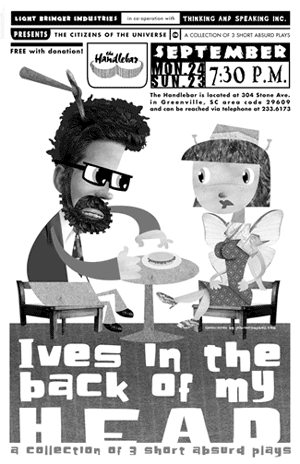
Ives in the Back of My Head
2001
(No pictures available)
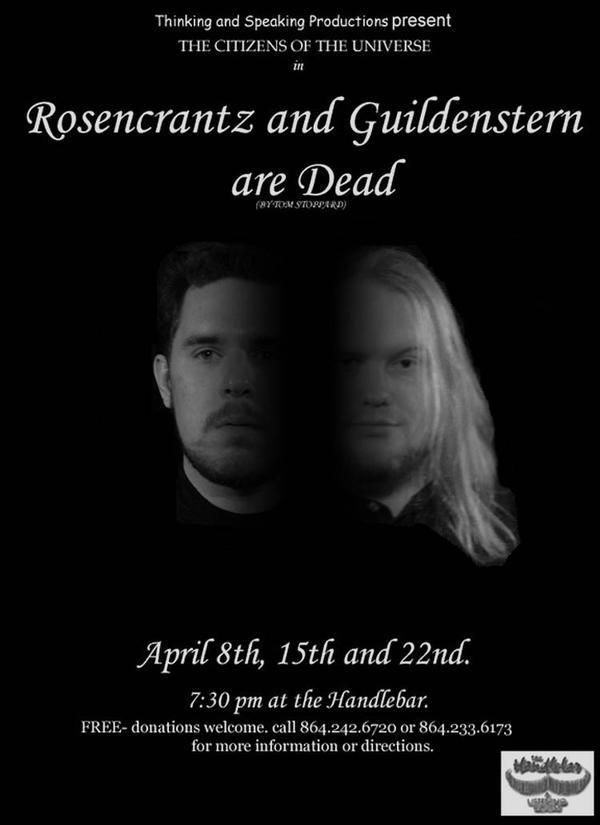
Rosencrantz & Guildenstern are Dead
2002
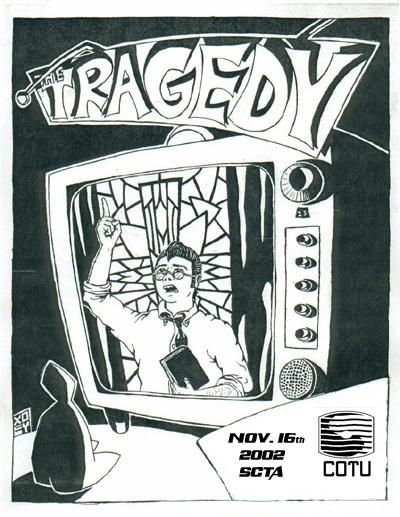
The Tragedy
2003
(PICTURES FORTHCOMING)
VIDEO 1
VIDEO 2
VIDEO 3
Equus
2004
Creation of the World and Other Business
2004
(No pictures available) 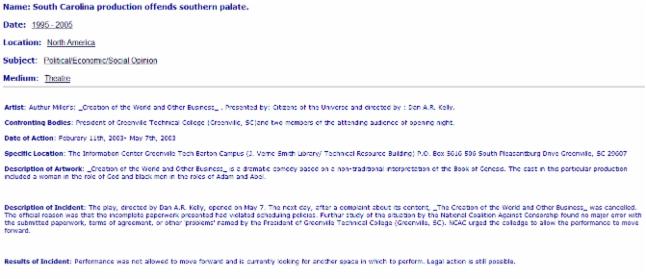
3/24: A 24 Hour Theatre Project
2005
(No pictures available) 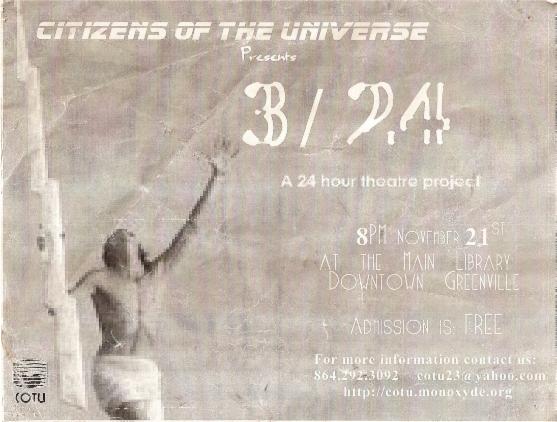
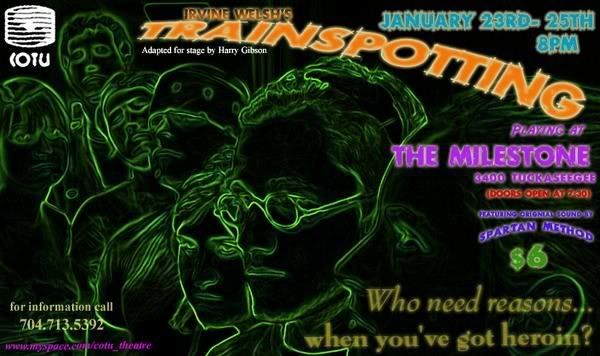
Trainspotting
2008
Setup
Live feed recording 1
Live feed recording 2
http://www.artsalamode.com/AALM_TheatreReviews.html
TRAINSPOTTING
Based on the novel by Irvine Welsh
Adapted for the stage by Harry Gibson
Directed by James Cartee
A Citizens of the Universe Production
The Milestone Club, January 23-25, 2008
Kudos to producer/director James Cartee. Not since Artzilla has Charlotte seen
such an original, subversive production. And yes, it's that Trainspotting. You
may have seen the 1996 film which has become a cult favorite. Also adapted from
the book, the film is a gritty black comedy about a group of young, socially
disaffected heroin users in Edinburgh, Scotland in the 1980s. It doesn't get
much blacker (comedically) and grittier than the stage production at the
Milestone Club. It is definitely not for those with delicate sensibilities. Age
should have nothing to do with it, though. A person can be old at 20, and young
at 80, so don't let that stop you from attending the closing performance
tonight.
There is a reason, if not a message to all three incarnations of this story. We
are mostly guided on our "tour" of the mean streets by Mark Renton
(John Wray) who looks around him and is not impressed with what he sees. You'll
probably recognize much of the dialogue, "Choose life. Choose a job.
Choose a career. Choose a family. Choose a ******* big television, Choose
washing machines, cars, compact disc players, and electrical tin openers…"
Then, the crux of the play, "I chose not to choose life: I chose something
else. And the reason? There are no reasons – who needs reasons when you have
heroin?" As mentioned, this is not a message play. The audience simply
goes along for the ride. There isn't a plot per se either, but a series of
escalating scenes that shows the brutality of addiction. Renton is intelligent,
he tells us he is a dropout university student, but alienated and staring at
the "truth" as he sees it in the beginning; you are born, suffer and
die, without much fanfare or making a difference. Yet, if you become addicted,
all your fears, anxieties, and problems just become one big problem - scoring
heroin.
Also along for the journey are the multiple characters portrayed with zeal by
the ensemble cast, all giving every ounce of energy to the multiple scene
changes, costumes, and Scottish accents they use. John Wray is outstanding as
Renton, the sarcastic, alienated, anti-hero. He maintains the accent
throughout, but is understandable. If his performance doesn't work, the play
doesn't work, but he does an excellent job of making Renton just human enough
that there is empathy in the face of his depraved behavior. That's not easy.
Joel Sumner is a standout in his roles, especially as the initially sweet,
naive Tommy. Jenny Wright is one of those actors who bring energy onstage
whenever she's in a scene, and is interesting to watch. She has one of the
grossest scenes in the play, but somehow makes it work. Diego V. Francica is
the most intense actor in the production and suitably scary as Berghie,
although at times I couldn't understand his thick accent. The other actors:
Stephen West-Rogers, Kaddie Sharpe, and Teresa Abernathy also add nicely to the
mix.
The "comedy" alternates with the torturous, shocking scenes of Renton
trying to kick his habit when he's physically sick and bodily functions are out
of his control, or he callously uses other people. Because Renton doesn't
preach to the audience, merely reporting on his debased life as an addict, the
audience can witness everything without being forced to make a decision of
right or wrong. It simply is the way it is. Renton's explanation about why he
choose heroin? "Take the best orgasm you ever had, multiply it by a
thousand and you're still not near it." Then you see the result of that
choice.
The Milestone Club provides good atmosphere for this particular play. The
program is a bonus and unlike any I've ever seen with CD's of songs donated by
various local and regional bands. The technical folks deserve special
consideration that so much was achieved with so little, but wear warm clothes.
The near capacity audience sat in their coats throughout the play, although it
didn't dampen their enthusiasm. Trainspotting is quite an accomplishment.
Review by Ann Marie Oliva
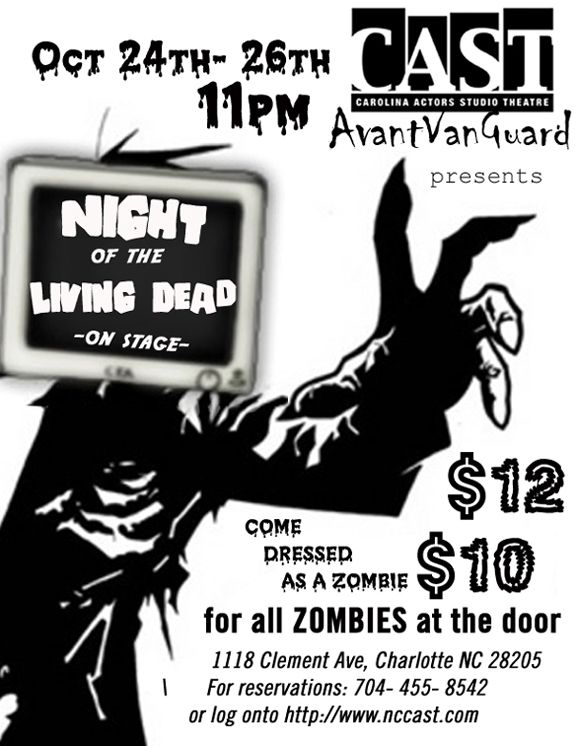
Night of the Living Dead
2008
(PICTURES FORTHCOMING)
Video
1
Video 2
Video 3
Video 4
Video
5
CAST AVG. While technically not a COTU venture, we helped this
production by doing a Zombiewalk before the show.
Perry Tannenbaum
Published 10.28.2008
While AvantVanGuard doesn't officially launch until this Thursday, with a
latenight aftershow at Carolina Actors Studio Theatre following the new
production of Monster -- The Real Story of Frankenstein, we caught a foretaste
after the Pointers late last Friday. If Night of the Living Dead can serve as a
predictor, Cirque de Morte will be gory, campy, gloomy, hysterical and heavy on
the makeup. James Walker and Nick Iammatteo were the chief earthlings fending off
the alien zombies engulfing the world, with James Cartee directing the mayhem
between splices of the classic film.
We will carefully watch this new CAST offshoot and report on all bizarre
mutations that show up over the Halloween weekend on Clement Avenue
GONZO: A Brutal Chrysalis
2009 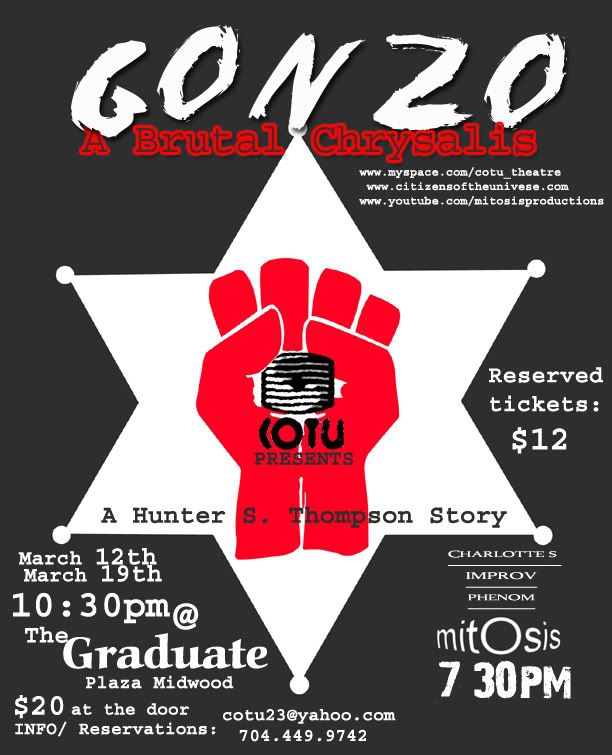
Fight Club
2009 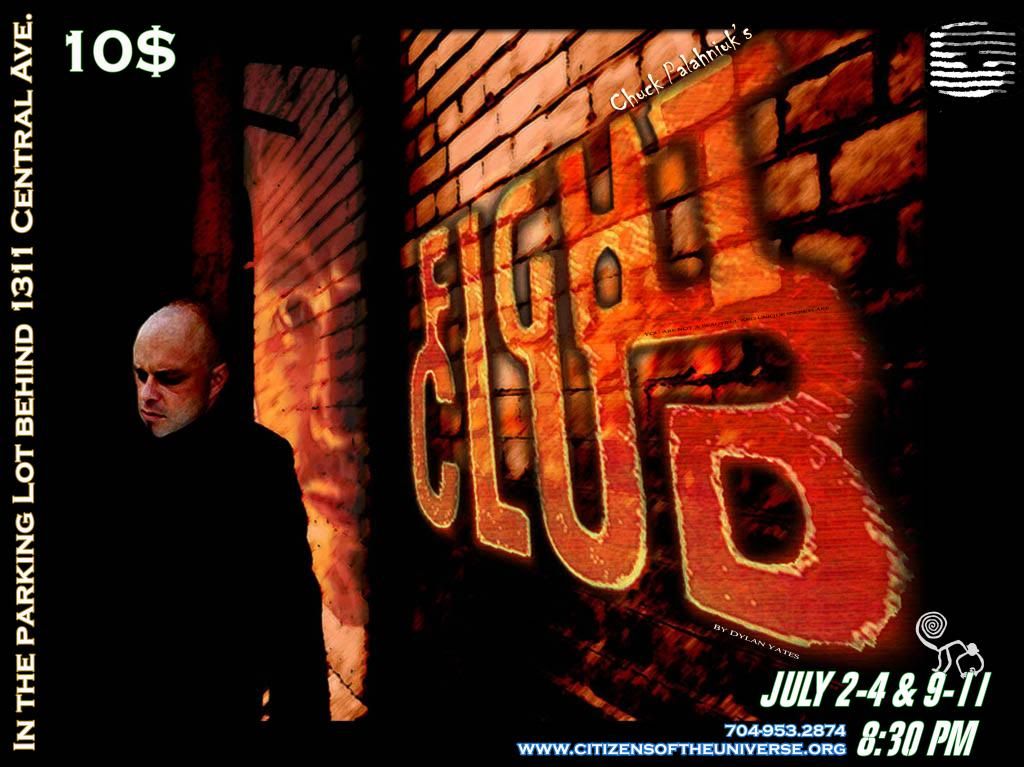
THEM'S FIGHTING WORDS: Stephen West-Rogers, Kaddie Sharpe, Diego
Francica (front, left-right), Bret Kimbrough, John Michael Coutsos, Kenny Kline
and Chris Freeman (back, l-r) put up their dukes in Fight Club.
Fight Club: Fistfuls of testosterone
Published 07.07.09
By Perry Tannenbaum
Sixth rule of Fight Club isn't in the script. It was decreed on opening night
of the current Citizens of the Universe production, tucked behind a corrugated
row of cheapjack office suites off Central Avenue, in a grungy parking lot
flanked by a loading dock and some railroad tracks. The sixth rule was
spontaneously proclaimed last Thursday midway through Act 2, when the rains had
already wrecked the lights and the sound system.
COTU founder and director James Cartee had replaced the kliegs and the spots at
intermission with the headlamps of a car and an SUV. The show went on, and the
rain resumed. Cartee emerged from his car and strode onto the makeshift stage
in the middle of a scene where the schizo narrator, Jack, was about to
experience a birthday celebration involving two cakes shaped like a woman's
boobs.
The candles were not to be lit in their central locations. Instead, Cartee
proclaimed the sixth rule:
"Gotta call it when the scenery starts blowing away."
Reasonable enough. Sue and I left under the cover of our umbrellas and, since
we had the CP day-night doubleheader booked for Friday, returned for the July 4th
edition of Fight Club. With pedestrians lined up on the sidewalks awaiting the
fireworks at Memorial Stadium, it was a little more difficult to find the 1311
Central Ave. location -- and to avoid mowing down mothers and children as we
entered the parking lot.
Stoppages were more benign at this performance. We timed our arrival to
coincide with intermission, so we had missed the stoppage during Act 1 when a
train had rumbled through. But we sure didn't miss the climax of the fireworks
at Memorial, a cluster of cannonades so loud that Diego Francica, playing Jack,
called the second timeout.
As aficionados of the Chuck Palahniuk novel and Brad Pitt movie are well aware,
I've already broken Fight Club rules 1 and 2: "Don't talk about Fight
Club!" Even a devout rule-breaker like me has trouble talking too much
about COTU's asphalt jungle version with sound dropouts, decimated sub-guerilla
production values, and a 47-1/2 hour intermission compounding the inherent
difficulties of Dylan Yates's stage adaptation. Additional hurdles presented
there include Palahniuk's circular plot; detours from the known frontiers of
chemistry, sociology and psychology; and frequent zigzags backward and forward
in time, with the occasional probability bypass.
Yet the whole testosterone spectacle rouses me to persist. So I'm talking. Jack
holds down an actuarial job at a Big Three automaker. Tyler Durden, a maniac
screen projectionist, coaxes Jack to live with him and launch his network of
nationwide Fight Clubs. Marla is the woman who loves them.
We get hints at the beginning of Act 2 that Tyler actually dynamited Jack's
condo before offering him shelter, but there are greater shocks and surprises
to detain us as the story unfolds. Fight Club evolves into a cadre of human
automatons who are a ghoulish mix of masochism and anarchist terrorism.
Comedy episodes seem to gravitate to Kaddie Sharpe, the only female in the
ensemble. Early in Act 1, she's a surreal stewardess on a down-market airline
whose pre-flight spiel includes a proscription against fucking in the
restrooms. (Reminds me: COTU's Porta-Potty is on back-order.) Then she settles
into her main role as Marla.
Act 2 hilarity peaks when Marla arrives at Tyler's pad with freezer baggies
filled with her mommy's liposuctioned fat. Why is Marla saving this gelatinous
gook, and why is Jack insisting so vehemently that she shouldn't open the
fridge? Here I won't talk, except to hint that it all connects with Tyler's
diabolical scheme to fund his underworld network and blow up more things --
resulting in Francica's finest moments as Jack in some gross-out physical
comedy you won't soon forget.
Fight choreography and tech are executed with the same precision as the
buffoonery. Stephen West-Rogers brings a martial arts fervor and simplicity to
Tyler that stamps a seal of authenticity on the larger Fight Club scenes. He's
as effective getting hit as doling out the punishment.
Four Space Monkeys fill out the cast, with Kenny Kline standing out in multiple
roles as Angelface, the Fight Club newbie; Gloria, the support group bimbo; and
the union boss who kicks the crap out of Tyler. The others -- Bret Kimbrough,
Chris Freeman, and John Michael Coutsos -- are all suitably silly, clueless or
fascist as needed.
Can the cast hold it perfectly together amid all the distractions, deluges,
mishaps, and interruptions? Not always. After the fireworks subsided, Francica
lost his lines briefly on Saturday night, and later on, Rogers made an
awkwardly delayed entrance, probably because it was impossible for him to hear
his unamplified cue line.
Stuff like that makes Fight Club even more fun to talk about. Even if it is
against the rules.
FIGHT CLUB
By Dylan Yates
Based on the novel by Chuck Palahniuk
Directed by James Cartee
Citizens of the Universe
A parking lot behind 1311 Central Avenue
July 2-11, 2009
OK, space monkeys. What's the first rule of Fight Club? Don't talk about Fight
Club. So I can't say as much as I want to. But this show proves that theatre
can take place just about anywhere. In a parking lot between corrugated metal
buildings, next to a train track and trees, beside a dumpster, Citizens of the
Universe is meeting with courageous theatergoers to explore our postmodern
appetite for violence and madness.
The opening night's rain ruined COTU's lighting and sound equipment. But the
company adapted, creating a more primal, urban experience with car headlights
and speakers in an open hatchback. Noise from nearby building fans, a
helicopter circling overhead, and even a train passing by—all add to the gritty
environment, even if actors' voices are hard to hear at times.
The set consists of shredded pieces of hung plastic, an unpainted platform on
the side, a fridge, and a table on the other side, plus a few folding chairs.
And the actors sometimes seem to be reading lines from the novel, rather than
playing characters. Yet this fits the novel's spirit of consumer critique,
sardonic wit, angry energy, and ironic mimicry.
Actual fight clubs emerged around the US, with men fighting bare-fisted and
bare-chested, in imitation of the machismo shown by Brad Pitt and Edward Norton
in the 1999 film version of Palahniuk's book. Perhaps some homegrown terrorists
have also been spawned by the goofy, violent pranks of Pitt's Marxist
trickster, Tyler Durden, and his Project Mayhem. But the book works on the
reader in a very different way from the film, drawing one inside the mind of
the troubled narrator, Jack. Through him, the novel evokes personal
identifications with the charming Tyler, rebellious Marla, and other weird
characters, twisting it all, through shockingly comical actions, into a
self-critical knot.
This Fight Club stands somewhere between the novel and film. With excellent
fight choreography—and the immediacy of actors' bodies hitting the same
concrete where spectators sit on portable chairs a few feet away—the thrilling
brutality of WWF or Extreme Fighting begins to peal away and the wastefulness
of young male egos appears. The play's airplane scene (and program cartoon)
also reveals the deeper terrors of mortal vulnerability and wasted time, behind
the veneer of safe travel and routine work, yet here with a comical roughness.
Likewise, the support group meetings, the soap making out of maternal fat, the
double-breasted birthday cake, and the split-self suicide become visceral in
this show, as well as literally insightful and movingly action-packed.
It's a difficult play to watch, though. Even the wicked charm of Stephen
West-Rogers as Tyler, the burning confusion of Diego Francica as Jack, and the
playful transformations of other actors into various characters barely makes
this show pleasurable. For they each acquire monstrous attributes that reflect
the madness in us (and the patriarchal crisis in our society) like an
intricate, shattered mirror.
So go if you dare. But don't tell 'em I told you about it.
Review by Mark Pizzato
Mark Pizzato is Professor of Theatre at UNC-Charlotte and author of Ghosts of
Theatre and Cinema in the Brain and Theatres of Human Sacrifice. His plays have
been published by Aran Press and his screenplays, produced as short films, have
won New York Film Festival and Minnesota Community Television awards.
A Universe of fists and words
Young, avant-garde Charlotte theater company brings ‘Fight Club' to the paved
outdoors.
By Lawrence Toppman
Theater Critic
Posted: Friday, Jun. 26, 2009
fight club
The cast of "Fight Club" reviews the rules of the organization under
which they do battle.
More Information
'Fight Club'
Book/film about a timid conformist liberated by a dangerous anarchist, staged
by Citizens of the Universe.
When: 8:30 p.m. July 2-4 and 9-11. There will be pre-show drinks and music at
Snug Harbor, 1228 Gordon St., starting at 6:30, and a post-show meet-the-cast
at Thirsty Beaver, 1225 Central Ave.
Where: Behind Quick Pawn Shop at 1305 Central Ave.
Admission: $10.
Details: cotu23@yahoo.com, 704-449-9742 704-449-9742 or 704-953-2874704-953-2874. 704-449-9742 or 704-953-2874704-953-2874.
First rule of Fight Club: You DO NOT TALK about Fight Club!
Oh, well – blew that one. Might as well tell everything, now.
This “Fight Club” is Dylan Yates' theatrical adaptation, blending
elements of
the novel by Chuck Palahniuk and the movie script by Jim Uhls. It offers
more simulated butt-kicking and actual wise-cracking than any other
local drama this year. And it takes place in a parking lot behind a
pawnshop. Not the play – the
production, which starts Thursday at dusk. It comes to you courtesy of
Citizens of the Universe, whose first local outing
– a similar take on “Trainspotting” – rocked the Milestone in 2008. COTU
then
staged “Night of the Living Dead” around Halloween at Carolina Actors
Studio
Theatre. On one level, the universe these citizens inhabit is familiar:
Hip,
impoverished thespians push the theatrical envelope until it all but
shreds. On a deeper level, like “Fight Club” hero Tyler Durden himself,
they're banging
their heads – metaphorically, if the fight choreographer did his job –
to prove
they matter in a community more accustomed to conventional things. COTU
is no democracy. Co-founder and “Fight Club” director James Cartee
clearly
ran the rehearsal where Tyler (Stephen West-Rogers) and The Narrator
(Diego
Francica) mock-pummeled each other in a cluttered artist's studio off
Central
Avenue.
Yet COTU is a place to take risks, to unveil a side of yourself even you
didn't
foresee. “This company uses any talent you want to bring to it,” says
Francica, who
played the short-fused Begbie in “Trainspotting” and also helped design
the
posters for that show.“He'll cast actors who don't know whether they
have (the role) in them, because
he sees something in you. And he'll give you lots of free rein.” Adds
West-Rogers, who met Cartee when they labored together at a lighting
company, “My entire wardrobe in this show is my own. I've made
suggestions
about sound. One actor custom-builds furniture and helped out with
elements of
the set. “It's not hierarchical here – and we all appreciate each other
much more that
way.”Flexibility has been the key since COTU began, just before 9-11in
Greenville,
S.C. Cartee, who had graduated from Winthrop University in 1998, hooked
up with
like-minded theater folks to produce an eclectic array of shows,
including an
“Equus” where the audience sat in a stable, surrounded by horses.
Cartee has held a range of jobs, moving to Charlotte briefly in 2003,
going
west, coming back in 2006. He meets bills now by working with IATSE, the
union
of professional stagehands, movie technicians and allied crafts. And
there are bills, not least when COTU is rolling. “I pay for all this,”
he says. “You have to save up to do a show, and you rely
on the actors' abilities to find props or costumes. The theater
community has
stepped up for us: We've gotten wood from Theatre Charlotte, help from
the
costume designer at Children's Theatre, support from CPCC and Actor's
Theatre.”
Cartee hasn't made things easy with “Fight Club.” He'll need body
microphones
and an outdoor lighting grid; the cast will compete with summer heat,
mosquitoes and audible interruptions from a train that passes a block
away. Is this all worth the pain? He nods. “I'm a child of the '90s,
with a feeling of, ‘Screw capitalistic
stuff, stand up and believe in yourself,'” he says. But ask about
artistic philosophy, and he shies away: “I did ‘Trainspotting' with no
intention of ‘art.' I'm planning a ‘Reservoir
Dogs,' and I felt I should do a show where I fought my initial reaction
to
something I didn't like, which is ‘Uncle Vanya.' So this company isn't
really a
company. It's a series of ideas."
Reservoir Dogs
2010
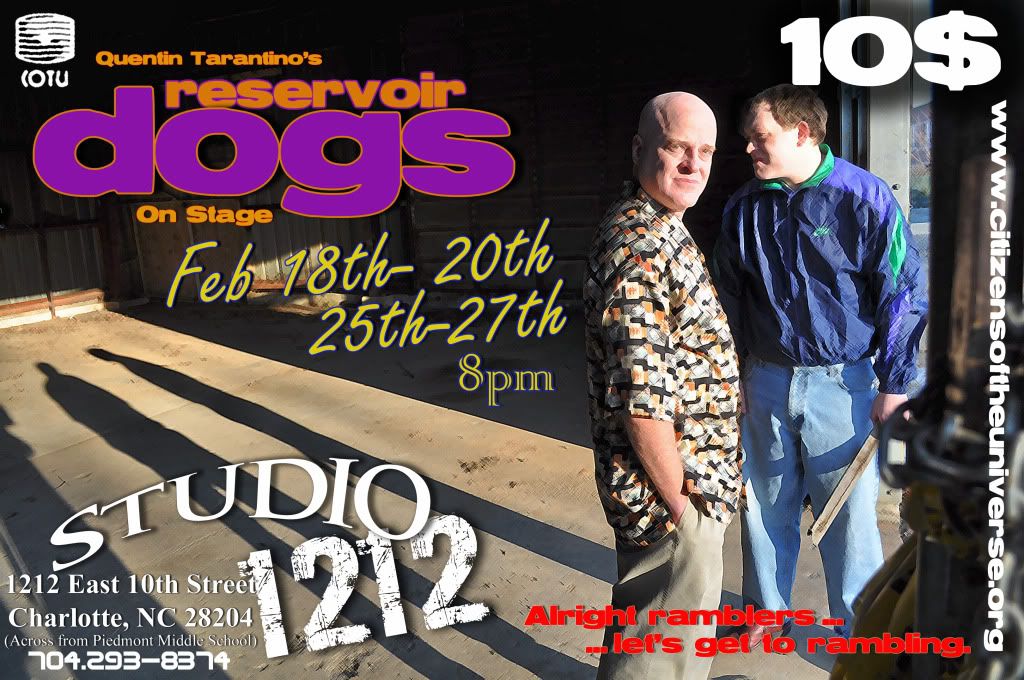
Deleted Scene
Video 1
Video
2
Video
3
Video
4
The gunplay's the thing in Reservoir Dogs
By Perry Tannenbaum
You wouldn't want to see a stage production of Quentin Tarantino's Reservoir
Dogs that left out the gunplay from the movie. So before you walk in to the
current Citizens of the Universe production, you'll find a jarful of
complimentary earplugs to bring in with you. As COTU's lead guerilla, director
James Cartee, tells us, we don't need the protection until Act 2, but when the
blood begins flowing in Act 1, it's reassuring to have that protection in your
pocket as you anticipate the fireworks to come.
Like last summer's Fight Club, simply attending a COTU operation is an exotic
adventure. Earliest arrivals can park in front of Studio 1212, tucked away on
that portion of 10th Street that connects Central Avenue and the Innerbelt. Otherwise,
a helpful dude with a flashlight guides you to parking spots across the street.
Then you must circle around the long warehouse, down a gravelly alley and past
an art car that looks like a Nazi nightmare.
Portions of Reservoir Dogs are even more frightful than the car, particularly
in Act 2, where gunfire and torture run amok. With some misgivings, Sue and I
held our ground in the front row after intermission, emerging unspattered. A
sprinkling of cinematic touches, impishly projected on the rear wall by Cartee,
provide welcome relief. At any rate, Sue's implantable defibrillator didn't go
off.
The bungling multi-colored Reservoir Gang -- including Mr. White, Mr. Blonde,
Mr. Brown, Ms. Blue, a tetchy Mr. Pink, and a profusely bleeding Mr. Orange --
are led by kingpin Joe Cabot, infused with raspy-voiced fire by David Holland.
Management support comes from Joe's son, "Nice Guy" Eddie, given an
effective layer of privileged superciliousness by Colby Davis.
Joe's slickly planned jewelry heist has gone spectacularly wrong, largely
because, as Pink -- the thinker in the group -- has rightly surmised, there's a
rat in the gang who has set them up. Even the setup flames out, when somebody
sounds the alarm, and we learn that Mr. Blonde has gone berserk. In the ensuing
shoot-out, a couple of colors die out of the Reservoir crayon box amid the
general carnage. At least one cop has been killed, and another has been
kidnapped by Blonde.
Tom Ollis lavishes a gleeful brutality upon Mr. Blonde, reaching an apex of
sadism when he begins torturing his kidnap victim – not to find out who the rat
is but just for the sheer joy of it. After a brief stint as the Waitress in the
opening scene, Brittany Patterson completes her memorable Charlotte debut in
frantic, blood-curdling style as Blonde’s victim.
That torture scene sets in motion all the falling dominoes that follow. In the
end, as the borderline between good and evil begins to blur, this becomes a
story of Mr. White's (Larry) paternal loyalty toward his fallen comrade, Mr.
Orange (Freddie). Scott Reynolds ably projects the twisted, combative heroism
of White as he becomes more and more invested in Orange's survival. For most of
the production's 108-minute length, Orange is in excruciating pain, but Berry
Newkirk lives credibly in this narrow, desperate range, his sufferings
occasionally the wellspring of cruel, black humor.
Keep your eye on the sly opportunistic Mr. Pink, rendered by Chris Freeman with
a nervous watchfulness that belies his coolheadedness under fire. Fight
choreography by Kara Wooten, as well as makeup by Amanda Liles and Rebecca
Brown, are well above the standards you would expect from a guerilla company
scrambling for locations to perform. Set design, such as it is, horseshoes
around the audience, so I'd recommend a seat on the innermost stage-left side
of the house where the gang is visible at their restaurant table. Sue and I
turned around, craned our necks, and caught most of the scene. But if more
seats get filled this week as word of mouth spreads, sightlines could be
further impaired.
Don't sweat it. Nearly all the action -- and all the blood -- is up front in
this fast-paced production.
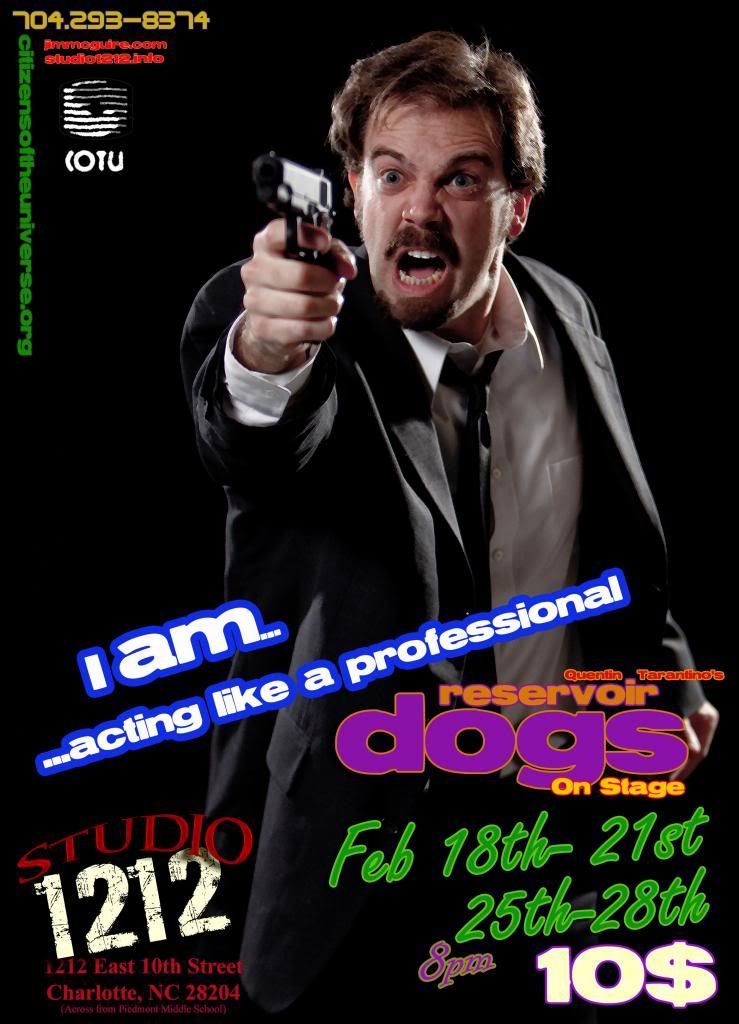
Reservoir Dogs’ bite is as good as their bark in COTU’s latest production.
By John G. Hartness
Presented by Citizens of the Universe
Studio 1212
In order for theatre to succeed, it must not be afraid to fail. If there is any
one word I would use to describe Citizens of the Universe founder and director
James Cartee, “fearless” is near the top of the list. From portraying
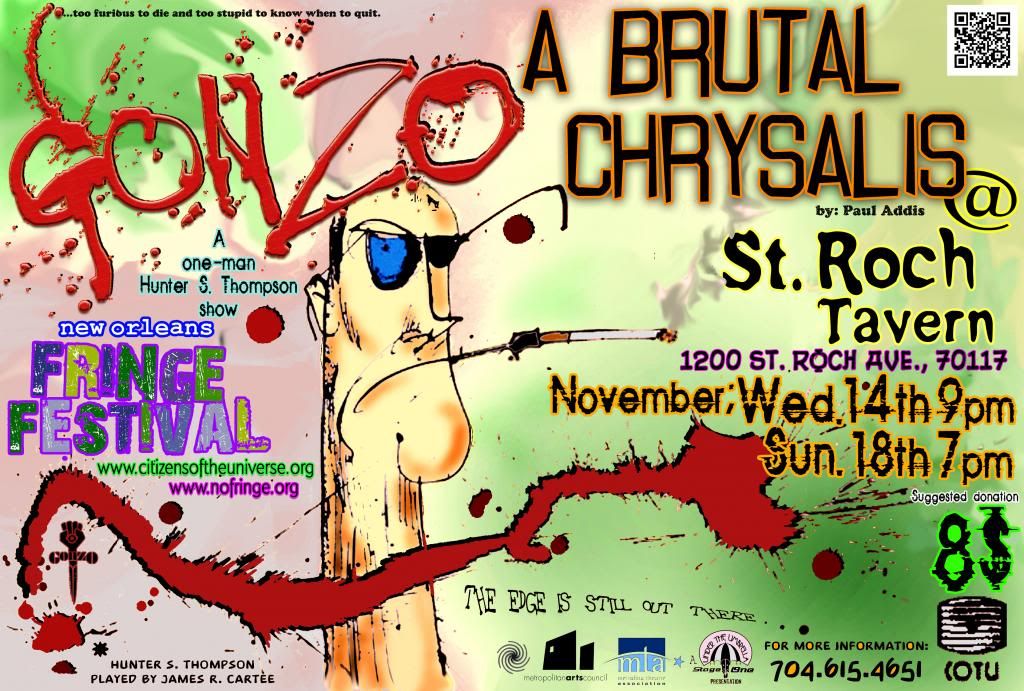
psychedelic journalist Hunter S. Thompson in the one-man show GONZO: A Brutal
Chrysalis to staging Fight Club in a parking lot, Cartee has quickly developed
a reputation in Charlotte theatre circles as someone who’s not afraid to take
chances. And in COTU’s current production, the stage version of Quentin
Tarantino’s breakout film hit Reservoir Dogs, those gambles pay off handsomely.
For those unfamiliar with the film, when the director hands out earplugs at
intermission, take him up on the offer. The tongue-in-cheek Cartee even reminds
us of that with a video message in the middle of the act! Reservoir Dogs thrust
Quentin Tarantino into the spotlight upon its debut at the box office, with the
rapid-fire, often-profane dialogue raining down on moviegoers like spent shell
casings on the floor of the set. The stage adaptation is amazingly faithful to
the film, which is good for fans of Tarantino’s work, but rough on the
production’s poor laundry crew. Anytime you estimate the stage blood usage in
gallons per night, it’s going to be a wild ride.
After a brief breakfast-table chat scene, the real action of the play gets
underway with the entrance of the normally unflappable Mr. White, played by a
very solid Scott Reynolds, and the gutshot Mr. Orange (Berry Newkirk) into the
warehouse rendezvous point after a jewel heist gone bad. Orange and White are
joined throughout the play by the other members of the Crayola gang, who use
colors as names to hide their identities from their cohorts throughout the
planning and execution phases of the job. A distraught Mr. Pink (Chris Freeman)
brings in the idea of a rat in their midst, and the psychotic Mr. Blonde (Tom
Ollis) brings his own special brand of party favor for the crew.
We watch these normally professional criminals devolve quickly in the face of
betrayal, death and possible incarceration, as the pressure cooker of the
hideout and distrust quickly begins to take its toll. Cartee’s choice of a
photo studio (Jim McGuire’s Studio 1212) as a performance venue may have been
inspired by necessity, but seems simply inspired as the studio subs very nicely
for an abandoned warehouse without need for much set dressing. And the dressing
is minimal indeed, a few chairs, a small platform and a few props. Six lights,
an LCD projector and a portable sound system are the major technical elements,
and the rest of the burden is on the actors. This is no Broadway tour, with
lavish sets to cover up the inadequacies of aging sitcom stars, this is
in-your-face acting, without a net.
And this cast and director can handle it. From the moment the lights come up,
the cast grabs your attention and doesn’t let go. Reynolds is the anchor in the
whirling dervish of activity, holding center calmly and crisply throughout the
night. The screaming Newkirk starts the show as a dying bag of blood (and more
blood, and more blood), but in Act II takes the stage with a fantastic
monologue that mixes direct address and narrative form seamlessly. Tom Ollis
always has done crazy well, but this time he may have outdone himself. His Mr.
Blonde was downright chilling, and there were times watching him on stage that
I wondered if he might have finally tipped over the edge. His partner-in-pain,
Brittany Patterson, made a great Charlotte stage debut as the doomed Jenny
Nash.
An almost unrecognizable David Holland owned the room as the growly Joe Cabot
whenever he was on stage and provided an excellent counterpoint to Colby Davis’
bouncy and hyperactive “Nice Guy” Eddie. But Act II belonged to James Lee
Walker II, who walked in as undercover tutor Holdaway and walked off stealing
every scene he was in. Walker brought a relaxed physicality and crisp
characterization to the bit part of Holdaway that worked exceptionally well
opposite the nervous pacing and jittery monologue of Berry Newkirk. Newkirk and
Walker dominate the flashbacks of Act II, and never let go of our attention
once they’ve grabbed hold. Credit Cartee with excellent casting all around,
mixing theatre and improv comedy vets to create a solid ensemble.
This is not a polished production, nor is it a polished venue. The hand painted
parking signs and gravel walk down a darkened alley set that stage for us
early. But if you’re looking for a little of what Lou Reed walked on, then
COTU’s Reservoir Dogs is for you. The language is vintage Tarantino, with
plenty f-bombs and racial epithets, so leave the kiddies at home for this one.
If you need valet parking for your theatre, then you’ll be better served
elsewhere, but for a show with a lot of guts, some excellent performances and
gallons of sheer hutzpah, you’ll definitely want to talk a walk on the wild
side with these dogs.
RESERVOIR DOGS
By Quenttin Taratino
Directed by James Cartee
Citizens of the Universe
Studio 1212
It’s hard to not be taken in by the sheer ebullience of this production.
This production of Reservoir Dogs is like an Andy Hardy film, only this time
instead of a barn, the audience is sequestered in a hangar-like artists’
studio, but like those films, we are treated to a plucky group of performers
who want nothing more than to “put on a show.”
Based on the 1992 film by Quentin Tarantino, Reservoir Dogs follows the plights
of seven total strangers who have been brought together to rob a bank. The
play, like the film, revels in a mix of violence, pop culture references, and
an almost insufferable need to be cool. The good news is if you like Tarantino
and/or love the film, than this production will not disappoint. The ensemble is
excellent.
I’m not entirely sold on the idea of performing screenplays as plays. Don’t get
me wrong, I was completely engaged by some first-class acting and a truly
remarkable ensemble. It’s just, especially with Tarantino, we are seduced by
clever camera angles, multiple edits, and innovative cinematography. It’s true
that Tarantino’s dialogue is clever enough, but once you get past the self
consciously ironic sex jokes, the incessant pop culture riffs, and the
heavy-handed morality, I’m never sure what it all adds up to. And ultimately,
when you strip Tarantino of the one thing that he is arguably strongest at, his
visual storytelling, you are only left with his words, and, clever as they are,
he’s no David Mamet.
Before I get too much further, let me day, everyone should see this play. This
company deserves an audience. Whether I agree with this particular choice of
play or not is immaterial, this company is unique and should be championed.
I’m not going to try to summarize the plot too much. Suffice it to say a group
of criminals are brought together to rob a bank. They’re not allowed to know
each other’s names, so they are given the names of colors. The fly in the
ointment, however, is that a cop may or may not be one of the criminals. I’m
not going to spoil it here, just in case you’re not familiar with the film. The
ending does sneak up on you.
As I’ve said, the ensemble is amazing. Nearly all of the actors are dynamic and
engaging. Berry Newkirk as the wounded Mr. Orange and Scott C. Reynolds as the
ill-fated Mr. White are particularly good, but the entire cast is fully
committed to this production and we are sucked in.
Technically the play is sparse. Slip-covered chairs suggest the escape car, a
plank of wood becomes the floor of a warehouse. There’s no need for much. The
studio suggests the warehouse very well, and the other few locations are easily
produced with an over-sized desk and some assorted chairs. Still, the costumes
are wonderful, and the use of firearms (necessitating ear plugs which are
generously provided at intermission) is great fun. There’s hardly a misstep in
the production save for some fight choreography that needs a little fine tuning
and some makeup effects that don’t stand up under the close scrutiny of an
audience that is this close to the action. I might also suggest in future
productions elevating either the audience or the actors. I missed a great deal
of the play in my third row seat.
Again, Citizens of the Universe is a company to support. This is some of the
best ensemble acting I’ve seen and this is a group that is seeking to do
something new and unique. I’m still not convinced that such a talented company
should be producing staged versions of movies, but they’re doing it really
well. I look forward to seeing what’s next for this compelling group! Review by
Tim Baxter-Ferguson
Tim Baxter-Ferguson is an associate professor of Theatre at Limestone College
and Chair of that program. He has had his plays produced throughout the United
States and Canada.
Uncle Vanya
2010
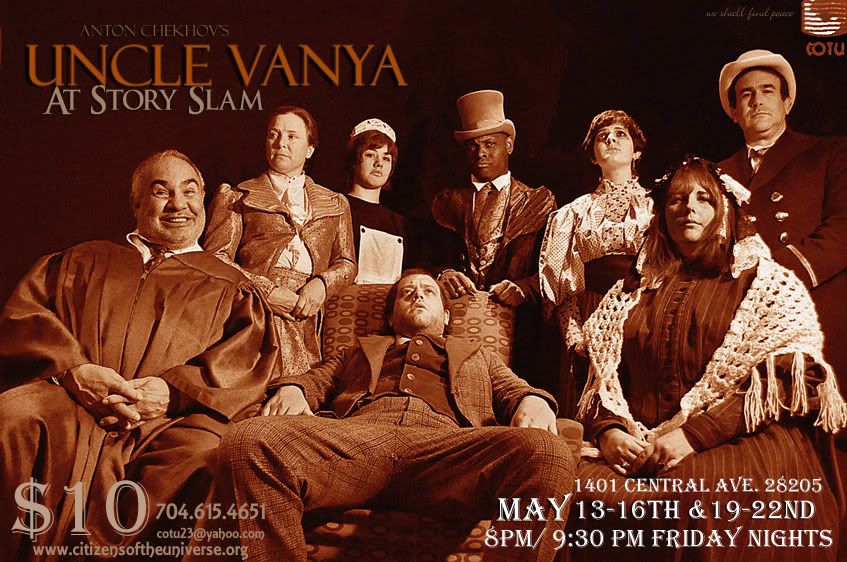
Theater review: Uncle Vanya
Published 05.18.10
By Perry Tannenbaum
With
the Fed and BP expecting all us media folk to cool it for
awhile on oil-and-water analogies, let me say that the artistic affinity
I
expected between director James Cartee and the Russian czar of
tragicomedy,
Anton Chekhov, to be no closer than chalk and cheese. The prospect of
Cartee
and the fight-club, reservoir-dog guerillas who populate his Citizens of
the
Universe tackling Uncle Vanya certainly didn't galvanize the COTU
company's
fanbase, judging by the turnout at Story Slam for last Friday's
late-night
performance. As it turns out, the friction between Cartee's hellbent
approach to theatre and
Chekhov's legendary subtlety proves to be rather fruitful. Instead of
fussing
with exquisite balances or emphasizing the protagonists' poignant missed
opportunities, Cartee glorifies the eccentricities of Chekhov's
characters and
the comedy. Rather than reminding us of the glowing bittersweetness we
find in
Chekhov's other masterworks -- The Cherry Orchard, The Three Sisters,
and The
Seagull -- this Vanya tends to evoke the outrageous absurdities we find
in such
one-act farces as "The Bear" and "A Marriage Proposal." Keying the shift
from subtlety to absurdity is Colby Davis, wearing his heart
and entrails on his sleeve as he bellows the hurts, the frustrations,
and the
hypochondria of Vanya between slurps from a whisky flask. He has adored
Yelena
Serebryakov for years, but she is married to a far older man, The
Professor,
whose scholarly pretensions Vanya has financed since the days of Prof.
Serebryakov's prior marriage to Vanya's sister. Besides, Yelena is
piously
devoted to her decrepit Professor and far more attracted to the busy
family
doctor, Astrov. The visiting Professor's daughter, who manages the
estate with
Vanya, has been carrying a torch for Astrov that burns no less brightly
than
Vanya's for Yelena. It's complicated.
Nobody else is quite as high-energy as Davis, but the eccentricity among other
key characters is layered so thick that this drama-queen Vanya isn't anything
close to a total misfit. As the Professor, Jim Esposito parades onto the stage
from the Slam lobby with all the ostentation of a Roman Caesar and presides
over his sickroom like a spoiled sultan. Studded with enough face and tongue
jewelry to outglitter Liberace, Zannah Kimbrel rubs against Sonia's desire to
transcend her physical plainness with a funky Central Avenue ferocity. And with
outré props and costuming by Cartee, Charlotte Hampton as Vanya's mother hardly
even dabbles in sanity. As for the impoverished landowner Telegin, we get a
free-range interpretation as Cartee lets James Lee Walker III play his
harmonica.
The COTU guerilla swagger is there from the outset. Off to one side of the
Story Slam platform, Davis is half-buried on a couch as Vanya sleeps off his
latest binge. On the other side, Cartee mans the rudimentary sound system,
cuing the occasional cricket while clad in a greatcoat that could very well
have been ripped off the back of a true Russian wino.
While Annette Saunders doesn't pass for 27 as Yelena, she has all the starchy
devotion to the Professor you could ask, and there's enough allure left to
warrant Vanya's adoration. She is aptly paired with Lou Delassadro as Astrov,
who turns out to have more than a medical interest in Yelena's well-being. With
Saunders and Delassandro, the tender romantic heart of Chekhov and the elegant
demeanor are preserved.
Unsettling for the Stanislavsky purists, but great fun.
UNCLE VANYA
by Anton Chekhov
directed by James Cartee
Citizens of the Universe
StorySlam
May 15-22, 2010
Citizens of the Universe, a Charlotte company that often acts out movies
onstage, has committed another sacrilege. As they must know, Chekhov is sacred
to many theatre artists, because Konstantin Stanislavski honed his realistic
acting "method" on Chekhov's tragicomedies. And that method, in
various American forms, permeates most of theatre and film acting today. But
COTU has turned Chekhov's esteemed Uncle Vanya into a Saturday Night Live
satire—making it outrageously funny, at least at first.
Chekhov insisted that his plays (about the foolish, passionate, self-sabotaging
upper-class and their servants in rural Russia over a century ago) were
comedies, though Stanislavski and later directors have tended to focus on the
tragic elements. With this production, Cartee pushes Chekhov's play into
Ionesco territory, finding its wild absurdities and adding more, across elite
and popular, past and present cultures. The deep, complex emotions and
relationships of the original become cartoonish. This may be initially
entertaining, even liberating. But it then becomes tedious like a TV skit going
on too long.
Lou Dalessandro, as Dr. Astrov, proves to be a handsome figure with mischievous
charm, as he twists his missing mustache or teases the servants. But his
passion to save a forest, to stop Vanya's suicide, or to confess his true
feelings for Yelena (and against Sonya) gets lost in the translation to satire.
Colby Davis puts great energy into portraying Vanya with reckless drunkenness,
smarmy sorrow, and violent lust, as if being John Malkovich in revenge against
Stanislavski. This evokes more sympathy for the actor, as entertainer, than for
the character—especially in his crazy love of, grabbing at, and falling for
Yelena. Annette Saunders as Yelena (married to the much older Professor)
provides a stoic grace but does not show the twisted feelings within this
character, as she poses for the gazes of various men around her, and helps or
makes use of the plain-looking Sonya, who has a hopeless love for Astrov.
Likewise, the other actors fit the director's concept well, though that limits
what they can do. James Lee Walker II, perhaps the most mutable actor I've seen
in Charlotte, gives new meanings to Telegin, who is also known as
"Waffles," due to his acne. Walker brings smooth black skin, big
smiles, harmonica playing, and pick-pocketing to his trickster turns. Jim
Esposito, as the Professor, gives a grotesque mirror to those of us who pose as
knowing more than others, while our aging bodies undermine such arrogance.
Caitlin Snead is absurdly young to play the old nanny, Marina, but that fits
here, too. Zannah Kimbrel has studs in her lower lip, as Sonya (the Professor's
daughter), perhaps connecting her motherless plain Jane to our time. And
Charlotte Hampton, as Vanya's mom and Sonya's grandma, Maman, reads a big book
entitled The Liberated Woman, pulls smaller books from her bosom, and reads
steamy scenes from an Anne Rice novel during the scene changes.
The small Story Slam stage allows for two to three acting areas with minimal
furniture. Prerecorded Russian music offers stirring spirits, more authentic
than the show. (The night I went, Virgo Musik also provided a wonderfully
lively hour of new American songs, with acoustic guitar and violin, prior to
Vanya. I especially enjoyed the ghost ballads and the love-crush tango.) But a
bill comes due from Stanislavki near the play's end—added by the director, as
if admitting the guilty pleasures here, with a classic tragicomedy trimmed and
twisted into soap opera. Review by Mark Pizzato
Mark Pizzato is Professor of Theatre at UNC-Charlotte and author of Ghosts of
Theatre and Cinema in the Brain and Theatres of Human Sacrifice. His plays have
been published by Aran Press and his screenplays, produced as short films, have
won New York Film Festival and Minnesota Community Television awards.
Trainspotting
2010
Vid- Part 1
Vid- Part 2
Vid- Part 3
Vid- Part 4
Vid- Part 5
Vid- Part 6
Vid- Part 7
Vid- Part 8 September 22nd, 2010 by Perry Tannenbaum in Arts
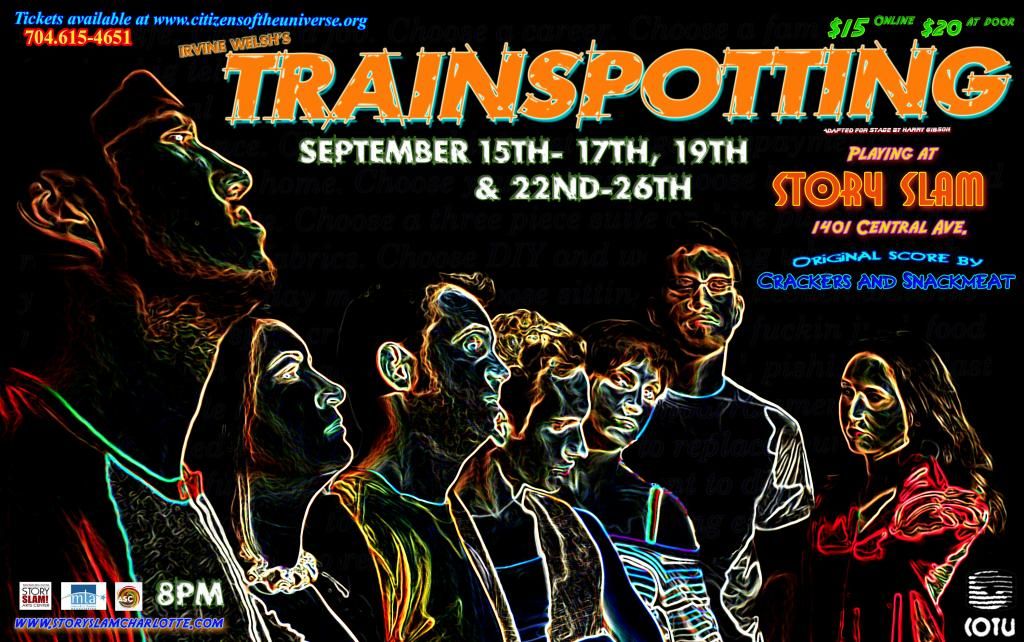
COTU unloads the ultimate gross-out
I’ve been married to my dear indulgent Sue for more than 11 years
and dragging her to see local theater productions for more than 12. But before
last Saturday night, she never had a better reason to ask me, “How could you
take me to see such shit?” For in the current Citizens of the Universe
adaptation of Trainspotting, the sensational 1996 Brit flick revel in the
pitfalls of heroin addiction (based on Irvine Welsh’s novel), flying shit
bespatters the walls of the Story Slam performing space at the end of the
opening scene. Then bookending Act 1, it comes splashing toward us, out of the
nastiest toilet bowl in Scotland, just before intermission.
Fortunately, the two scenes forming this fecal sandwich are nearly
as funny as they are gross, certainly among the most hilarious I’ve seen this
year. Even more fortunately, director James Cartee and his guerilla chemists
aren’t simulating the smells of these scenes along with the sludgy sights.
Otherwise, Sue and I would have made a beeline for Central Avenue. We were
courteously warned, by the playbill and Cartee’s curtain speech, that the front
rows should be considered splash zones (although sewage was not mentioned), so
we did retreat to the second row. Tipped off during the break that there would
be no further shit in Act 2 – or I should say shite, since most of the
Edinburgh folk have accents thicker than diarrhea – we returned safely to the
front.
The font of all the shite spewage is our narrator/hero Mark
Renton, whom we first encounter waking up in a strange bed that he has
thoroughly befouled, aside from the aforementioned solids, with vomit, urine,
and a sprinkle of semen. Such are the repellent degradations experienced by a
truly devout junkie, and it would be cruel to divulge how Mark’s private shame
hilariously and unforgettably explodes at his hosts’ breakfast table. Suffice
it to say that Berry Newkirk, so scintillating last month as the mastermind in
Queen City Theatre’s Rope, is every bit as perfect here and far more charming.
And let’s not overlook Mark’s redeeming qualities, for it is on the road to
kicking his dependency that Newkirk must muck around in that ugly,
graffiti-decorated toilet. The graffiti, by set designer Diego Francico, is
lavished over a scenic concept best described as urban outhouse.
It’s Stephen West-Rogers who turns this production into something
of a foreign language travail without the benefit of subtitles, for I may be
wildly exaggerating if I claim to have understood 40% of the slang-infested
brogue he speaks as Francis Begbie, Mark’s best bud. Still the violent
vehemence of this obviously cynical and embittered young man needs no
translation, and West-Rogers is mercifully intelligible in his other six roles.
Everyone else in the cast has at least three different roles as
this picaresque kaleidoscope unfolds. Joel Sumner is the most affecting as
Tommy, the clean-cut friend who too easily persuades Mark to cook up his first
dose of smack – and is a totally lost soul from that moment on. Chris Freeman
is most memorable as Johnny Swan, the déclassé local drug dealer who isn’t
above it all.
Women have lesser roles here – we are back in the 80s, after all –
but they can be vivid nonetheless. This is especially true for Mimi Harkness,
who is an abused girlfriend, a battered wife, and perhaps most indelibly, a
stoned dominatrix among her seven incarnations. Kaddie Sharpe is quite capable
as a couple of the girlfriends we encounter along the way, including the one
whose home Mark wakes up in at the start, but she’s not the sensation she was
last year in Fight Club. On the other hand, Jenny Wright is haunting as
Allison, a rather criminally unfit mother – to us and to Mark, who hallucinates
about Allison’s dead baby in the throes of withdrawal.
A top 10 film in BFI’s list of the 100 best Brit flicks of the
20th Century, Trainspotting wasn’t exactly drawing a sellout crowd at Story
Slam last Saturday night when we went. So this week, they’re reducing tickets
to $10. At that price, you’ve got to see this shit.
TRAINSPOTTING
Based on the novel by Irvine Welsh
Adapted for the stage by Harry Gibson
Directed by James Cartee
Citizens of the Universe
September 15-26, 2010
Story Slam
Based on the cult novel by Irvine Welsh which follows the lives of
several young people in Leith, Edinburg all of whom are either addicted to
heroin or whose lives revolve around others with such addictions, Trainspotting
is a energetic, obscene, sometimes poignant evening. Set in the 1980s, the play
revels in the lowest levels of humanity. No bodily function is off limits and
any fluid that can be emitted by the male or female body is referred to at
least once. Usually this is to good effect, and some good laughs are created by
taking the audience to the edge of their comfort level and beyond. Still, with
scene after scene after scene of depravity one begins to wish for a little
something more. Welsh’s novel both celebrates and lampoons the disaffected youth
of 1980s Scotland.
The play makes some attempt at touting redemption, but this seems
perfunctory. It is clear the play, like the novel, is more interested in
shocking us than in truly examining these lost souls. Still, despite all of
this, its youthful, angry, anti-establishment, rant is heartfelt and effective
it just never really adds up to anything concrete. So should you see this
morally ambiguous mess? Yes, absolutely! Citizens of the Universe‘s production
is so sincere, so devoid of self importance or snobbery, that it takes what is
essentially an aging hipster’s wet dream and transforms it into a sad riff on
the seductive trap of addiction.
The ensemble, though uneven, does a nice job of projecting the
too-cool-for-life sentiment of the heroin chic. Accents are handled well-enough
and Stephen West-Rogers’ homage to Sean Connery in one brief scene gets a
well-deserved laugh. Berry Newkirk, last seen in Queen City’s Rope gets more
opportunities to emote here as Mark. His character tries to be good despite the
lack of anything for him to live for. He slowly becomes aware of the sinking
ship he and his friends are on, and eventually tries to save himself. Newkirk
conveys all of this nicely. Jenny Wright holds her own against the depravity of
the men in this ensemble, able to shock as well as the best of them, but still
finding some small moments of reflection and tenderness. Stephen West-Rogers
does well as Begbie (and others) and is perhaps the best at the thick dialects
which forms the core of one quite humorous monologue. For the most part the
cast is quite good and it is clear all are quite committed to this production.
Every now and then you see an ensemble that feels more like you’re watching the
members of some indie punk rock band than an acting troupe, that’s what I felt
here!
Special mention must be made of Diego Francica’s phenomenal set.
Setting the play in a men’s room is inspired and appropriate. The wall-to-wall
mural of Bread and Water also enhances the nihilistic environment. The minimal
lighting equipment is put to good use by Eric Winkenwerder. Though I like the
use of original music, some preshow music and other choices were confusing to
me. Though the text of the play seems set very clearly in the eighties with its
mention of AIDS as a certain death sentence, the music is quite contemporary.
Another minor quibble—no mention in the program (unless its in the microscopic
print at the bottom which no one can read) is made of this being based on the
novel of the same name nor of the author Irvine Welsh. Its clear that COTU
celebrates the arts and the artist, and I imagine this slight was certainly
unintentional.
When I attended on Friday night, the crowd was small but
appreciative. I hope people will find the time to support this exciting theatre
troupe. Like Queen City Theatre, COTU has a strong identity and a clear
mission, I hope they can find the large audiences they deserve. Trainspotting
is good, shocking fun. So leave grandma and the kids at home and head out to
Story Slam! Review by Tim Baxter-Ferguson
Tim Baxter-Ferguson is an associate professor of Theatre at
Limestone College and Chair of that program. He has had his plays produced
throughout the United States and Canada.
Trainspotting Review
by Colby Davis on Wednesday, September 15, 2010 at 2:35am
Choose This Show
by Colby Davis
I did not see Trainspotting when it was first produced here in
Charlotte by the Citizen's of the Universe, nor have I read the novel it is
based on. I hear there is an Alec Guinness movie as well. I’ll have to check
that out. As virgin as my experience was to this rollercoaster of disgusting
hilarity, I knew it involved one thing at least: Heroin. That’s it. Well, there
are a lot of things that come to mind when you think of heroin. Things like
spoons, needles, rubber bands, and even HIV. But what the common junkie doesn’t
grasp a hold of is clearly portrayed by Jimmy Cartee’s Scatpack. Choose life,
because the antithesis is an oxymoronic disillusioned reality of peaks and
valleys. Even when someone does “choose life” they still have to account for
their past decisions. Decisions that would haunt normal people, but who needs
reasons when you have heroin?
I
was impressed at how the show, almost simultaneously, made me want to gag and
laugh at the same time. There were multiple times when, I warn those faint of
stomach, I embarrassed myself trying to keep from throwing up. I say
embarrassed because I didn’t want to take away from what was going onstage.
“Just think of it as oatmeal and chocolate syrup”, another show seer said to
me. I was not able to. The show sucked me in like blood in a syringe and shot
me up with dose after dose of brutal, raw, uncensored glory. Censoring this
show is akin to digitally putting Jabba back in to the original Star Wars film.
Don’t do it! The cast was a fantastic ensemble, changing hats and wigs at a
whim, and always bold with their characters. Berry Newkirk leads the group as
the main protagonist of the story and brings you along his journey from smack,
rehab, and everywhere in between and after. He only leaves this character for a
brief…ummmm…period...during in which he plays an out of towner at a local pub.
The bar maiden, Jenny Wright, uses her sex to her advantage in a scene I will
not soon forget. Joel Sumner and Stephen West Rogers both are as hilarious as
they are threateningly present. The rest of the cast, Chris Freeman, Mimi
Harkness, and Kaddie Sharpe have fantastically sexy and sadistic cameos that
leave you wanting for more. I’m relapsing as I type
The
set is beautiful. Black walls with art you might see tagged on any poor
building in Charlotte. Three bathroom stalls are the main coming and goings for
the characters, props, and effects. Fitting with the themes in the piece, the
toilets to me are gateways to possibilities. All throughout, the negativity of
the material world is flushed away by the monologues of tempted youths. The
show does a great job at showing you what it truly means to be in a fully
orgasmic state of mind, but is keen on focusing more on the horrors of its
aftermath. Some get a chance to move on, hooray. Some don’t, ah well. But for
any theatre goer with a brain open to fantastic storytelling, this won’t be so
easy to get over.
Prince Bride
2011
A
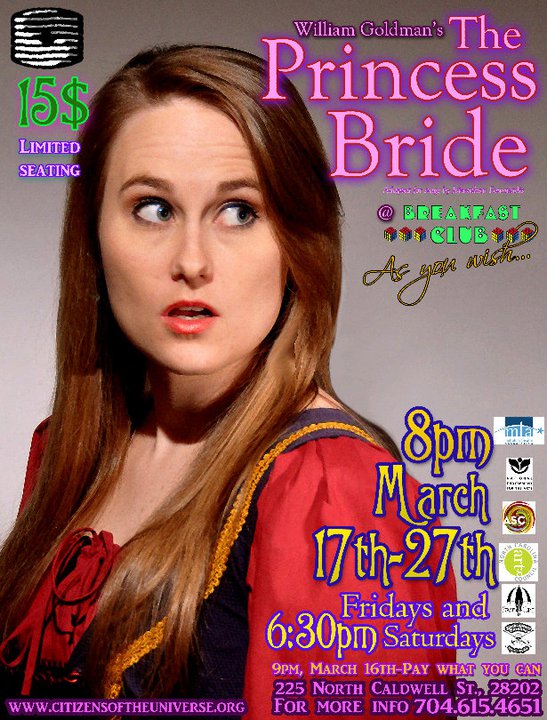
grungy royal wedding: The Princess Bride
By Perry Tannenbaum
Since
its humble beginnings in a backroom at The Graduate with Gonzo: A Brutal
Chrysalis just over two years ago, James Cartee's Citizens of the Universe has
prowled around the Plaza Midwood area, spreading the company's deliciously
conflicted dogma. They've presented quixotically ambitious projects in the
grungiest locales — Reservoir Dogs in a Bohemian studio off 10th Street and
Fight Club in a parking lot off Central Avenue. Up the road at Story Slam,
where they found shelter until the whole shebang was disgorged back in January,
they veered from the streetwise grittiness of Trainspotting to the pastoral
elegance of Uncle Vanya.
To the questions are you brutal or pretentious, punk or poetic, crass or
crusading, Cartee and his COTU guerrillas have always answered yes.
Now in the wake of the Story Slam blowup, COTU is staging an amazing
resurrection — in the shadow of the Time Warner Cable Arena. Yes, the
two-year-old guerilla group has ventured out of its Plaza Midwood cradle,
presenting William Goldman's The Princess Bride at The Breakfast Club in a
stage adaptation by Johnathan Fourniadis of the screenplay.
Breakfast Club isn't the shabbiest joint in the Uptown, but surrounded last
Thursday by nearly vacant parking lots sporting absurd $15 and $20 signs in
anticipation of the NCAA regionals the following night, the three-story
nightclub boasted formidable eyesore credentials. We steeled ourselves with
medieval courage and parked as close as we could to the front entrance, which
faces away from N. Caldwell Street. Go ahead and fearlessly do the same, for we
gratefully learned that Breakfast Club covers the parking tab — even when some
stooge leaves a citation on your windshield.
More pleasant is the surprise when you climb the clanging outdoor staircase to
Breakfast Club's second level. OK, you may still think it's a dive once you're
inside, but it's marvelously apt for the rough magic Cartee and his co-director
Mimi Harkness seek to create. There's an overhanging balcony that serves
beautifully for the evil Prince Humperdinck's wedding to our darling Buttercup
and for assorted royal proclamations.
There is vast interior space, minimizing set changes when we trek from
Buttercup's homely homestead to the Cliffs of Insanity and from there to the
Fire Swamp — or when Buttercup's true love Westley is finally imprisoned and
tortured on The Machine. Even our storyteller and his pesky audience, Grand Dad
and Grand Kid, have their own little nook where they can camp out and
occasionally interact with the fairy tale protagonists — particularly when
Buttercup and Westley presume to smooch.
Suzi Hartness contributes a marvelous set of costumes, from the dwarf brigand
Vizzini up to the Turkish giant Fezzik, with plenty of royals, lackeys, tramps
and swashbucklers in between. But the real reason this is such a technical
apotheosis for COTU is that we see Cartee ensconced in a soundbooth running
light and sound cues with electrical equipment actually designed for that
purpose, instead of his customary car headlights and kitchen utensils.
Cartee always overachieves in attracting artistic and acting talent, so the
cast will likely blow you away most of the time. A Tarradiddle mainstay at
Children's Theatre, Lesley Anne Giles knows exactly how to tilt the title
character toward an adult audience, but Thorin Thompson is still a
work-in-progress as Buttercup's beleaguered lover Westley, acting with dashing
credibility but needing to pump up the volume to full theater level.
They're supported alarmingly well, with impressive debuts from Errol Sulleyman
as the priggish barbarian Humperdinck and Dominick Weaver as the six-fingered
Count Rugan. One unexpected chink in the solid armor is Berry Newkirk as
fencing master Inigo, his Spanish accent often an impenetrable thicket.
Comically upstaging everyone, David G. Holland and Poppy Prittchit wear tons of
makeup and costume, doubling as Humperdinck's doddering royal parents and their
lowliest subjects, Miracle Max and spouse.
Princely fun.
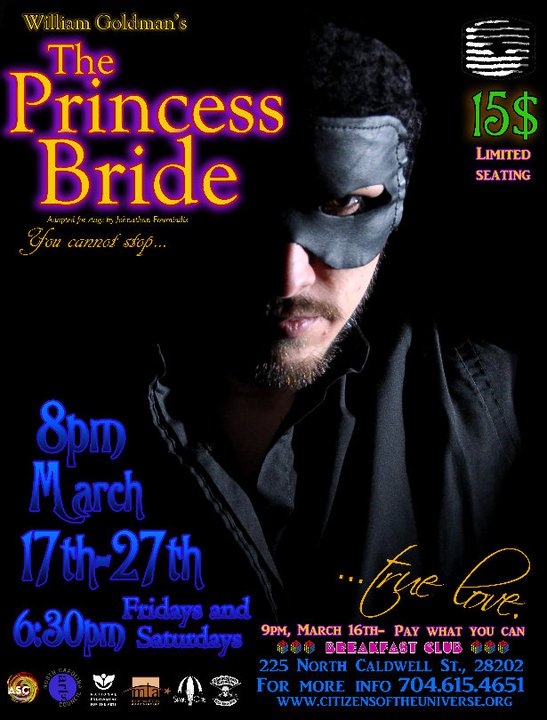
THE
PRINCESS BRIDE
By William Goldman
Adapted for the stage by Johnathan Fourniadis
Directed by James Cartee & Mimi Harkness
Citizens of the Universe
The Breakfast Club
March 16 – 27, 2011
How can you not like The Princess Bride? And how can you not appreciate
Citizens of the Universe for taking chances, and coming up with unexpected
venues. In this case it is The Breakfast Club, a bar/dance club in uptown
Charlotte. As COTU has proven before, you can do theatre anywhere as long as
you have actors, directors, and audience. Oh yes, and a first-rate script.
William Goldman’s satirical fairy tale is a favorite of many and with good
reason.
Buttercup orders around Farm Boy until she realizes that she loves him as much
as he loves her. He sets off to make his fortune so they can marry, but when
she learns he’s been killed, she begrudgingly agrees to marry Prince Humperdinck.
There are the pirates, a giant, double-crosses, human-sized rats, and the
snappy, wonderful dialogue you remember.
One drawback with such a familiar story is that the movie has been shown over
and over on television. You have to try and leave comparisons behind, because
on stage, in this venue, it just can’t possibly have the expensive production
values, or camera tricks of a film. Yet directors James Cartee and Mimi
Harkness make the most of the second floor area which has numerous openings,
doorways, and levels where actors make entrances and exits.
Off to one side Grand Dad (Ted Delorme, solid as usual), and Grand Kid (Abigail
Olsen, sufficiently pouty), engage in the book reading/storytelling of The
Princess Bride. A nice touch is when Grand Kid has some long distance
interaction with the characters. Leslie Anne Giles is perfectly cast as the
pretty, feisty Buttercup. Her love Westley is played by Thorin Thompson who
certainly looks the part, but the audience strains to hear him at times. This
is not uncommon for those who work in film, then come to the stage. (Mr.
Thompson has produced and directed a film in Charlotte recently.) Errol
Sulleyman brings just the right energy to the effete Prince Humperdinck.
One of the highlights of the show is when Miracle Max (David G. Holland) and
Valerie (Poppy Prittchit) revive the tortured Westley who is only mostly dead.
They are over-the-top hilarious, and every bit as good as the originals, and
that’s saying a lot. Joel Summer adds laugh-out-loud bits as Vizzini/The
Albino/The Distinguished Clergyman. Berry Newkirk admirably stays in character
with accent as the sullen Inigo Montoya out to avenge his father’s killer. Ian
Fermy, Dominick Weaver, and Russell Bennet, Jr. round out the cast with their
contributions to the zaniness.
Technical elements are challenging in this space, but Charles Holmes does an
excellent job as fight director with the actors wielding their weapons well and
in synch with each other. Suzi Hartness is also to be commended for the
colorful costumes.
The acoustics are not the best, and the night of the performance was an
unusually warm evening that made it somewhat uncomfortable. Yet, Citizens of
the Universe is the closest thing Charlotte has to avant-garde theatre. It’s
not perfect, and in its imperfections we are shown why it can be so much fun to
suspend your disbelief. I hope theatre fans will come out and support this
production. You may find out why, with all the hard work and limited rewards,
so many have an appreciation for live theatre. Review by Ann Marie Oliva
Ann Marie Oliva is an award-winning local playwright with productions across
the United States, a published fiction and non-fiction writer, and reviewer.
She is the producer/editor of ARTS à la Mode and a judge for the National Youth
Theatre Awards. Ann Marie is a member of the Dramatists Guild of America.
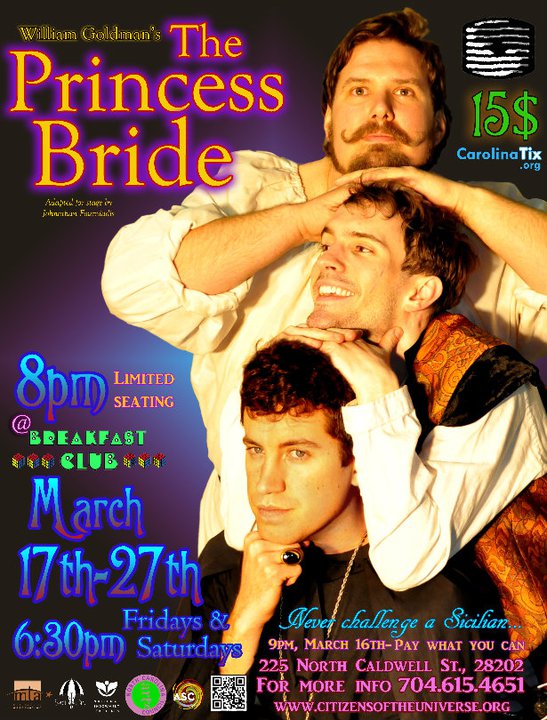
Love Conquers All: A Quiet Evening with Sid & Nancy
2011 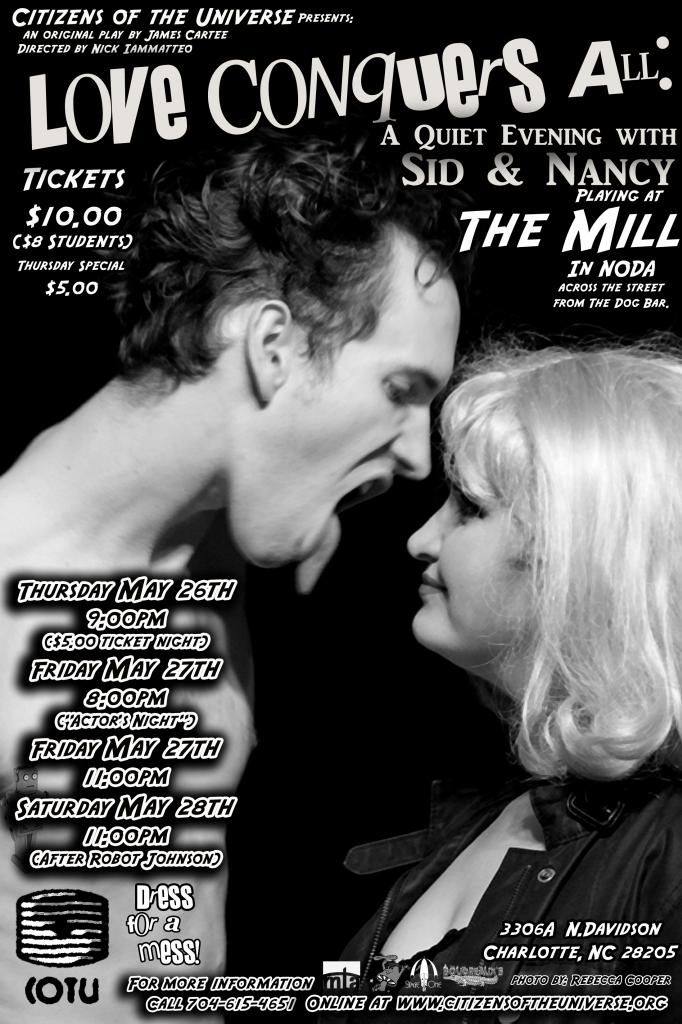
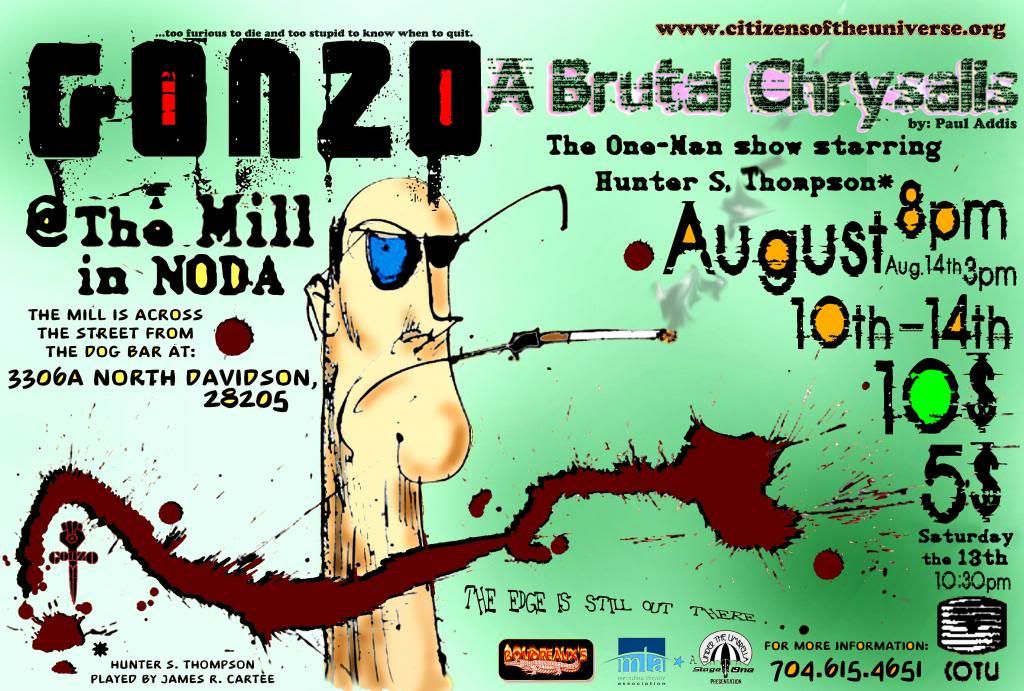
GONZO:
A Brutal Chrysalis
2011
Theater:Gonzo:
A Brutal Chrysalis and More
Posted by Perry Tannenbaum
Thu,
Sep 1, 2011
Creative
Loafing CLOG
Among local performers, Simon Donoghue and James Cartee are as different as it
gets. So it wasn’t surprising that, in their recent one-man shows, the two
actors took on wildly different historical figures. Last week at Belmont Abbey,
the urbane and understated Donoghue portrayed Renaissance philosopher and
politician Sir Thomas More. A week earlier, the frenetic and over-the-top
Cartee completed a weeklong stint as the gin guzzling, pill popping,
firearm-hoarding firebrand of gonzo journalism, Hunter S. Thompson — against
the back wall of The Mill, that lovable NoDa dive.
What a perfect spot for Gonzo: A Brutal Chrysalis, Paul Addis’s sputtering, splenetic
tribute to an obviously kindred spirit. I’d seen Cartee’s shtick in its
previous 2009 incarnation at The Graduate. Then as now, the production in
Plaza-Midwood was directed by that grizzled master of subtlety, Tom Ollis, an
old hand at trashing typewriters since his True West days. This time around,
people besides Ollis and me were in attendance as Cartee popped pills, swilled
various simulations of ethanol, brandished firearms, and trashed his little
stage, including a hapless Selectric.
Instead of the somewhat forced laughter I encountered in 2009, from Ollis and
other Citizens of the Universe partisans who were manning the crude electronics
— rudimentary electronics are a COTU badge of honor — there was plenty of lusty
spontaneous laughter at The Mill, spurring Cartee on to funnier, more
outrageous excesses. The approval also had a gradual mellowing effect on
Cartee, so that more of Hunter’s fantastical ramblings were actually
intelligible during Act 2, slowed down from blinding roadrunner speed to that
of a creature less hunted.
In Thompson’s signature self-absorbed style, Gonzo takes us through the
misadventures of his early career, dropping us off before his famed takedowns
of the war on drugs in Las Vegas and the ’72 presidential campaign. So we hear
about his sojourn with the Hell’s Angels, his beating at the hands of the
jackboots at the ’68 Democratic Convention in Chicago, his quixotic run for
sheriff in Aspen, Colorado, and the improbable triumph of his scribblings on
the 1970 Kentucky Derby. That’s about halfway through a hard-drinking,
loud-revving life that ended in 2005 with a self-inflicted gunshot to the head.
If the COTU guerillas revive it, The Mill will remain the ideal place for the
booze, the bluster, the cigarette holder, and the whole Hunter mishegoss.
Reconnoitering the area near the N. Davidson-36th Street intersection during
the intermission, I discovered posters on walls and in nearby shop windows
ballyhooing Gonzo in an apt Bohemian style. Eureka! Somewhere in Charlotte, of
all places, theater was happening like a grassroots community event. So the
city isn’t running entirely on barcodes, plastic, and ATMs.
Cut to the Tower of London in 1535, where Donoghue as Sir Thomas addresses us
with full monastic solemnity on the final morning of his life prior to his
beheading. It’s just 400 years before Pope Pius XI will confer sainthood on the
martyred champion of the Roman Catholic Church, so the man could use a stiff
drink. But the “man for all seasons” didn’t cope with the vicissitudes of life
— or literary composition — by turning to chemicals as Thompson would.
Or at least he doesn’t in Donoghue’s account, for Donoghue wrote More with the
blessing of the Thomas More Scholars of Belmont Abbey College. While there are
plenty of signs of More’s intelligence and wit, including some of his more
familiar bon mots, the language is cold sober, devoid of expletives or
startling expostulations, with frequent denunciations of heretics and
expressions of piety — as there should be, since he is on the verge of dying
for them.
The non-gonzo aspects of More’s style make for some dreary sledding in Act 1 as
we hear about his study and practice of law, his first forays into politics and
diplomacy, the acclaim bestowed upon him as author of Utopia, his disputations
with Martin Luther, and his rise to the exalted — and dangerous — position of
Lord Chancellor during the reign of Henry VIII. Intermission leaves us on the
precipice of the “Great Matter,” Henry’s desire to annul his marriage to Queen Catherine
and marry Anne Boleyn, so he can sire a male heir to his throne. One huge
obstacle lies in the king’s path: the Roman Catholic Church must approve.
So Act 2 perks up considerably as More’s loyalty to his king and loyalty to his
church and conscience become more and more contradictory. Sir Thomas attempted
to walk a tightrope after resigning the chancellorship, refusing to sign the
Act of Succession endorsing Queen Anne’s children as Henry’s heirs yet never
denouncing the king’s divorce or his formation of the Anglican Church. But how
many queens would Henry go on to imprison and decapitate? You knew things
weren’t going to go well for Thomas if he stuck to his guns.
Donoghue won a Creative Loafing Charlotte Theater Award for his contribution to
A Man for All Season when Charlotte Rep presented Robert Bolt’s drama as the
first show ever at Booth Playhouse in 1992, but that was merely a cameo. Under
some deft direction by Jill Bloede, Donoghue was more fully in the spotlight
revisiting More’s tragic demise, and once again he shone.
I’m betting that Donoghue and his one-man show will surface again in the near
future, outside the Abbey. With its minimal set and lighting by Gary Sivak,
More should travel light. Just not to The Mill.
GONZO:
A BRUTAL CHRYSALIS
Written by Paul Addis
Directed by Tom Ollis
Citizens of the Universe at The Mill
August 10 - 12, 14, 15 - 17, 2011
Many of us are nostalgic for the Sixties era, whether we lived then or not.
James Cartee's one-man show, portraying gonzo journalist and novelist Hunter S.
Thompson, presents various comparative points between our time and that era,
beating the drum of history for 90 passionate minutes.
An American flag forms the backdrop for the small set, with a desk onstage,
typewriter, phone, newspapers, pill bottles, carafe, shot glass, and pistols,
much of which goes to the floor during the show. Cartee is a whirlwind of
energy, often changing moods, shirts, and hats, though perhaps peaking too
early with his outrage at society and challenges to his audience. And yet, he
portrays many poignant points in his character's story, while tearing up the
stage and interacting with his imagined readers beyond it.
The play covers the years 1968-70, and also represents Thompson's suicide in
2005 at the age of 67. The character explains his gonzo attitude for getting at
the heart of a story by throwing himself into it, blurring the lines between
non-fiction, fiction, and political activism. Likewise, Cartee throws himself
into the role, showing Thompson's personal and professional battles.
Thompson tells about the birth of his son, but also how he and his wife lost
several other pregnancies. He reenacts his private interview with Richard Nixon
in the back of a limousine, showing both sympathy and hatred for this political
nemesis. Thompson evokes Mayor Daly's brutal "army of cops" at the
1968 Democratic National Convention in Chicago, where he was beaten along with
others in the crowd. He describes the seductive edges of insanity, alienation,
intoxication, and political provocation—recounting his wife's miscarriages, his
articles being banned, his drug use (with speed as a safer "pick me
up" than acid), and his leadership of the "Freak Power" party in
his run for Sheriff of a Colorado county.
Thompson criticizes liberals as being too comfortable to fight for
"fundamental and necessary change." In a similar way, Cartee offers a
disturbing portrayal of this famous character from the Sixties. His Hunter S.
Thompson is funny and scary, creative and destructive, while representing the
truth-seeking, revolutionary idealism of the Sixties and its bad-trip dangers.
Review by Mark Pizzato
Mark Pizzato is Professor of Theatre at UNC-Charlotte and author of Ghosts of
Theatre and Cinema in the Brain, Theatres of Human Sacrifice, and Inner
Theatres of Good and Evil. His plays have been published by Aran Press and his
screenplays, produced as short films, have won New York Film Festival and
Minnesota Community Television awards.
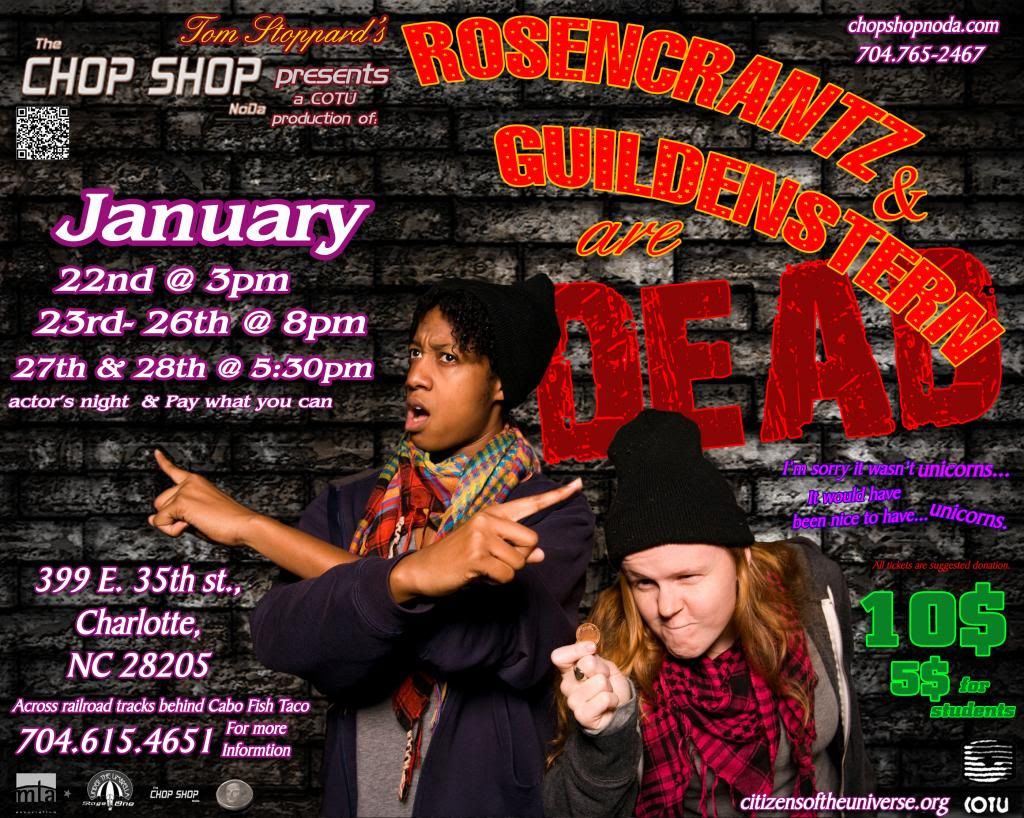
Rosencrantz & Guildenstern are Dead 2.0
2012
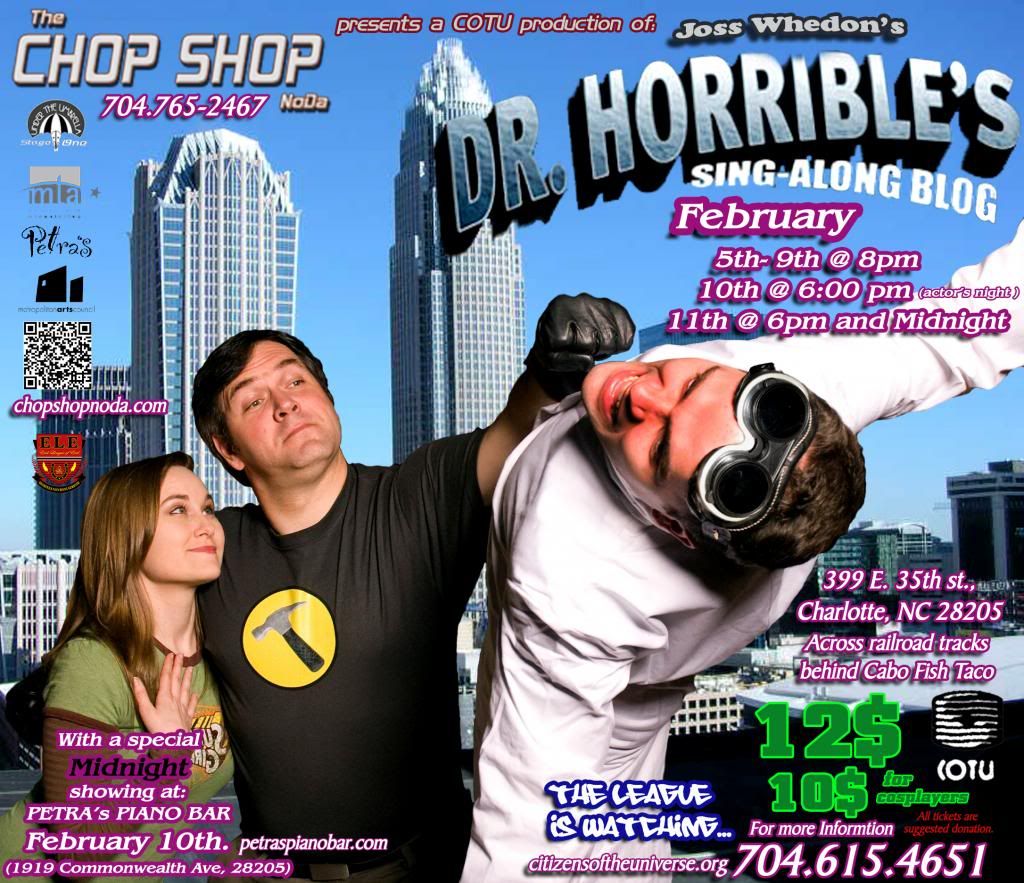
Dr. Horrible's Sing- Along- Blog
2012
GONZO & MARX
2012
GONZO in New Orleans!
2012
Eternal Sunshine of the Spotless Mind
2013

PaperHouse Theatre, Citizens of the Universe's humble beginnings
by Perry Tannenbaum Feb 21, 2013
PaperHouse Theatre and Citizens of the Universe aren't performing simultaneously
at Wine Up in NoDa right now, but the upstairs dive just past 36th Street has
nurtured both companies in recent months.
The less fringy of the two, PaperHouse began life back in November with Penny
Penniworth, a deliciously swift takedown of Dickens and the Brontes. After that
Wine Up debut, it's already mainstreaming at Spirit Square. COTU, on the other
hand, has been hanging around NoDa since spring 2011, bouncing around from The
Mill to the Chop Shop before ascending to Wine Up last summer with Marx in
Soho.
When company founder James Cartee isn't going rad with such iconoclasts as Marx
and Hunter Thompson, he's usually exhuming screen gems such as Trainspotting,
The Princess Bride, Fight Club, or Sid and Nancy and adapting them for the
stage. That's approximately what the COTU guerillas are doing now with the
world premiere of Cartee's adaptation of Eternal Sunshine of the Spotless Mind.
Co-directed by Cartee and James Lee Walker II, the production retains an
element of cinema with a screen that often projects freshly shot footage behind
the actors onstage. There are tables facing that screen and, if you arrive
early, you have the option of ordering from Wine Up's menu or from nearby
Beaudreaux's. Yet the overall experience is as much like watching a NASCAR race
from the infield as it is like dinner theater.
Especially in Act 2, when the pace accelerates, action is staged around the
audience, and the swivel chairs you're seated on become quite handy. The
commuter train where Joel and Clementine meet at the outset and both of their
apartments are to the audience's right. Front and center, the space in front of
the screen is where the couple makes their dearest memories. To our left are
the offices of Lacuna Corp., where Clementine has gone — fearing commitment or
heartbreak, or maybe out of sheer kookiness — to erase all memory of Joel from
her brain through the ministrations of Dr. Holly Mierzwiak.
Nearly as young and foolish, Joel goes to Lacuna for a matching erasure. But
after the process begins, Joel experiences buyer's remorse, so he schemes to
hide his memories of Clem in places where the Lacuna technicians and their
machinery won't find them. The vertigo of migrating memories and the vertigo of
lurching forwards and backwards in time — and in and out of Joel's mind as the
story climaxes — mesh well with the swirl of action circling around us as Joel
strives to save his love.
Though I haven't seen the 2004 film, I'm guessing that Cartee and Walker
decided to go way against the grain in casting Colby Davis as Joel and Megan
York as Clementine. What they give us is worlds apart from anything I've seen
from Jim Carrey or Kate Winslet, but it's a brilliant blend. Joel's shyness and
nerdiness are stiffened to the verge of paralysis, yet Davis makes his steely
core, the source of his tenacity, strong enough to reach to the rear of the
audience, wherever that happens to be. York gushes with spontaneity, impulse
and enthusiasm — as if she's supposed to be the "eternal sunshine" of
this story — clearly her best stage work so far.
Supporting players aren't quite on the same high level, but Walker and Cartee
deliberately deflate our expectations from the outset. With the movie screen
flashing brightly behind them, the actors chaotically scurry back-and-forth across
the stage, pausing long enough to show us their characters' names scribbled on
typing paper. That's as close as we'll get to opening credits. Hollywood this
ain't.
WITH A CAST that any local company would drool over, PaperHouse ratchets
expectations considerably higher for Arthur Schnitzler's classic La Ronde at
Duke Energy Theater. Spreading the current epidemic of co-directing, this
production divvies up the 10 dialogues among four directors, Greta Zandstra,
Peter Smeal, Andrea King and Nicia Carla. The three women also act in scenes
they're not directing, while Smeal handles set design and emcees.
La Ronde doesn't take us very far from the Victorian England presented in
PaperHouse's Penniworth, but in transporting us to pleasure-loving Vienna, Schnitzler
is showing us sensuality, anxiety, ennui and openness that are vastly more in
tune with modernity. Each time a belt buckle is unloosed or a petticoat hits
the floor, the time traveling begins.
If you haven't seen the 1897 original before — or David Hare's notorious
modernization, The Blue Room — it's the structure of La Ronde rather than the
story that requires explanation. Whenever one of these liaisons ends, one of
the sex partners exits while the other lingers for the next scene, making a
second connection with the opposite sex. The chain continues to grow until the
last character we see, a noble count, couples with the first to exit, a lowly
whore named Leocardia, completing the grand circle of lust and promiscuity.
By Charlotte standards, there is ample concupiscence, with the women disrobing
more often — and thoroughly — than the men. All four directors seem to agree
that we'll be keeping things lighthearted. From Carla's encounter as the Whore
with Chaz Pofahl as the Soldier, we proceed merrily until Chad Calvert makes
his entrance for the fifth and final scene before intermission as the starchy
Husband of a repressed Young Wife (Gretchen McGinty, back from a fling with a
neurotic Young Gentleman, done to perfection with Berry Newkirk). Calvert seems
to think he's Torvald in A Doll's House. It's that pompous and tedious.
Act 2 brightens considerably when Calvert meets Michelle Busiek as the sweet
Little Miss. But after the new layers of Matt Cosper as the Poet and Zandstra
as the Actress, we hit the shoals again with Alan Poindexter's enervated
comeback as the Count, so reserved in his elegance that he won't even
condescend to be audible. He looks the part, I'll say that.
ETERNAL
SUNSHINE OF THE SPOTLESS MIND
Adapted
for the stage by Jimmy Cartee
Directed by Jimmy Cartee and James Lee Walker II
Citizens of the Universe
WineUp
February 13-17, 20-22, 2013
"With the smallest and with the greatest happiness there is always one way
in which happiness becomes happiness: through the ability to forget or, to
express the matter in a more scholarly fashion, through the capacity, for as
long as the happiness lasts, to sense things unhistorically." Friedrich
Nietzsche
Citizens of the Universe (COTU) premieres Eternal Sunshine of the Spotless Mind
for the stage with a poignant iteration of Charlie Kaufman's story that's
arguably better than the original. Jimmy Cartee's adaptation draws—sometimes
even forces—audience members to actively participate in and engage with Eternal
Sunshine, its lead characters, and the all-encompassing natures of memory,
love, and loss.
As it was with Kaufman, time is simply a tool for co-directors Cartee and James
Lee Walker. They lead us through Eternal Sunshine on a golden spiral of
narration—from an opening dance sequence where they draw audience members out
of their seats to dance with the cast to a heartrending post-erasure meeting
between Joel (Colby Davis) and Clementine (Megan Sky Stegall York); from Joel's
mind and memories to moments past and present with former/future flame Naomi
(Meg Harper).
The main explorations of Kaufman's story—questions of chance, control, memory,
weight and lightness—shine through subtly in the gracefully contrasted
performances of Davis and York. Davis deliberately mediates audience opportunities
to sympathize for and connect with Joel. Like Joel, who's standoffish at first
with Clementine before warming up to her endearing manias, Davis moves through
delicate and devastating moments at a pace that disallows immediate
understanding of Joel or the choices he makes. As the play
"progresses," Davis and Joel become more accessible—we warm up to
Joel in accordance with Davis's unveiling, a set of directorial and acting
decisions that work well with York's exuberant Clementine. Clementine is meant
to be captivating, to overwhelm Joel—at least at the outset—and York's
portrayal does. She's sensual and spritely, compulsive and fun. She's sexy and
crazy and draws the audience in—so much so that when Davis/Joel start to ramp
things up, we're invested and able to appreciate the shift in relationship and
stage dynamics.
The supporting cast is similarly strong—Kacy Southerland makes a touching turn
as Mary Svevo, unwitting lover, victim and assistant of memory MD Holly
Mierzwiak (Kelly Ogden). Meg Harper triples down as Naomi, Joel's mother, and
Carrie Eaken, the wife of his best friend. Even the technical aspects of
theatre, tricky enough to begin with, are wrangled elegantly. In the small
working space of an intimate taproom, Adam York's lighting clamors for
attention when needed and accents well in quieter moments. Cartee's sound, a
dynamic cocktail of indie love songs and deviant dervishes (from the likes of
Tom Waits and Asheville's Hellblinki Sextet), fleshes out thematic over - and
undertones with impish dexterity, and additional visuals/projections add extra
dimensions to some of Joel and Clementine's most significant memories.
COTU's production succeeds on several levels: at bringing its audience in on
scenes that prompt personal and philosophical reflection, at removing customary
roles of passive viewer/active participant, at leaving open lines of dialog to
take home after hours. Eternal Sunshine is interactive and insistent. It
teaches and reminds us of the potential, power, and importance of theatre
which, like memory, is painful, magical, and necessary.
Review by Hannah Levinson
Hannah Levinson is a lifelong aficionado of music, theatre, literature and
film. She is a contributing writer for Shuffle Magazine and a freelance sound
designer. Hannah is currently pursuing a Master of Arts in Ethics and Applied
Philosophy at UNC Charlotte with a research focus on the use of artistic media
in social and political advocacy.
'Spotless Mind' acquires a new set of bodies
Premiere of stage adaptation makes us look at the 2004 movie with fresh eyes
and ears.
By Lawrence Toppman
Charlotte Oobserver
Posted: Thursday, Feb. 14, 2013
‘Eternal Sunshine of the Spotless Mind’
Citizens of the Universe does a stage adaptation of the Oscar-winning
screenplay for the 2004 film, in which an estranged couple erase each other
from their memories. Billed as a world premiere.
WHEN: 8 p.m. Feb. 14-17 and 20-22.
WHERE: Wine-Up, 3306-C N. Davidson St. (upstairs).
RUNNING TIME: 150 minutes.
“Think of this as theater in the round in reverse,” said the master of
ceremonies, and I saw within moments what he meant – and why we’d been seated
in swivel chairs. “Eternal Sunshine of the Spotless Mind” flows all around
Wine-Up, as its cheerful physical chaos reflects the psychological chaos of its
characters.
Citizens of the Universe specializes in stage adaptations of screenplays. “Why
do this?” you may wonder, especially when (in this case) an Oscar-winning
script came to two-dimensional life onscreen with Jim Carrey and Kate Winslet
ideally cast in the leads. But there’s a point.
When we hear lovelorn Joel Barish and vivaciously unhinged Clementine
Kruczynski battling and smooching before, behind and beside us, we feel more
like neighbors than onlookers. Adapter James Cartee has also chosen a fresh and
apt soundtrack; it often consists of post-’90s rock, but “Yakety Sax” sets off
an especially wacky chase.
If you know the story, you won’t be surprised by events, although the head of
the clinic that erases Joel and Clementine’s memories is now played by a woman
(Kelly Ogden). She still has an affair with a female employee (Kacy
Southerland), though no more is made of it than of the heterosexual fling in
the film.
The narrative is a shade harder to follow onstage. Directors James Lee Walker II
and Cartee don’t have the luxury of changing sets in so small a space – only 40
audience members can fit – so we sometimes struggle for a moment to know where
we are.
Much of the play takes place in Joel’s memories, as he regrets his decision to
eradicate Clementine and tries to “hide” with her in his mind from the machine
probing his brain. Like the film, the play jumps in time between real actions
and remembered ones, and the directors use their space efficiently to
differentiate between the two.
The cast interacts mildly with the crowd, squirting a few of us once with water
pistols or asking us to leave our seats briefly so actors can use them. Yet
there’s not much interaction, so it never stopped seeming like a gimmick.
Colby Davis, who’s more restrained than Carrey, builds his performance slowly
as Joel. At first he seems benumbed, staring about like a medicated owl. His
emotions build, until he’s distraught at the idea of losing a woman who may not
be good for him.
More remarkably, Megan York finally dispelled recollections of Winslet in her
Oscar-nominated triumph. Winslet’s kookiness was always somehow endearing; York
isn’t afraid to make Clementine sympathetic and broken and attractive and
infuriating.
You may not like her now or feel that she and Joel must inevitably make each
other wince. The ending struck me differently in the stage show than it did in
the film: What I once took for optimism had more pain in it. Or perhaps that’s
just my own memory, beginning to fade in this case after nine years of disuse.
If you’re drawn to avant-garde theater, decide for yourself.
Read more here:
http://www.charlotteobserver.com/2013/02/14/3854054/spotless-mind-acquires-a-new-set.html#storylink=cpy
Titus Andronicus 2012
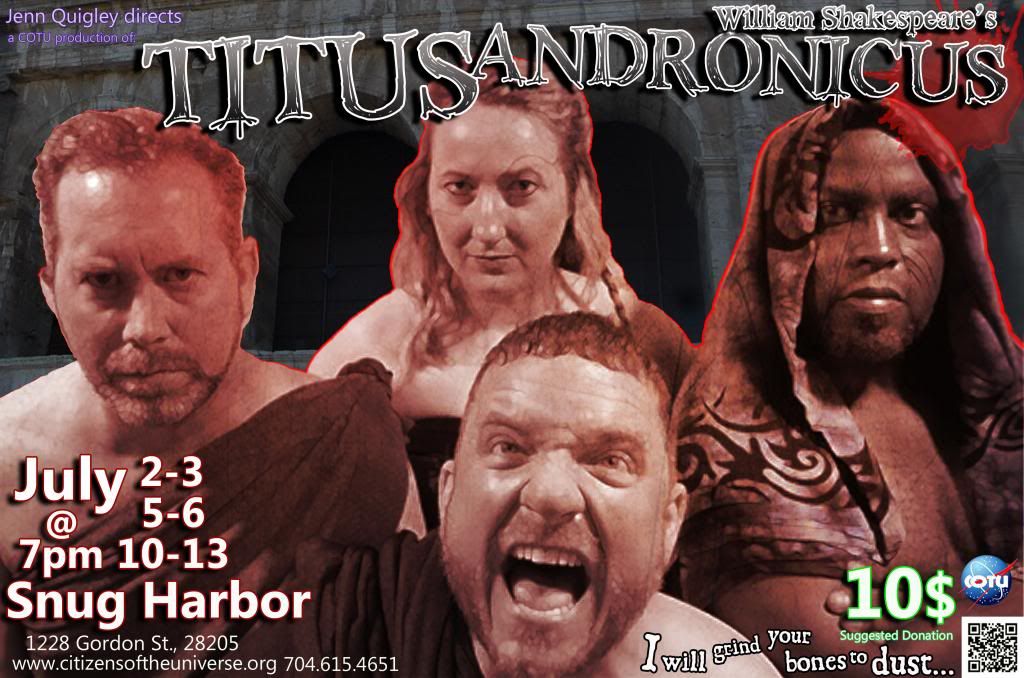
The Bard's bloody banquet in Titus Andronicus
COTU's latest production offers live lopping of limbs
by Perry Tannenbaum
There
is more than enough malice and carnage in Titus Andronicus for a few
worshipers of Shakespeare to seriously doubt he wrote it. Since the
object of their bardolatry is universally acknowledged to have fashioned
the atrocities of King Lear and the body count of Hamlet, we must be
considering a degree of brutality and barbarity that is quite
formidable. Historically, the bloodletting has been enough to dissuade
companies and directors from producing Titus — and enough to dissuade
mothers and small children from watching. Yes, even for
Shakespeare, this apocryphal tale of bloodlust and revenge during the
Roman Empire is over-the-top in its violence. So let me pass along a
couple of facts about the Citizens of the Universe production, currently
running in the rear patio at Snug Harbor, before passing judgment on
its merits.
• Scenes of graphic violence are sufficiently bloody
to warrant a "splash zone" encompassing the audience seats closest to
the main staging area.
• When my wife Sue and I attended last
Wednesday, the most violent scenes invariably elicited laughter from a
good portion of the crowd.
COTU has never been intimidated by the
fact that live onstage special effects usually pale in comparison with
the horrors achieved by Hollywood goremeisters. Cheesy or not, the
gross-out episodes of Titus will no doubt land it a place alongside the
company's guerilla presentations of Trainspotting and Reservoir Dogs in
local lore. Each of these dramas has come burdened with daunting
technical challenges and bodily spewings, but the live lopping of limbs
required by this Shakespeare tragedy is likely unprecedented in
Charlotte's annals. The butchery begins early. Titus enters as a
triumphant general who not only spurns offers from the populace to
become the new Roman emperor, elevating Saturninus to the crown, but he
also rejects the captive Queen of the Goths' pleas for mercy on behalf
of her eldest son. Nor are Queen Tamora's entreaties politely denied,
for Titus' surviving sons — in the hearty spirit of avenging the 21 sons
of Andronicus who lost their lives in battles with the Goths — engage
in an orgy of limb-lopping before casting poor Alarbus into the fire. So
the enmity between Titus and Tamora, both of whom come equipped with
still more spare children, could hardly be more extreme. When Saturninus
takes Tamora to be his empress — a brief betrothal with Titus' daughter
Lavinia just doesn't work out — the spigots of vengeance and vendetta
are opened full blast. Rape is merely the beginning of the violation
inflicted upon Lavinia, and the vengeance Titus takes on Tamora's
remaining two sons plumbs the depths of ghoulish gourmet horror.
Reminiscent
of COTU's previous outdoor venture in Plaza Midwood, the legendary
Fight Club of 2009, actors dealt admirably with the vagaries of the
weather, this time a drizzle rather than a downpour. Tom Ollis and
Meredith McBride are wonderful adversaries as Titus and Tamora, both
brimful of noble conceit and hauteur. With so much more adversity to
deal with after dispatching Alarbus, Ollis is far more volatile,
erratic, agonized and blustery. How many other Charlotte actors have
taken on roles where they incidentally murder two of their own children
along the way? Even Titus' cunning is outsized and flamboyant in this
delicious performance by Ollis. Between the horrors she
experiences at the outset and in the denouement, McBride is the more
calculating, two-faced rogue. While plotting her vengeance upon Titus
and the Andronici, Tamora spends her leisure hours two-timing
Saturninus, going for the gusto with her Moorish slave Aaron. As much
zest as McBride puts into the plots and dalliances of Tamora, Ron
McClelland channels into the pure wickedness of Aaron. When he is
finally brought to justice, Aaron's only regrets — expressed in two
monologues lavished upon him by the Bard — are that he might have
inadvertently done some good during his lifetime and that he didn't do a
thousand times worse.
Though not in the same league as Titus or
Tamora, Saturninus is a pretty nasty piece of work. Brian Willard ably
embodies the emperor's unsavory malignity and earns extra credit for
co-designing the blood effects with Ollis and overseeing the fight
choreography. Others on the tech team earning kudos are stage director
Jenn Quigley, who co-designed the period costumes with Mandy Kendall,
and Gregory Hewitt, who created the clotted hooves that serve as hand
props for our amputees.
Only one glaring weakness mars this COTU
effort, Russell Smith as Titus' brother Marcus. By the time the evening
ended, clocking in at a trim 1:44, I'd long ago abandoned hope that
Smith would begin acting the role of the politic tribune. Just getting
through his lines without catastrophe was enough to satisfy me and the
anxious actors awaiting their cues. Far better were David Loehr and
Chesley Oxendine as Tamora's dopey, bestial sons, decisively avoiding
being carbon copies of each other.
The 13-member cast often
enters and exits through the audience, making the snug Snug Harbor patio
seem heavily populated — and making us often feel part of the Roman
populace. Most promising among the remaining players were Robert
Brafford and Kendall as the last Andronicus children to survive, Lucius
and Lavinia. In an empire that conspicuously lacked spotless role
models, Brafford emerged credibly as the worthiest at evening's end.
Kendall, bless her heart, was a most poignant victim as Titus' dear
daughter. But I can't swear that I was able to refrain from joining the
laughter when she finally revealed the names of her ravishers — in an
unforgettably horsey manner.
Titus is clearly a unique slice of
Shakespeare, almost completely devoid of elegance. It's a banquet of
blood that could be to your taste. Eternal Sunshine of the Spotless Mind
2014
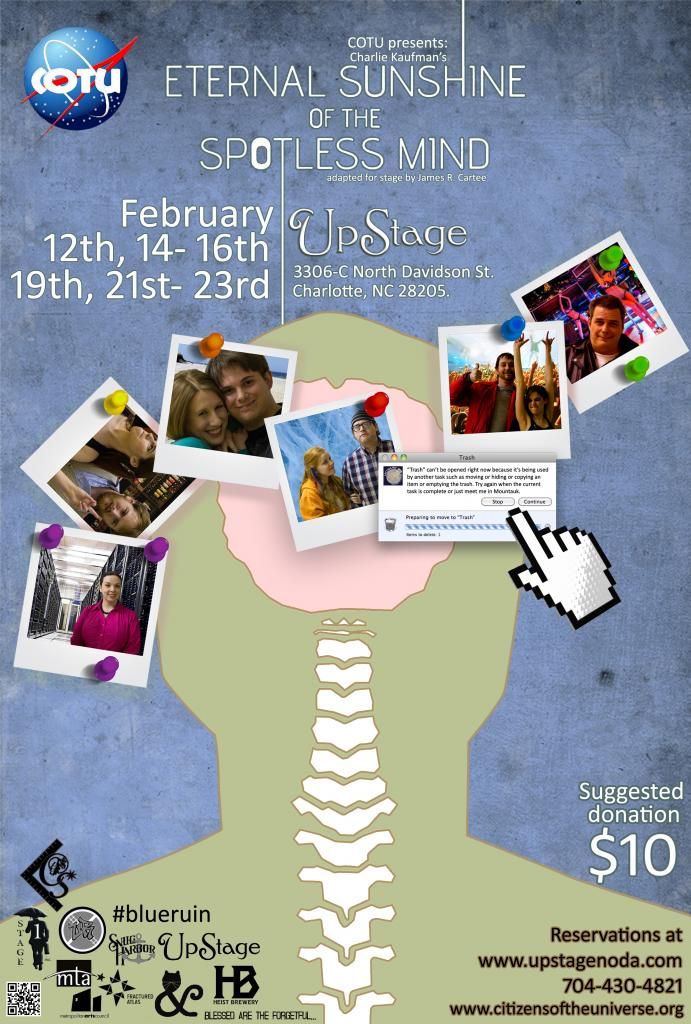
The BIG Lebowski
2014
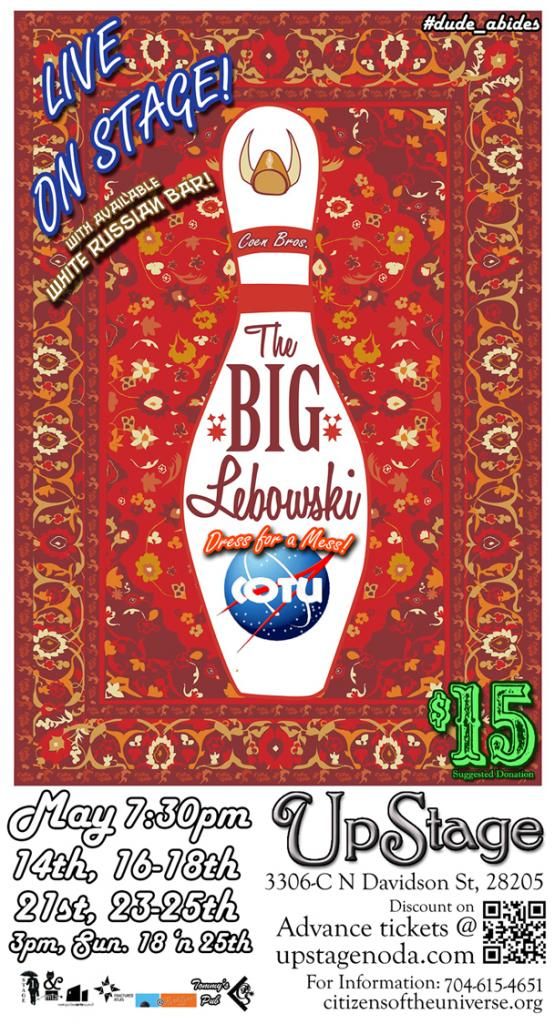
Theater review: The Big Lebowski
Posted by Perry Tannenbaum on Fri, May 23, 2014 at 10:09 AM
You might say that the Coen Brothers were taking aim at the intricacies and smoky atmospherics of film noire when they created The Big Lebowski. Or you might say they conceived their follow-up to Fargo as a latter-day descent into the underbelly of Los Angeles, designed to show us how far modern life has devolved since the antiheroes and monsters of Chinatown walked the earth.
Such theorizing would be wildly overthinking the whole enterprise - and unfairly accusing it of ambition. As the current Citizens of the Universe stage adaptation shows us, the Coens were more likely in the mood to just have some fun with their screenplay, delivering a dopey flow of mayhem laced with drugs, thugs, weirdoes, wet dreams, femme fatales, and bowling. Masterminded by COTU intergalactic peacekeeper James Cartee, the sloppy, seedy, over-the-top energetic production now at UpStage is nothing if not fun.
With a manic slovenliness, Tom Ollis portrays The Dude, nee Jeff Lebowski. Dude is roughed up by a pair of goons who have mistaken him for the Big Lebowski, a wheelchair-bound tycoon whose wanton wife is in huge debt to a big-time porn peddler. What really sets Dude off isn't the beating - it will be the first in a series - but the fact that one of these muscled creeps peed on his rug.
"That rug really tied the room together," Dude famously grouses. So he goes out to confront the real Lebowski at his mansion - right, a mansion in the loft of UpStage in NoDa. The tycoon is about as friendly as a rattlesnake and quickly dismisses Dude and his hard-luck petition to redress all the wrongs that have been done. Yet we find that Dude is capable of real chutzpah, telling the butler on his way out that Lebowski has granted him the choice of any rug he likes.
You can argue about Dude's taste, but there's no denying that this replacement rug brings the Coen Brothers' plot together. Pretty soon, Dude is involved with the wife, the daughter, a kidnapping, and a huge ransom drop. Yet this isn't quite a full-time job for the formerly lazy lout. He still has time for the occasional White Russian at a nearby watering hole and the necessary hours for commingling with his bowling teammates in Dude's favorite recreation.
That is so fortunate for us, since one of these alley cats is the hyper-intense Vietnam War vet Walter Sobchek, a walking hand grenade rendered by Lamar Wilson with such bellowing, relentless insanity that the perpetually-pissed Ollis seems mild-mannered by comparison. Walter is always ready to stand by Dude when adversity strikes, but he jumps into the breach with such gung-ho bad judgment that he invariably screws things up. Spectacularly.
No strangers to playing heavies, Ollis and Wilson turn out to be a marvelous comedy team. But there are other marvels sprinkled through the cast, including Chris Freeman as a sleazoid rival bowler, Gayle Taggart as our cowgirl narrator, and Dink Nolen as the mean, crippled Lebowski. Mandy Kendall as Lebowski's daughter sounds the nearly serious notes in this romp - wanton, disturbed, and mysterious. Just a little too ready to drop her clothes to be mistaken for your old-time femme fatale. I'm guessing that if your momma is hooked on porn, the apple doesn't fall far from the tree.
The Merry Wives of Windsor
2014 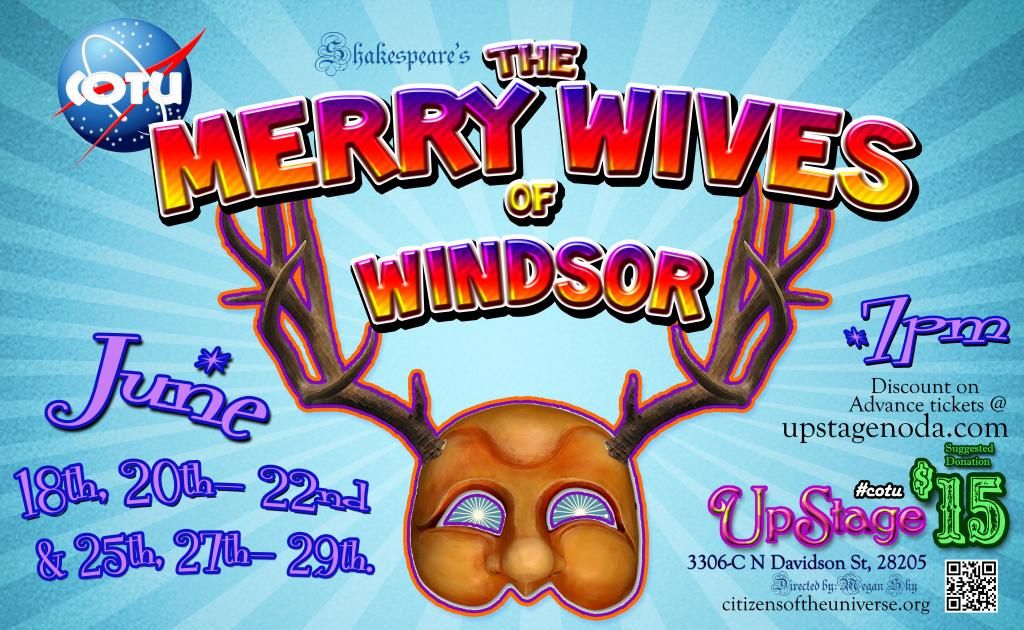
The Merry Wives of Windsor
Posted By Perry Tannenbaum on Fri, Jun 27, 2014 at 12:28 pm
Written after the two parts of Henry IV and before its sequel, Henry V, William Shakespeare's The Merry Wives of Windsor is the only play by the Bard to be set in his own time. There is very little blank verse in the script, which substantiates the supposition that the uncharacteristic prose piece was rushed through the assembly line at the command of Queen Elizabeth I in the space of just 14 days - and perhaps hastily premiered on the playwright's 33rd birthday.
The raison d'être for this merry comedy is the fat knight immortalized in the Henriad, Sir John Falstaff, whom Her Majesty wished to see in the throes of love. You can judge for yourself at UpStage in NoDa whether Shakespeare truly fulfilled the queen's command, in a fresh production by Citizens of the Universe that doesn't seem to take place in any specific era at all.
COTU director Megan Sky may not even be insisting that we view the motley crowd onstage as fully human. Most of them are put in masks designed by Citizens peace-keeper James Cartee. They accentuate the bestiality of the whole lot, and tip the balance of the emotion driving Sir John further away from spiritual love to animal lust. It's a bit disorienting at first, especially with so many people onstage. Their aims are nebulous and have no interest in Sir John, but once the central merriment kicks in, it's a jolly ride.
The critical wringing-of-hands over Shakespeare's retooling of an audience favorite has now continued for 417 years, despite the fact that Verdi's operatic version of the Merry Wives comedy, Falstaff, long ago made this lusty, bibbing version of Sir John into the one best-known and loved around the world. Minus about 100 pounds - and some of his "alacrity in sinking" - that is the Falstaff you'll find here, toting tankards big enough to make a dent in the weight differential by the end of COTU's run.
Inside a Cartee mask, David Pollack isn't merely red-faced as the dissolute knight, he's positively ruby, with bulbous cheeks hanging about his mouth. While the mask and its pendulous cheeks don't cover Pollack's mouth, a good portion of what he says seems to emanate Santa-wise from his gut. Nor is there any compelling reason for Sir John to be besotted by the crème de Windsor, for the plain fashions worn by Amanda Liles as Mistress Margaret Page and Farrell Paules as Mistress Alice Ford don't compensate for the disfigurements they suffer from their masks. Pure pleasures of the flesh, along with the delicacies afforded by a prosperous estate, must be their chief attractions.
Sundry suitors pursuing Margaret's daughter, Ann Page, mostly make the sybaritic Sir John look and sound elegant by comparison. Nancy Gaines takes the early lead as the most repellent suitor, spouting a thick brogue as the priestly Sir Hugh Evans - in a mask that has her looking like a gilded chipmunk. But she, um he, is eventually far overtaken by Doctor Caius, a Frenchman whose accent occasionally spills into Italy in Tom Ollis' booming rendition, once his voice gets past the sharp nauseating teeth of whatever hideous creature he might be in Cartee's most outré mask. My guess is a cross between a rabid beaver and a warthog.
Becca Thompson, one of the few performers not outfitted with a mask (*note: she was in a blue mask) , gives a suspender-snapping dimension to Margaret's husband George that you'll never see anywhere else. Peter Engel doesn't need a mask as Frank Ford. His hyper-jealousy as Alice's husband is so intense that cartoon smoke seems to issue from his ears and hover over his head. Of course, Shakespeare screws the plot tension so prettily, humiliating Falstaff in three consecutive randy rendezvous with Mistress Ford. Meanwhile the wives' cleverness allows Sir John to neatly escape Frank's frantic searches, with exits right under his nose in his own home, stoking Frank's jealousy after each of the first two trysts.
The slapdash COTU production style probably carries over too much into the final midnight scene, where Falstaff's shame finally becomes public. More flamboyant extremes from the lightboard of darkness and fairy shimmer would help bring stronger accents to the magic and the farce. Yet Sky does deploy the spritely imposters all around the house, mingling with the audience and creating a neat demarcation between the masking Shakespeare wrote and the masking COTU has piled on.
No account of my impressions would be complete without a special shout-out to Deanna Pendragon aka Big Mamma D, the imperial immensity who portrays Miss Quickly - the hideous Doc Caius' bawdy emissary to the Page household. She actually my nominee to play Falstaff if COTU ever rolls him out again.
Night of the Iguana
2014 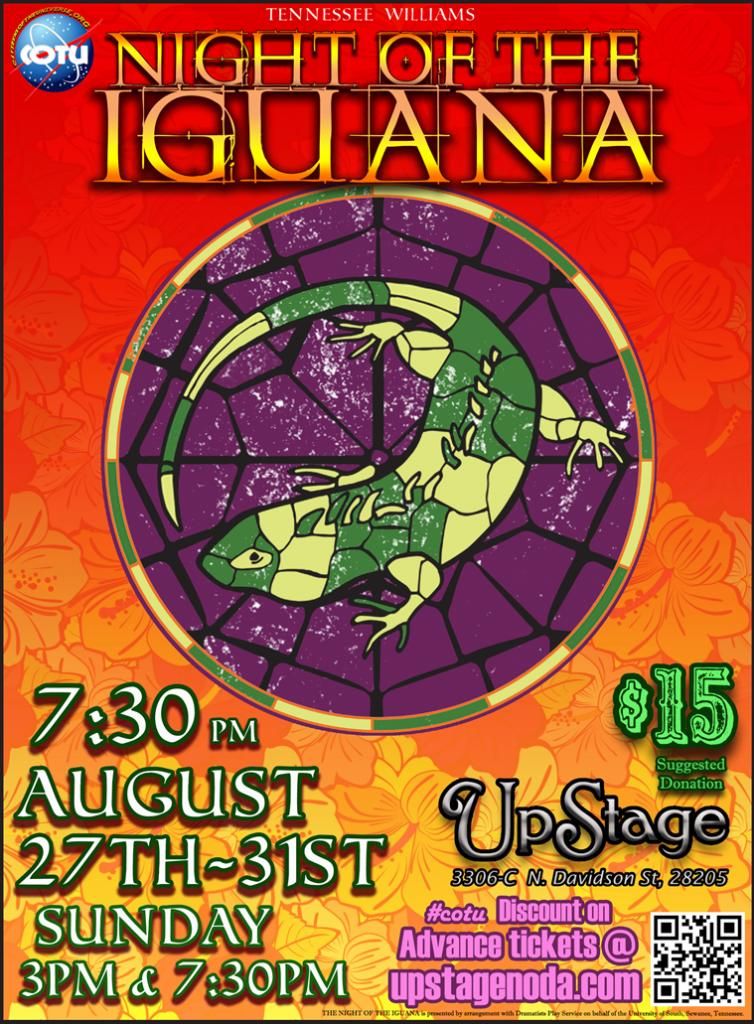
‘The Night of the Iguana’ brings us rare Williams By Lawrence Toppman Thursday, Aug. 28th “The Night of the Iguana” represents the dividing line between the early hits that made Tennessee Williams beloved – mainly “The Glass Menagerie,” “A Streetcar Named Desire” and “Cat on a Hot Tin Roof” – and the later flops written on his descent into obscurity.
After “Iguana” ran for nine months in 1961-62, no new play of his held the Broadway stage longer than 15 weeks. “Iguana” has the strengths of his masterpieces – tenderness, dark humor, an unashamed streak of poetry – while revealing the weaknesses of the plays that would follow: It’s diffuse, occasionally repetitive, not wholly credible. Like almost all his plays, it’s about the devastating fear of loneliness and the lengths to which it drives us.
It has driven disgraced priest Larry Shannon into the Mexican jungle to lead tours of church ladies and seduce willing, underage girls. That crew lands at Maxine Faulk’s dumpy hotel, where Shannon has slept off previous bouts of drunkenness and depression. There he meets resilient, gentle Hannah Jelkes; she travels with her frail grandfather, Nonno, and sells his poems and her paintings.
Megan Sky directs a Citizens of the Universe production that brings out elements I didn’t remember so strongly from the 1976 Broadway revival, especially the jokes and Shannon’s angry self-disgust. (Brian Willard’s at his best there and stresses something easily forgotten: Shannon has a fever throughout the action.)
Yet Sky doesn’t fully expose the play’s wistful sadness. Stephanie DiPaolo’s well-grounded Hannah seems a survivor from the start, not someone whose outer softness slowly gives way and reveals inner strength. Her heartbreaking monologue about a strange romantic encounter, which encapsulates all Williams wants to say about loneliness, is more analytical than empathetic.
The major characters reflect Williams more clearly than in any other play: the anguished atheism of Shannon, the naughty humor of Maxine (Nancy Gaines), the rebuffed kindness of Hannah and the fragility of Nonno, the aged poet who struggles to keep making verses and shouts them at an ever less appreciative audience. (Don McManus plays Nonno as a senile attention-seeker.)
The results are poignant, even when the writing doesn’t succeed. Maxine’s captive iguana becomes a clunky symbol for Shannon himself, once she tries metaphorically to tie him down. The mind-body-spirit triangle of Shannon-Maxine-Hannah gets underlined a bit heavily. Boorish German tourists remain ugly, useless caricatures.
Yet Williams’ command of language never deserts him. He’s not afraid to be sentimental, and he makes that style work for him. As the exhausted Nonno creates a lovely final poem only we may ever hear, we remember that Williams’ writing retained some of its beauty and power long after people stopped listening.
Read more here: http://www.charlotteobserver.com/2014/08/28/5134034/the-night-of-the-iguana-brings.html#storylink=cpy
“The Night of the Iguana” represents the dividing line between the early hits that made Tennessee Williams beloved – mainly “The Glass Menagerie,” “A Streetcar Named Desire” and “Cat on a Hot Tin Roof” – and the later flops written on his descent into obscurity.
After “Iguana” ran for nine months in 1961-62, no new play of his held the Broadway stage longer than 15 weeks. “Iguana” has the strengths of his masterpieces – tenderness, dark humor, an unashamed streak of poetry – while revealing the weaknesses of the plays that would follow: It’s diffuse, occasionally repetitive, not wholly credible. Like almost all his plays, it’s about the devastating fear of loneliness and the lengths to which it drives us.
It has driven disgraced priest Larry Shannon into the Mexican jungle to lead tours of church ladies and seduce willing, underage girls. That crew lands at Maxine Faulk’s dumpy hotel, where Shannon has slept off previous bouts of drunkenness and depression. There he meets resilient, gentle Hannah Jelkes; she travels with her frail grandfather, Nonno, and sells his poems and her paintings.
Megan Sky directs a Citizens of the Universe production that brings out elements I didn’t remember so strongly from the 1976 Broadway revival, especially the jokes and Shannon’s angry self-disgust. (Brian Willard’s at his best there and stresses something easily forgotten: Shannon has a fever throughout the action.)
Yet Sky doesn’t fully expose the play’s wistful sadness. Stephanie DiPaolo’s well-grounded Hannah seems a survivor from the start, not someone whose outer softness slowly gives way and reveals inner strength. Her heartbreaking monologue about a strange romantic encounter, which encapsulates all Williams wants to say about loneliness, is more analytical than empathetic.
The major characters reflect Williams more clearly than in any other play: the anguished atheism of Shannon, the naughty humor of Maxine (Nancy Gaines), the rebuffed kindness of Hannah and the fragility of Nonno, the aged poet who struggles to keep making verses and shouts them at an ever less appreciative audience. (Don McManus plays Nonno as a senile attention-seeker.)
The results are poignant, even when the writing doesn’t succeed. Maxine’s captive iguana becomes a clunky symbol for Shannon himself, once she tries metaphorically to tie him down. The mind-body-spirit triangle of Shannon-Maxine-Hannah gets underlined a bit heavily. Boorish German tourists remain ugly, useless caricatures.
Yet Williams’ command of language never deserts him. He’s not afraid to be sentimental, and he makes that style work for him. As the exhausted Nonno creates a lovely final poem only we may ever hear, we remember that Williams’ writing retained some of its beauty and power long after people stopped listening.
Read more here: http://www.charlotteobserver.com/2014/08/28/5134034/the-night-of-the-iguana-brings.html#storylink=cpy
CA&T Awards
2015
The of the World Sampler Platter
2014 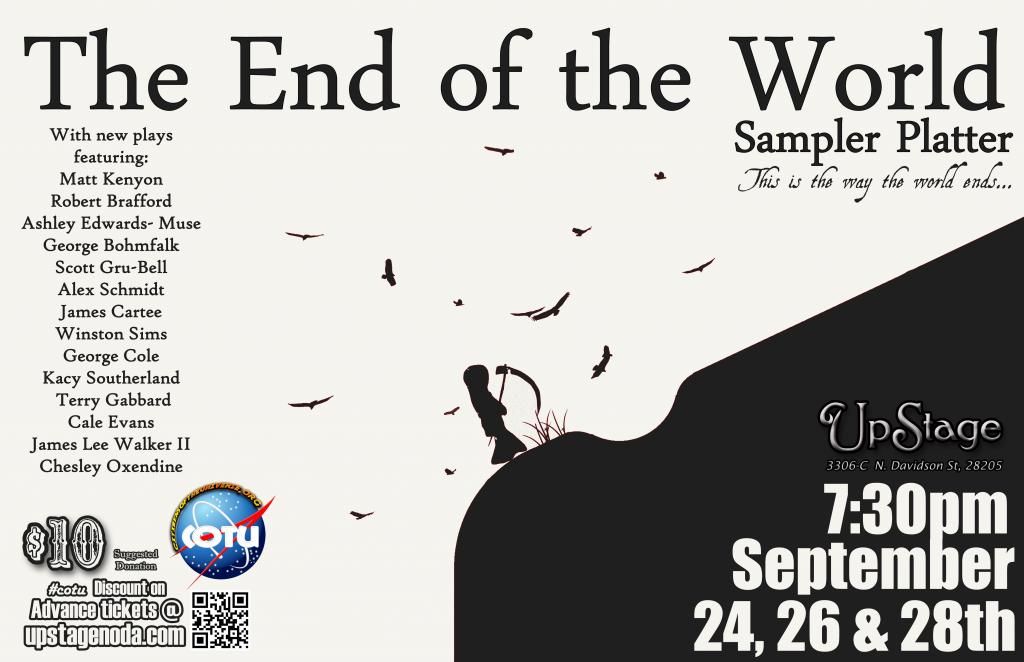
They're Playing Our Song and The End of the World Sampler Platter
A weekend of lightweights and quickies
By Perry Tannenbaum
My fondest memories of Marvin Hamlisch are his 1975 Tony Award-winning score for A Chorus Line and his Oscar-winning tearjerker, "The Way We Were." Sadly, these pleasant memories are far outweighed by my most vivid memories of Hamlisch, when he popped up on every talk show on TV, indefatigably hawking his latest Broadway musical, They're Playing Our Song. I can still see him sitting at the keyboard with his relentless energy and wholesome cheer, playing that title song and selling it, selling it, selling it. Compounding the numbing repetitiveness of his guest appearances was the nightmarish repetitiveness of Carole Bayer Sager's lyric.
So while They're Playing Our Song followed in 1979 close on the heels of Hamlisch's greatest successes, I avoided seeing it with the same zeal that I'd avoid Ebola. For a show that tallied over a thousand performances on Broadway, this has been far easier than you might expect — even for a theater critic who has covered nearly every Charlotte theatrical during the past 27 years. The current Song at CPCC is only the second that has been staged under my watch, the first since 1990.
One of the easiest things to forget about any theater piece during a span of 24 years is how small it is. Whether measured against Hamlisch's own Chorus Line or the newborn 101 Dalmatians currently running at ImaginOn, the math is pretty devastating. Compared to the 26 and 18 roles written into those respective shows, the autobiographical Our Song only puts two characters onstage, composer Vernon Gersch and lyricist Sonia Walsk. Two core questions must be settled over the course of the evening: Can this couple become a successful songwriting team, and can they form an intimate relationship?
Hamlisch and Sager beef up the cast by adding a backup trio for each of the two protagonists, ostensibly representing the inner selves Vernon and Sonia keep hidden from each other but really souping up the vocal arrangements and cutting into the vast open spaces surrounding them at Halton Theater. The Bankable One, Neil Simon, pitches in by adding a comical complication in his script, the unshakable shadow of Sonia's needy, clingy ex-boyfriend Leon. Director/choreographer Ron Chisholm also provides filler, placing music director Ellen Robison and a robust instrumental octet upstage, so when Vernon and Sonia have their climactic showdown at the recording studio, it doesn't look like they're sparring in a laboratory clean room.
Lifting this lightweight weakling largely falls upon the able shoulders of Andy Faulkenberry, a proven leading man and triple threat for more than five years. His Vernon certainly draws upon the determined forbearance we saw from him last year as Princeton in Avenue Q, but he draws much more heavily from the hyperactivity we saw from him in his 2009 debut, playing the Cat in the Hat in Seussical. One more facet of Faulkenberry's talent emerges here, for if he isn't actually playing those upright pianos and accompanying himself at the keyboards, he's doing the best imitation I'll ever see.
Vivian Tong, best remembered as Christmas Eve in Avenue Q, has the unenviable task of being even perkier and more irritating than Vernon as the perpetually tardy Sonia with her ever-present baggage. Gushing relentlessly and moving around with whirlwind capriciousness, Tong struggles heroically to make the selfish, neurotic and irresponsible Sonia appealing, but my immunity to peppiness was never quite breached.
Nor do Faulkenberry and Tong have much to work with, musically or emotionally. There are just nine songs in They're Playing, closer to the eight in Dalmatians than the dozen in Chorus Line. That's just one more song than a kiddie musical that runs 37 minutes less than CP's 2:03 but is far more packed with interesting action. Truth is, Joan Cushing probably worked harder on her score than Hamlisch and Sager worked on theirs. Aside from the stultifying repetition of the toy locomotive title song, there are two others — "Workin' It Out" and "Fill in the Words" — that are noteworthy for their scarcity of lyrics.
But you know what? When Faulkenbery and Tong take their turns singing "They're Playing My Song," they make a pretty big splash in this small musical, both of them lively and charming. Now that's some pretty impressive heavy lifting.
It's not an encouraging omen when you look down at your playbill and find that one of the short plays you're about to see bears a title that misquotes a famous line by T.S. Eliot. Sure enough, The End of the World Sampler Platter, presented by Citizens of the Universe, turned out to be a fairly bumpy ride, with Kacy Southerland's "But With a Whimper" about par for the course.
Nine of the 14 quickie plays assembled by COTU for their weekend run at UpStage were on view when I attended the closing night on Sunday, and Southerland's 10-minute play about the distressingly few career paths available to a stressed-out college grad opened the second half of the program. It also typified how broadly the "end of the world" idea could be taken by the neophyte playwrights who participated. "Ides" by Scott gru-Bell took us back to the death of the Confederacy, reminding us of enduring racism and John Wilkes Booth.
"Earth 2.0" by George Bohmfalk took us to a product meeting in God's office as the Almighty conferred with Satan and Jesus on how to relaunch creation after humanity has botched the 1.0. That opening play was one of the evening's highlights, along with Ashley Muse Edwards' "The Juggler," about the eccentric man who keeps the universe in order and the shrink who has drawn the assignment to deal with him. COTU founder James Cartee, who is eccentricity, was stellar in this.
Lastly there was Matt Kenyon's zany "The End of the World — The Play" on some distant planet where a love triangle between a virgin, a hunk and a scientist is punctuated by launching Adam and Eve, the newborns of the hunk's dead wife, into space — Superman style — as their planet perishes. The triangle disintegrated as emphatically as the planet. Threesome!
My City MagazineOct 17, Drama with James Nov Dec 2014
DRAMA
with James Lee Walker II
I
got my first theater buzz in over a decade, and by no means do I mean
any offence to any beautiful experience I’ve had in my public cubical,
the stage, my house, my home. What I mean is I walked off stage and all
of the colors were more vivid, sounds were brighter as if they were the
production of Tokyo Pop engineers, and I felt stronger than ten minutes
before. The thing I performed was written and directed by me. It was
written years ago, edited heavily recently, and was performed for The
Citizens of the Universe one act showcase, The End of the World Sampler
Platter.
All of the one acts were written directed and performed
by locals. James Cartee has been working on the concept and execution
for a long while now. To date it is my favorite COTU production. There
was a script written by Cartee titled Vortex that never made it to
stage. I want to mainly blame myself due to the lack of availability I
offered. Just me and James on stage talking our existence into oblivion
with a coin vortex as our metaphoric engine. Darn it. Yet, the theme
‘End of The World’ lay heavily as it exploited variation. Such
contrasting commentary on the same subject grabbed your focus and forced
it to find the end of each.
OK, so my favorite piece was called,
‘The End of the World - The Play’ written by Matt Kenyon and directed
by Mary Mo Sharpe. The script was 15 minutes of hilarious substance and
camp. Well-acted camp is a knack you can catch even if you don’t have
Bruce Campbell’s blood. These guys got it, and the translation of the
text was master crafted by Mary Mo. I mentioned Tromaville (They
produced such film gems as ‘The Toxic Avenger’, and ‘Class of Nuke-em
High’) later on the evening on the night I revealed my appreciation of
her work. We both smiled and our conversation was liberated from a
sentence of over analysis.
Stepping off of that stage, watching
the other one acts and watching my peers work and perform wasn’t at all
the end to my arts induced high, not at all, I’ve been on a bender. I am
to start hosting a local film night at The Common Market in
Plaza-Midwood. This localized sense of patriotism isn’t a new thing for
me, but the last few months I’ve had some experiences that make me feel
so right in my choice to stay here and cultivate my art. This arts
community feels more important, more credible than I believe another
community can be. Hopefully if you find that sentiment naïve, and you
live and play in Charlotte, you will still hope it can be or be active
in making it true anyway.
A few months ago, I ran the actor
auditions for the 48 Hour Film Project. I wrote a monologue, trying to
keep in mind that these films are going to be short, in many different
genera, and that I was writing it for men and women. I titled it ‘Trust
Me’, I copied and pasted it to the great Will Fisher, who was the
mastermind behind this year’s 48. I sent it via Face Book, and never saw
where he posted it, but I imagine the title ‘Trust Me’ was not left in
bold. It wasn’t when I’d copied and pasted it in the message, but I
didn’t think anything of that. So when the first actor started their
monologue with the words “Trust me” I was a little taken aback. Then I
reveled in the awesomeness of watching thirty different people say,
“Trust me” and read a 150 word monologue that I wrote. Some delivered it
very seriously, some were hilarious. I haven’t written a New York Times
listed best seller yet, but I can’t imagine that would make me feel as
proud of what I’d written. It’s not like I’d be able to get thirty
different people to read it to me no matter how great the book was.
So
no particular reviews out of me, this issue, of any show in particular
or any artist or actor in particular. I am writing this because I am
buzzed. I am high off of community right now. I like writing about art,
writing as art, performing art, and patronizing art. There were so many
shows that went by over the last few months that I wish that I’d gotten
to see, Footloose at Theater Charlotte, The Vagina Monologues at
Upstage, and so many others were on my list. I’m disappointed when I
don’t make shows that I say I’m going to, but over the last few months I
have been having a strange drive for making and nurturing new
connections that almost dulls my disappointment.
I saw so many
theater actors at the 48 Hour Film Project Auditions. There were so many
first time actors and directors in the End of the World Sampler Platter
at Upstage. Film makers hear about my ‘Local Film Night’ and you can
hear them dusting off their lenses, or polishing them, or whatever film
makers clean up before they start using it to make film. “I’m excited.”
They say. I say, “I’m excited, too!”, and what’s crazy to me is that I
mean it. I really do.
I picture many new multimedia theater
presentations in the next coming year. I see a bunch of well-versed
stage actors setting screens a blaze and taking a film to a place where
is echoes all the way to Indy film fame. I see gig musicians replacing
pit musicians in order to take a stuffy old musical and rock the average
nineteen year old ‘Book of Mormon’ fan so hard they get mad at their
parents for not telling them how cool ‘Anything Goes’ was. I get
exhilaration from performing, sure, but it isn’t about me, it’s about
us. It’s about art. Do art, hard.
A Disturbance in Whitechapel
2014
Theater reviews: The Game's Afoot, or Holmes for the Holidays, more
CPCC Theatre's latest keeps you laughing and guessing
By Perry Tannenbaum
Even if you aren't familiar with Ken Ludwig's most successful scripts — Lend Me a Tenor, Moon Over Buffalo and Crazy for You — the full title of his more recent frolic, The Game's Afoot, or Holmes for the Holidays tells you what to expect and what the playwright's strategy will be. After conquering stage, screen and TV, Sherlock gets a shot at Christmas in a comedy now running at CPCC. You can also readily deduce that Ludwig aims to keep you laughing and guessing.
Admirers of Ludwig's hits will also anticipate that Sherlock's sleuthing will be smothered in a showbiz ambiance and garnished with backstage lore. What's startling here is that, instead of his usual mash-up of showbiz stereotypes and history, Ludwig builds his comedy mystery around an actual theater legend, actor/playwright William Gillette. In many ways, most notably the deerstalker cap and the "Elementary" catchphrase, Gillette invented Holmes for the American theater, and it was his own adaptation of half a dozen Arthur Conan Doyle yarns that he performed onstage more than 1,300 times over a span of 30 years.
From the beginning, Ludwig messes with us. We seem to be watching the climax of a classic Sherlock manhunt, but we're actually watching the end of a Gillette performance — and the violent crime occurs while he and the cast are taking their bows. So, we adjourn to Gillette Castle on the Connecticut River, where William indulges his impulse to sleuth in real life, inviting all the suspects to a Christmas soiree.
We quickly learn the actor has grown fabulously wealthy, giving free rein to his eccentricity. Weapons and gadgets line the walls of his posh parlor: rifles, pistols, axes, a garrote, an intercom and even a taping system run by remote control. Sprung by a false sconce, one of the walls actually revolves!
Pretty nifty for Christmas 1936, when the real Gillette would have been past his 83rd birthday, and rather quixotic for CPCC Theatre to install at panoramic Pease Auditorium. Perhaps, with the aid of unseen ninjas, scenic designer James Duke gets the revolve to work every time, but we must thank the tuxedos, wigs and evening dresses from costume designer Emily McCurdy for helping us to overlook the lack of patrician polish in the decor.
The most outrageous of those wigs are worn by Eleanor Wixson as William's loopy mom, Martha (on loan from Arsenic and Old Lace), and Christine Noah as William's flighty ex-paramour, Aggie. Not so long ago, Aggie married a millionaire who died in a freakish skiing accident. Dressed in deep crimson, not widow's black, the ingenue actress arrives at the Gillette mansion in the company of Simon Bright, who turns out not to be Aggie's escort but — suspiciously soon — her new husband. Also on the guest list are acting couple Felix and Madge Geisel, played by Scott Reynolds and Shawnna Pledger, William's longtime friends and castmates.
Into this cozy coterie, William tosses a wildcard, nasty theater critic Daria Chase, a vicious gossip columnist to boot. The would-be Sherlock has a trick or two up his sleeve, and Daria fits into his scheme in multiple ways. One of her nuggets of gossip may be the key to solving the theater shooting and the subsequent murder of a stagehand. Or, since she professes to be a medium, she may be able to summon the soul of the victim at a seance.
Tasked with William's egotistical flamboyance and Daria's preternatural cattiness, Tony Wright and Lainie Mabbitt have drawn the plumiest roles at Pease, and their performances typify the merits and shortcomings of both the script and the CP production. An adept Shakespearean actor, Wright is exactly what Ludwig requires from his over-the-top protagonist, particularly when he declaims the Bard's pentameters. But the device is way overdone, to the point of conspicuously displacing wit and humor.
On the other hand, Daria brings a welcome profusion of physical comedy to the table — a jumpy and shaky table — and both sides of that revolving wall. Director Tom Hollis, along with Duke and sound designer Jeff Murdock, help to make Daria's seance a lethal delight. But moments of uncertainty punctuate Mabbitt's work, as if she often had to be reassured during rehearsals that, yes, she should go that far with the critic's flakiness. Mabbitt may also be afflicted with critical intelligence when she gets to Daria's last paroxysms in Act 2. Ludwig ignores another STOP sign there.
Nathan Scott seems far more ill-at-ease as Simon in his CP debut, and he's probably too soft-spoken for those seated at the rear of the house, but everyone else in the cast appears blithely convinced that they're working with wondrous material. Wixson has us turned around as often as her son, wielding teacups and daggers in Mother Gillette's dotage, and Noah keeps us confused with Aggie's gushy capriciousness. Would the Geisels plot to kill off their old friend? Reynolds and Pledger exude a Nick-and-Nora elegance that says it's impossible, even when they're quarreling.
As a storm rages outside, the lights fail and the phone goes on the blink, you might get a fatalistic hint of Ten Little Indians in the air. Sure enough, Amy Laughter bustles onto the scene as Inspector Goring to investigate the fresh murder on the premises. She is exactly what Miss Marple would be if Agatha Christie had allowed her to come out of the closet. A sweet touch.
Citizens of the Universe engaged in some hamming and sleuthing of their own last week with A Disturbance in Whitechapel, a comedic desecration of the Jack the Ripper murders by NoDa guerilla-at-large James Cartee. Featuring a timorous Victorian civic booster and a stodgy police commissioner, the bumbling Whitechapel investigation dragged us across several NoDa landmarks, including the Smelly Cat, Growlers and the intersection of North Davidson and 36th. Beggars and butchered harlots dotted our paths.
There was plenty of improv all evening long as actors interacted with audience, guiding us along our twisty path. Because of the Halloween cloudburst last Friday, the final scene couldn't be staged out behind The Rat's Nest. So I think the fiend was unmasked indoors at Jack Beagle's (NoDa 101). What I know for sure is that the culprit was decided at UpStage, where the action began. Little did we know, as we ate our pre-show dinners, that five prime suspects in the cast were playing poker right before our eyes to determine who the killer would be. Yep, there were five different endings to this mystery.
TV Funhouse!
2014 
1984
2015
Getting to watch Big Brother
By Perry Tannenbaum
In a recent New Yorker piece on the democratizing effect of paperback novels on the American book industry and our reading habits, the steamy cover of George Orwell's 1984 serves as the poster child for the whole phenomenon. Books were set loose from the confines of mail-order book clubs and scarce, far-flung bookstores, free to roam — and be picked up cheaply, on impulse — at newsstands, drug stores, lunch counters, and train stations. Luring customers, publishers blurred the lines between the pulps and the classics on their book covers, employing the same hacks (I mean, artists) to illustrate both.
After I had read 1984, Orwell wasn't perched on top of my list of great romance writers or of fine craftsmen chronicling sexual activity. So at a distance of a half century, I'm hard-pressed to recall what force was stronger in keeping my keen interest as I turned the pages: The romance between Winston Smith and Julia, oppressed under the rule of Big Brother, or Orwell's acute observations on the machinations of totalitarian regimes. At that same distance, it isn't difficult at all to tell you which of those components I remember most vividly.
Julia's name and existence had long faded from my memory when Citizens of the Universe opened 1984 last week at a promising new theater space that's carved, guerilla style, into the vast warehouse at 200 E. 36th Street. You enter through a welcoming little lobby, and the performing space is like a curtained-off area at a convention center with an iconic telescreen embedded in the middle of the upstage curtain. Seating is more unique, with a regal platform behind a few rows of chairs, where sightlines are presumably better than they would be at floor level. Central heating, however, is a work-in-progress.
The stage adaptation by Wilton E. Hall Jr., Robert Owens, and William A Miles Jr. revived my memories of Julia, the wily O'Brien, and the brainy, pedantic Syme, all of whom toil at the Ministry of Love in the one-time future world of Oceania. We get a good taste of the office politics and the forbidden romance that propel the storyline of 1984 forward, but there's proportionally more emphasis on Orwell's brilliant political analysis — cynical totalitarian slogans such as "War Is Peace" and his enduring coinages, including newspeak, doublethink, and Big Brother himself. MS Word's spellcheck dares not correct any of these.
COTU's production can be faulted for the dullish acting and directing that crops up occasionally — and for the refrigerated ambiance that enfolds it — but the force of Orwell's vision is unscathed. It may be erroneous to suggest that Brian Willard has more than one variety of gravitas at his command, and romance with Julia might spark more convincingly if Kristin Varnell had drawn a more responsive partner. Director Michael Anderson doesn't help matters with some pointless blocking. Nor does he crack the whip on behalf of energy often enough.
Perhaps Anderson's operating theory is that Big Brother's rule has robotized even ruling party workers such as Winston, who works diligently at rewriting his nation's history until doubts arise — and Julia makes her audacious advances. Maybe there's a tranquilizer infused into the "Victory" coffee that Winston and his co-workers must drink, causing his torpor.
Whatever Willard's shortcomings may be on the receiving end of Varnell's romantic overtures, he's wondrously transformed when the lovers are captured. Willard does fear and horror really well, so the scenes of physical and psychological torture are gripping. Of course, he gets fabulous stimulus from Robert Brafford as O'Brien, a hard-as-steel tormentor with a handsome, villainous smirk. Jesse Boykin Kimmel as the innocent Syme and Kelly Ogden as the persnickety snitch Parsons aren't as powerful, but they're nearly as fine. James Cartee appears as Big Brother — exclusively on telescreen — looking more like the old paperback illustration than anyone else onstage.
In an age awash with facile and jejune dystopias, we can be grateful that COTU has delivered such a meaty and fearsome version of the original. If you haven't read Orwell since you were 15, you might find that he was even more profound and astute than you remembered. I did.
Charlotte's theatre weekend was already numerical enough with 1984 opening at the same time that nuVoices 3 was unfolding at Actor's Theatre of Charlotte.
Add to that the local premiere of 2 Across at UpStage in NoDa — presented by Three Bone Theatre — and the alphabet could be fretting over its adequacy.
Written by Jerry Mayer and subtitled "A Comedy of Crosswords and Romance," 2 Across takes place entirely on a BART train in the San Francisco Bay area — in the wee hours of the morning when a two-hander would be plausible. The script observes the classic unities, designed to play for 82 minutes without an intermission. With Mara Rosenberg and Phil Robertson as the leads under the direction of Rachel Jeffreys, they nearly hit the mark exactly on Sunday night, clocking in at 80:42.
Both Janet and Josh have their newspapers opened to the daily crossword puzzle as they board the train, but Janet is serious about solving each morning's challenge while Josh merely dabbles and gives up. Janet is on her way back home from an explosive airport farewell with her son, who is leaving against her wishes to join the Marines, while Josh is on his way to an interview with Banana Republic after quitting his father's button business.
Josh gets more than he bargains for when he asks for help and hints with the puzzle. Not only does Janet frown upon cheating and shortcuts, she believes that crosswords are a template for life: if you ponder the clues closely, persevere, and complete your puzzle, you will succeed. If Josh completes today's puzzle before the train arrives at its final stop, Janet assures him that he will nail the Banana Republic job.
For his part, Josh is not above meddling in Janet's life, which is strictly circumscribed by the rules. She won't accept Josh's offer of a sandwich because of the sign posted against eating at the rear of the empty car, and she bristles at the very thought of keeping the library book in her purse past its due date, even when Josh offers her a dollar for the fines. Both of the commuters bend during the trip, Josh agreeing to finish the puzzle if he can rendezvous with Janet after the interview to share the result. Meanwhile, Janet loosens up enough to break a rule or two. You will not only see her eat; she will also drink!
Robertson loudly plays the loose cannon, somewhat pushy but not too much for a mid-lifer who shuns commitment. He's aware that his approach to life hasn't worked, but it probably would take someone like Janet to make him do something about it. Rosenberg is more than sufficiently prim and prissy as Janet, with a wider gulf to cross because she has successfully deluded herself into thinking that she has always chosen the right path — and burned her bridges when she hasn't. An attractive, interested, and helpful man plus a couple of drinks might be necessary to steer her around toward enlightenment, so Rosenberg's initial starchiness eventually yields dividends.
I wasn't totally satisfied with the way that Mayer handles the touchy matter of his protagonists' marriages, but Robertson and Rosenberg deliver the warmth and simple wisdom of his script so naturally that I was able to cut the playwright some slack. Mayer's humor is another key selling point.
GONZO: Fear & Loathing
2015
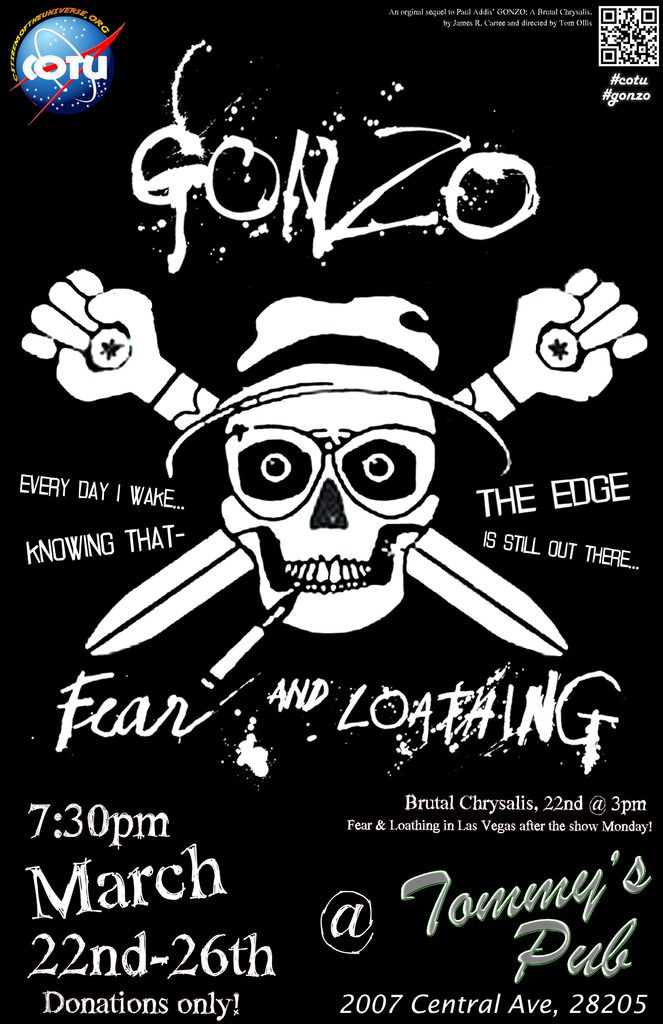
Durang v. Ives
April 2015
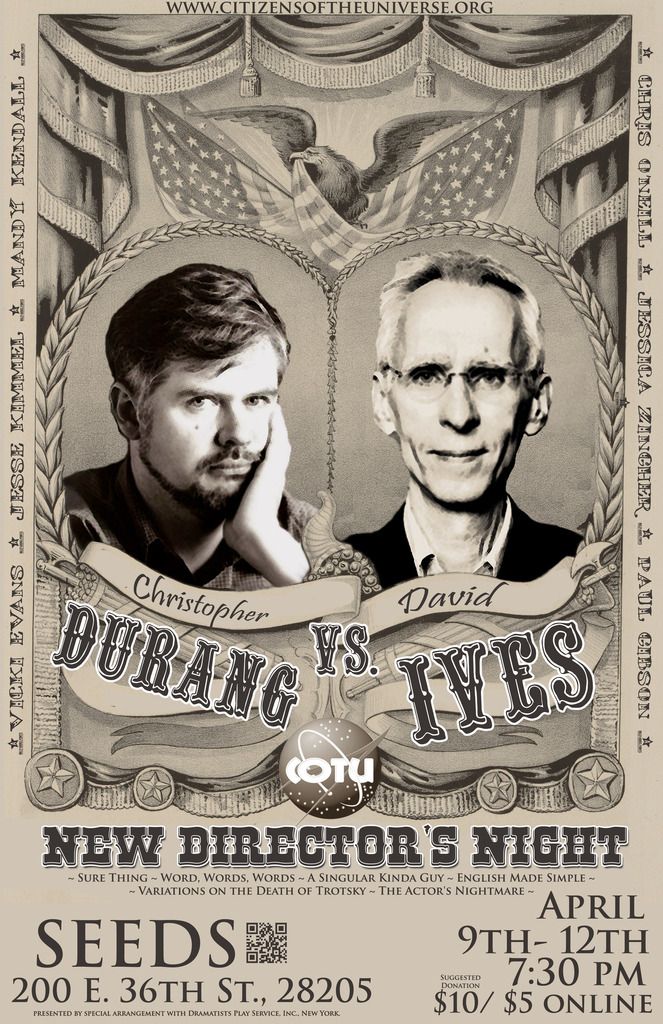
The Rocky Horror Show May 2015
Theater reviews: Pippin & The Rocky Horror Show
Charlemagne & Son Under the Big Top
By Perry TannenbaumTheater
Looking back at my review of the 2013 Broadway revival of Pippin, I'm amazed that I could have predicted that the touring version might be better. Nailed it! The Roger O. Hirson book for this early Stephen Schwartz musical has always been rather flimsy and derivative, basically the fables of Candide and The Fantasticks loosely transported to the Age of Charlemagne. But director Diane Paulus had a brilliant idea: keep the famed Bob Fosse-style choreography, substituting circus and magical spectacle for the original vaudeville style.
Trouble was, Matthew James Thomas was such a bland Pippin that he was terribly upstaged by everyone around him — Broadway power couple Terrence Mann and Charlotte d'Amboise as his royal parents, a Tony Award winning performance by Patina Miller as our emcee, another Tony winner by Andrea Martin as his grandma, and the bodacious circus performers from Les 7 doigts de la main. Yet my optimism about the touring version at Belk Theater took a gut punch when I opened my playbill and discovered that understudy Lisa Karlin would be replacing Sasha Allen in the Miller role as the Leading Player.
As it turned out, Karlin was pretty damn good, with a strong voice, jazzy Fosse movement, and a fraction of Miller's style and charisma. Further narrowing the imbalance between the emcee and Charlemagne's eternally questing son was the energy and verve that Kyle Dean Massey brought to Pippin. Suddenly our hero's songs — "Corner of the Sky," "With You," and "Morning Glow" — weren't medieval trials by ordeal.
Though Sabrina Harper isn't memorable as Charlemagne's conniving Queen Fastrada, John Rubinstein steers the emperor in a radically different direction from Mann's take on Broadway. Mann's bellicosity was funny because it was outsized and overdone (and mixed with some juggling). Rubinstein, the original Pippin on Broadway in 1972, is funny because his tyrannical barbarism emanates from such a frail and elderly frame.
With Adrienne Barbeau as the wise granny Berthe, the tour does boast some star power if your memory stretches back to her glory days on Maude, a TV sitcom that also premiered in 1972. Her acrobatic exploits didn't look as incongruous as Martin's did, though it turns out Barbeau is actually older, but I was happier with the way she led the saccharine "No Time at All" singalong.
The able acrobats sashay across the stage with quaint placards to mark Pippin's various stages in his quest for self-fulfillment — his forays into politics, warfare, creativity, and domesticity — so the vaudeville aspect of Schwartz's original vision isn't altogether discarded. Set design by Scott Pask and costumes by Dominique Lemieux turn the circus ambiance of Pippin into a dream big top. At the end, when Pippin runs out of ambitions and quests, you'll be glad to see that the dream lives on.
In their first stab at a musical, Citizens of the Universe discovered a cruel truth on opening night of The Rocky Horror Show at 100 Gardens on 36th Street. They need better equipment — and maybe better singers. At an opening night that sounded more like a tentative tech rehearsal, body mics buzzed, blared, or only worked intermittently. In his local debut as Rocky, for example, Zeke Jones was rarely heard above the pre-recorded accompaniment.
As the innocent couple that walk into a spooky household of sexually rapacious aliens, Bryan Green and Becca Whitesmith have a certain awkward charm as Brad and Janet. But previous Janets that I've heard had the ability to carry a tune. Whitesmith may be as tone-deaf as she sounded on Wednesday, or she may just have been finding it difficult to hear and sing with the canned accompaniment.
Costumes by Darcy Russell, choreography by Shannon Wightman-Girard, and makeup — plenty of it — by Mandy Kendall all bring plenty of fun to the evening. Fen Temple was a sight to behold, greeting the betrothed couple as Riff-Raff and sustaining a fine creepiness in the face of frequent sound dropouts. More fortunate in her miking was Kitty Beard, looking even more outré as the evil genius-dominatrix of the aliens, Frank 'N' Furter, who creates Rocky and sexually initiates both the lovebirds. Beard powered through the dropouts and left no doubt how striking Frank will be when technical difficulties are overcome.
As the wheelchair-bound Doctor Scott, James Cartee left nothing to chance, disdaining a microphone and bellowing the Doc's Germanic accent at fairly high decibels. There will be plenty to admire in Rose Avalon's stage direction if this Rocky ever achieves reasonable audibility. The silhouetted deflowering scenes work pretty successfully with Temple's set design, a reminder that lighting equipment isn't as temperamental as audio.
If COTU manages to solve their audio woes, perhaps they'll begin to draw more fervid, dedicated, and orthodox Rocky crowds. Little baggies are handed out as you enter, filled with the cards, newspaper, noisemakers, and oversized eyeglass frames that devotees might expect. Most of the folks at 100 Gardens on Wednesday night had little more idea what to do with these things than I did.
The Lion In Winter July 2015
The Lion in Winter approaches from the comedic angle
Christmas with the barbarians
By Perry Tannenbaum
After watching the wrangling and intriguing of King Henry II, striving to bend his competing heirs and rival queens to his will, people are unlikely to think of The Lion in Winter as anything but a drama — particularly when his chief adversary is the legendary Eleanor of Aquitaine. Energies and passions between family members, including the visiting King Philip II of France (Queen Eleanor's stepson) are as complex and fissionable as any drama written since Friedrich Schiller's Don Carlos. Yet James Cartee, who directs the production now running at Seeds on 36th Street, is reaffirming that he isn't ordinary people. The self-proclaimed Intergalactic Peacekeeper — and founder — of Citizens of the Universe sees the script as a comedy.
That's a tough sell when we reach the summit of the English king's towering rages, but Cartee does have a point. Aspects of the plotline are certainly viewable through a sitcom lens — though you'll readily distinguish the strife between Henry and Eleanor from the squabbles that enlivened The Honeymooners — and playwright James Goldman sprinkles some unmistakable zingers along the way. Of course, the absolute topper, Eleanor's "It's 1183, and we're barbarians!" winks right through the fourth wall.
While the scale and seriousness of the issues between Mr. and Mrs. Plantagenet dwarf those between the Kramdens, the chemistry is curiously similar: Henry blusters, brags and hotly rages; Eleanor coolly deflates. Further narrowing the gap is the setting. For those of you who haven't explored Seeds on 36th, it's a far cry from Henry's castle in Chinon (southeast of Paris), where the king is spending the holidays, furloughing Eleanor from prison as a Christmas gift.
Succession to Henry's kingdom is the key issue here, since he's not inclined to go the Lear route and split it in three. Eleanor wants the crown to go to her dear Richard the Lionheart, the eldest and most valorous of the sons, while Henry wants it to go to his youngest and favorite son, Prince John, a teenager who is conspicuously weak-willed and weak-minded. The middle son, Geoffrey, has signed on to be John's chancellor and advisor so long as Henry holds the upper hand. When the winds start to shift, Geoffrey will cut a deal with anyone.
Short-term, Henry holds sway. The crown will pass to whomever he chooses. But long-term, Richard figures to snatch the crown whether or not his mummy lives to see the day — unless dad subverts the natural right-makes-right calculus by putting sonny to death.
But why must any of this be decided now as the royals decorate the Yuletide tree? Well, the visiting King Philip is insisting that after a long, long time of vacillating, Henry should make up his mind about his sister Alais, betrothed at the age of 8 to be the queen of England as part of a barbarically civilized territorial swap that netted Henry the Vexin, whatever that was, to go along with the Aquitaine. Unless Henry fulfills the terms of his 15-year-old agreement with France, marrying his 23-year-old mistress or handing her off to England's future king, Philip wants his Vexin back. More than his sister.
So besides the short- and long-term considerations, lust is bumping up against politics. Outside Henry's castle in France — notwithstanding the fact that we're at Seeds on 36th — we're to imagine that King Philip has an army that could conceivably tip the balance of power toward a spurned English heir. So there are many plots and treacheries to be discussed, including a possible junket to Rome, where the Pope might deign to annul the holy matrimony between Henry and Eleanor.
Above all, these Plantagenets delight in hurting one another, so their humor is salted with malice. Late in the game, Philip proves that he also has the knack. Even Alais, so lamblike at the outset, sprouts some fangs toward the end.
As much as we need a Christmas tree on this set to make it imaginable for Henry to bring up the Pope in conversation, we desperately need Deana Pendragon's richly evocative costumes to help us believe these royals are who they say they are — and not some cruelly twisted distortion of Married With Children. The regal trappings are especially helpful in maintaining the gravitas of Tom Ollis as he dives headlong into the tirades of Henry, but you'll also find that Prince John's dopey pageboy costume gives Robert Brafford extra comical dimensions to play with.
We can admire Brafford for just appearing onstage with that ludicrous dress, let alone simpering, pouting, and flopping in it so zestfully. Cartee’s courage is subtler, casting Dean Messer as King Philip. Instead of a man attempting to combine elegance and effeteness in a callow king, we get a transgendered person merely acting more manly and allowing the golden costume to do the rest. There’s more to Messer’s performance than just that, of course, but the ease of it makes you wonder why Cartee’s crossover casting choice is so rare.
Brafford as John, Michael Anderson as Geoffrey, and Shane Brayton as Richard are probably the least brotherly trio I've seen as Henry's sons, not a bad thing as they plot and connive against one another. Watching Brafford skipping merrily around the stage when, in spite of his cowardice and brainlessness, he seems to be back on top of the heap would be less comical if Anderson's coldness and Brayton's arrogance hadn't already made Geoffrey and Richard such unsavory alternatives.
One by one, they parade into Philip's boudoir in the first of two climactic scenes, each one bent on ruthlessly cutting out the other two. Yet with all the hiding behind curtains, it does play out like farce. With the heart and humanity drained out of the siblings' conflict, it's almost impossible for Ollis to break our hearts — as Peter O'Toole did in the 1968 film adaptation of this 1966 drama — when he realizes he has lost all his boys.
All the heart in this production channels instead into the love triangle, and there is plenty of it. I found it easy to wish Alais happiness with Henry because Mandy Kendall makes her so unequivocal in her love and admiration for Henry, old as he may be, and in her detestation of the brothers. Yet she is schooled by the brothers over the course of the holidays, learning that she'll need to stand up for herself to survive their plotting, and this newfound spine ultimately makes her dearer to Henry.
The excellence of Ollis and Meredith McBride as man and wife isn't limited to their love-hate marital relationship or the vicious glee they take in wounding each other. Sharing a tempest-tossed history, they're just as convincing in their camaraderie as suffering, disappointed parents.
Ollis is bearish, loud, and — thanks to the necessity of turning off the air conditioning system during the performance — sweaty in in his kingly vulgarity, restlessly prowling his lair in search of a satisfying legacy. Yet it's McBride who is the most majestic as Eleanor, cool and witty with her rejoinders and scorching in her bitterness. Watching her is like seeing one of those imposing portraits in the National Gallery come to life, still slightly two-dimensional as she advances toward us, yet unmistakably immortal as she shoots her barbs.The Lion in Winter approaches from the comedic angle
Christmas with the barbarians
Beowulf July 2015
Beowulf fights monsters at Spirit Square
BY DON BOEKELHEIDE
The improbable voyage of “Beowulf” to Spirit Square started two months ago at Tommy’s Pub, the popular bar on Central Avenue now scheduled for demolition.
“Beowulf” now is being performed at the Spirit Square’s Duke Energy Theater.
Beginning in April, Megan Sky, the organizer, director and co-writer, started holding meetings at Tommy’s to talk about the show. A youthful bundle of red-haired energy, Sky wanted create an original theater piece based on the 1,000-year-old Anglo-Saxon epic poem.
With James Cartee of Charlotte’s improvisational theater company Citizens of the Universe, Sky recruited a “Beowulf” group. Perched on bar stools along Tommy’s beer-stained counter, the group decided to stick close to the original: The hero Beowulf faces and defeats the monster Grendel, kills Grendel’s even more ferocious mother and finally meets his doom slaying a fire-breathing dragon.
Sky stuck with Tommy’s for the auditions, using a dingy little room off the bar. Much of “Beowulf” takes place in a mead hall – more or less a Medieval version of Tommy’s – with Vikings replacing bikers and honey wine in place of Coors Light.
For rehearsals, the production moved from Tommy’s to the former Carolina Actors Studio Theater space in NoDa. With help from the cast, Sky and Cartee continued to rewrite the play.
Zannah Kimbrel, a graduate student in UNC Charlotte’s Religious Studies Department, plays Grendel.
“Grendel was read in the original as a vicious monster, but we have chosen to look at it as a representation of indigenous peoples who were destroyed or forced to assimilate at the hands of conquering forces.” Kimbrel said. “Grendel and its mother are representative of an ancient, earthly force, and can be seen as feminine, in opposition to the ‘civilized,’ masculine warriors who have come to subjugate it.”
Only days before the first performance, Sky and company finally gained access to Spirit Square.
“This is a great space, but it is tricky.” Sky said. “We are more used to performing in found spaces. To be in a ‘real’ theater with real equipment and lighting is a huge advantage, but there are all kinds of rules here.”
“Beowulf” is a timeless story with lasting influence: “The Hobbit” borrowed from Beowulf, as did “Harry Potter.”
Citizens’ and Sky’s local version is approachable, owing much to improvisational and street-theater technique.
And, in a city where developers routinely destroy unruly but creative spaces such as Tommy’s, it may be especially worthwhile, as Robin Bates suggests, to look again to the ancient story of Beowulf for lessons in balance and heroism.
Read more here: http://www.charlotteobserver.com/news/local/community/city-news/article27313672.html#storylink=cpy
Monster Mash in the Q.C.
Wolfman gets kicked off the kick line
By Perry Tannenbaum
Monsters were on the loose across the Queen City over the weekend, ravishing women in Transylvania, slaughtering warriors in Denmark and sparking panic among their peoples. Fortunately, Mel Brooks and an anonymous 11th Century poet have provided heroes to combat these scourges, making it safe for the rest of us mere mortals to venture into Halton Theater on the CPCC campus and Duke Energy Theatre at Spirit Square.
Although Mary Shelley housed the horrific experiments of Victor Frankenstein in the German Rhineland, where the storied Frankenstein Castle still stands, Brooks seems to have moved Young Frankenstein to Transylvania so that Dracula can make a cameo appearance. An additional move to 1934 enabled Brooks and Gene Wilder, who co-wrote the 1974 screenplay and snatched the title role, to slice and dice the storyline and add new characters, most notably Victor's Americanized grandson, Dr. Frederick Frankenstein, who is mightily ashamed of his family's heritage.
The musical version, which toured here in 2011, remains nearly 20 minutes longer in CPCC Summer Theatre's premiere than the film. Brooks' original score adds a cluster of loony tunes to the notable musical moments we relish on screen, namely Peter Boyle's catatonic "Puttin' on the Ritz" and Madeline Kahn's ecstatic "Ah, Sweet Mystery of Life." All the best shticks are lovingly preserved: the horses' neighing at the very mention of Frau Blucher, the mechanical Nazi constable, Igor's shifting hump and Elizabeth's post-coital Bride of Frankenstein hairdo.
Brooks proved surprisingly adept at manipulating the medium when he musicalized The Producers, his biggest Broadway hit, and he's best here when he builds upon the juiciest movie bits. Fredrick's rapture at the wonders of "The Brain" reaches glitzy proportions, the Blind Hermit's horrendous hospitality toward The Monster gets a schmaltzy vaudeville prelude, and Elizabeth's ecstasy blossoms into an extra song outburst, "Deep Love" — so good that The Monster reprises it.
"Together Again," "Roll in the Hay," "Join the Family Business" and "He Vas My Boyfriend" all spark intermittently as Igor, Inga, Victor and Frau Blucher take turns luring Fredrick into replicating Victor's mad experiments. But the two songs accorded Inspector Kemp wear out the Prussian's welcome, and Elizabeth's derivative "Please Don't Touch Me" is an outright clunker when we've hardly begun. Nor does it help that Elizabeth's frigidity, bidding her fiance Frederick adieu, is embroidered with a vast ensemble of dancing couples who never touch each other.
Under the direction of Tom Hollis, the young CP cast throws caution to the winds navigating this uneven show. As a result, this new production often surpasses the touring version, particularly when choreographer Ron Chisholm is set loose on the climactic "Puttin' on the Ritz." Of course The Monster can become a tap-dancing whiz in three easy lessons! When the ensemble reaches full intensity, Wolfman appears out of nowhere and tries to break into the kick line, but The Monster tosses him out with a growl. If that happened on the tour, it wasn't nearly as funny.
Looking strapped for cash in recent seasons, CP's scenic and technical budgets seem to be sitting pretty this year, with set designer Jennifer O'Kelly's exploits — teaming with tech director Don Ketchum — surpassing her fine work on Boeing Boeing. Steve Gamble not only comes close to completely taming Halton's notorious sound system, he starts punctuating the presentation with thunder before Hollis delivers his curtain spiel. Lighting designer Gary Spivak is also champing at the mock horror bit, shining plentiful bursts of lightning on the curtain even before it rises.
Nor are we let down when the curtain goes up. The lecture hall is passable with its glowing-brain centerpiece, but it's the spooky laboratory where O'Kelly takes fullest advantage of the Halton's height, flying The Monster high above at the galvanic moment of his creation — on a massive slab hoisted by four thick chains. And yes, Fredrick and Inga take that same breathtaking ride when they couple.
If you saw Matthew Blake Johnson and Ashtyn Hutchings as the leads in Anything Goes earlier this summer, you'll need no further urging to come see them now. Adding a pair of mildly nerdy eyeglasses as Fredrick, Johnson excels at the nerdy comedy of "The Brain." Playing opposite a worthier love object in Hutchings, he also gets better chances to click in romantic comedy. In scantier costumes and a blond-bombshell wig, Hutchings as Inga isn't the sophisticate Reno Sweeney was — the same can be about Brooks vis-a-vis Cole Porter — but she's pleasingly seductive in "Roll in the Hay" and "Listen to Your Heart."
Ashton Guthrie does the heavy comedy lifting again as the creepy, humpbacked, incompetent Igor. Jacob Estes and Kelly Kohlman, previously paired as Moonface Martin and Bonnie Le Tour, also return as The Monster and Frau Blucher. Estes makes the most of his chance to hoof it in top hat and tux while Kohlman still seems to be ruminating about how best to project Blucher's dyspepsia. Until "Deep Love," I was on the verge of liking Kylee Verhoff as Elizabeth. She comes reasonably close on that showstopper.
No such problems with Rob Addison. You have to go back to the beginning of the CP's summer season to recall Addison's excellence as Fagin in Oliver! Here he serves his time as Inspector Kemp before returning to his full glory as the Hermit. Jolson himself would likely crack up seeing Addison on his knees earnestly begging for "Someone."
Citizens of the Universe has written an entirely new stage version of Beowulf, and the manner in which it was stitched together could easily be a modern Frankenstein story in itself. Of course, there's the thousand-year-old poem in what sounds like a non-alliterated translation. Layered on are the rampaging monster's inner thoughts, the presence of a poet in King Hrothgar's devastated court, and the monster's protestations that Beowulf's victory was an accident ? telltale signs that COTU may have dipped into Grendel, John Gardner's subversive retelling of the Old English epic from the monster's point of view.
Under the formalistic direction of Megan Sky, we're frequently reminded of theatre's ceremonial roots. Becca A. Whitesmith is our warrior storyteller, doubling as Wiglaf late in Act 2. Chesley Oxendine as the Danes' Shaper chips in with more lore — and multiple toasts — while Jesse Boykin Kimmel presides over the famed Herot mead hall as King Hrothgar. For some occult reason, COTU strips Beowulf of all his boasting when he arrives to save Hrothgar and his subjects, so Jeffrey J. Whiteside's portrayal of the great Geat makes him radically strong and silent until his battle with the dragon. As Warriors in Beowulf's service, Kathy Mullican and Stephen Skarecrow Russell trumpet their master's virtues, remembering a good majority of their lines.
Sporting a blood-red forehead and a large Hebrew-lettered tattoo below her collarbone, Zannah Kimbrel as Grendel is all you would — and wouldn't — expect the hellish spawn of Cain to be. Amy L. Snyder broods restlessly onstage throughout intermission as Grendel's Mother, showing us soon afterwards why you don't want to mess with her.
An Adult Evening with Shel Silverstein
August 2015
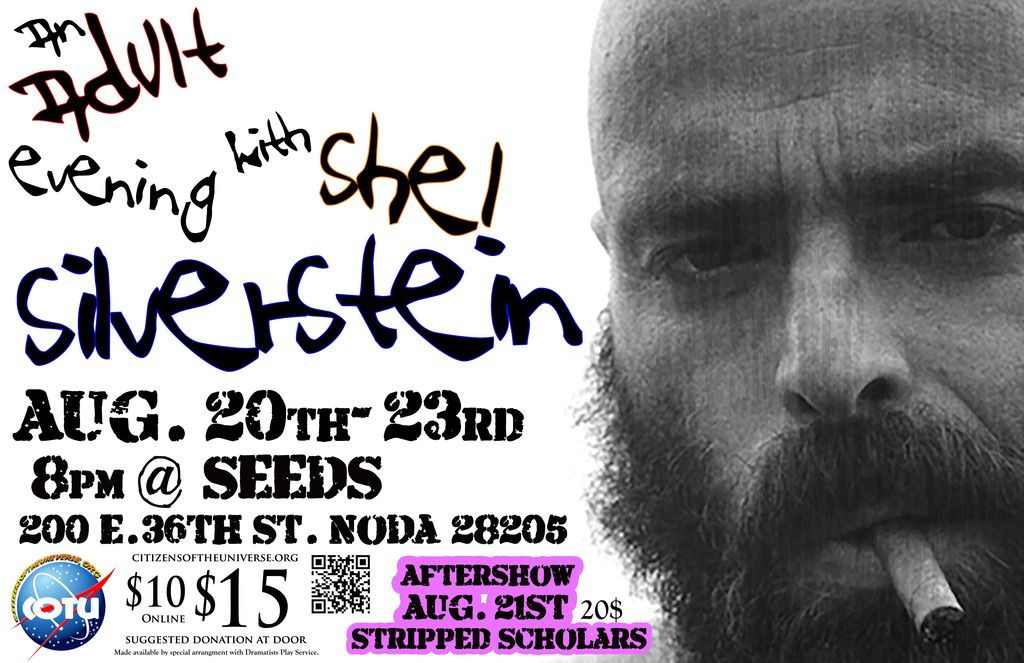
CA&T Awards II
September 2015
A Disturbance in Whitechapel: The Ripper Returns
September 2015
The Woolgatherer
November 2015
The Woolgatherer
Posted By Perry Tannenbaum on Thu, Nov 19, 2015 at 3:04 PM
Anyone who has seen William Mastrosimone’s Extremities, either onstage or at the movies, is likely to approach the playwright’s previous 1979 drama, The Woolgatherer, with a certain amount of wariness. For me, the violence that erupted in Extremities when I saw it at UNC Charlotte in 1991 was shocking – and I’m not easily shocked. The new Citizens of the Universe production of that earlier script often seems to be headed down a similar harrowing path as Rose, a painfully shy and paranoid hemophiliac who works at a dime store candy counter, entertains a grubby long-haul trucker named Cliff in her boarded-up South Philly
Obviously, there are echoes of Rocky (1976) in this coupling, with Rose’s counter work and Cliff’s corny jocularity fitting the Adrian & Balboa mold. But Rose’s fragility also seems partly inspired by Laura in The Glass Menagerie. As for the seething aggression that we see churning inside Cliff as Rose neurotically fends off his advances, it seems to be rooted in a deep underclass place, the wild soil of our industrial jungle. Cliff’s restless, predatory instinctiveness in David Pollack’s performance reminded me of the fearsome yet inwardly broken Pale in Lanford Wilson’s Burn This (1987).
Yet the drama does prove to share some crucial DNA with Extremities, for Mastrosimone also toys with the idea that the shrinking Rose is as much a predator as the well-traveled and rugged Cliff. So as the story unfolds, and the balance of power teeters, it’s advisable to forget that Pollack himself is directing this tense two-hander. Aspects of Megan Sky’s manner as Rose may strike you as overly directed or insufficiently spontaneous at first. Her arm folding, her cowed bent-over head, and her sideways movements pulling away from Cliff are the most obvious ways an actress can signal that she’s shy.
Then as the truth emerges in Act 2, you may perceive hints from Sky that rudimentary acting may be Rose’s primary weapon. Buying that will likely raise your estimate of Sky’s performance after the previously fleeced Cliff returns, knocking on Rose’s door in the middle of the night.
No set builder was required to provide this sturdy door, for COTU’s newest production is at the unleased site where Carolina Actors Studio Theatre once stood – the same 2424 N. Davidson St. address previously occupied by Charlotte Rep and NC Dance Theatre. Both of the CAST theater venues have now been liquidated, but COTU is actually using the space where Rep and NCDT had their lobbies, elevated above the floor where performances and rehearsals were previously staged, directly accessible from a doorway facing 28th Street. Folks are manning the old CAST entrance on the side of the parking lot, but we found parking less iffy last Friday out on 28th Street.
It’s a much cozier performing space than any that’s been used by the three previous tenants, raw and ramshackle in the true COTU spirit. This corner of 2424 works especially well with Mastrosimone’s raw, déclassé script. The chemistry between Pollack and Sky frequently shuttles between attraction and repulsion, veering more toward extremes when antagonisms are roused. Whether either of these commitment-averse losers could be redeemed kept me guessing until the emotional denouement.
Nosferatu: A Silent Experience
October 2015
BWW Review: COTU Gives NOSFERATU the Silent Treatment
October 30
6:24 AM
2015
Recent rumblings have reached me hinting that Citizens of the Universe may soon be taking its last lap around the track. As NOSFERATU was opening last week, it was certainly disconcerting to hear that Charlotte's most unique theatre company may soon announce a final season. Yet a possible flame-out is not out of character. Founded just over six years ago, COTU has always personified the restless energy, creativity, and eccentricity of its artistic director, James Cartee.
Hunter Thompson himself would have gasped in astonishment at Cartee's hyper-caffeinated portrait of him in his one-man paranoid fantasia, Gonzo: A Brutal Chrysalis, COTU's signature production. Cartee & Co. ranged from Beowulf to Eternal Sunshine of the Spotless Mind, from Uncle Vanya to Reservoir Dogs, and from Titus Andronicus to The Princess Bride. No less restless than the range of Cartee's interests is the range of venues he has taken his company to - surely unprecedented in Charlotte theatre history.
The fact that there are no real theaters on Central Avenue or in Plaza-Midwood has never discouraged Cartee. COTU's guerilla invasions have targeted The Graduate, Studio 1212, Snug Harbor, the defunct Story Slam, and a warehouse loading dock on Central Avenue. Cartee's explorations in NoDa have been no less pioneering, including UpStage, the Chop Shop, Seeds 100, and an epic tour of NoDa restaurants, bars, and coffee houses - in pouring rain - chasing down Jack the Ripper. The Beowulf at Duke Energy this past July was an out-of-body experience for COTU followers. We were all in seats you couldn't budge!
No, Cartee hasn't settled in there - or at any other place aside from Story Slam where he could become acclimated to the equipment. So COTU's new NoDa foray, outdoors in the loading area of Salvaged Beauty, the community's "music and art collective," is almost as technically plagued as its maiden voyage into musicals, The Rocky Horror Show, was at Seeds back in May.
But it really doesn't matter that much in NOSFERATU. You wanted to hear what Brad, Janet, and their assorted tormentors were saying and singing in Rocky Horror, but in turning to silent film for the first time, Cartee mostly gives the silent treatment to Friedrich Wilhelm Murnau's 1922 classic.
Henrik Galeen's screenplay was an unauthorized adaptation of Bram Stoker's Dracula, with all the names changed and the ending deftly condensed. Cartee's stage adaptation adds a smattering of spoken narrative, but it is not from Thomas Hutter, nee Jonathan Harker in Stoker's novel. Through strings of journal entries and letters home to his dear fiancée, Harker was the purported author of our tourguide to Transylvania.
At Salvaged Beauty, it's Professor Bulwer, the crucifix-swinging Van Helsing in Stoker's original, who occasionally creeps across our field of vision, reading snatches of an eerie narration. Among local actors, JC Kingsley is only eclipsed by Tom Scott and Brett Gentile for the sheer loudness of his voice, so my usual preference for sitting as close as possible to the action - especially for outdoor productions - could be confidently tossed by the wayside.
The more compelling reason to move away from the playing area is the wide vista of the action, which encompasses about half of Salvaged Beauty's considerable depth. While titles flow downwards from the top of a closed garage door at the side of the building, action is usually staged off one of the sides, near front one of the adjoining entrances. Even when I withdrew from the rows of seats at floor level to the platform behind, keeping track of the titles and the action was often like watching a tennis match.
At the macabre ruins of Carolina Theatre, where Cartee originally intended to present his Halloween saturnalia, the whole concept could have worked far more effectively, with titles projected above the action - or below it, if the rickety old stage has been rehabilitated. But the main problem with the titles on opening night was that they were totally out of sync with the action, falling awkwardly behind the dialogue or leaping even more awkwardly ahead. Worst of all, when the titles were allowed to languish too long, catch-up was accomplished at the expense of watching whole chunks of dialogue and connecting narrative scroll by at an impossibly blurry speed.
Mandy Kendall as Hutter's wife, Ellen, takes the brunt of this technical glitch in scene after scene fretting over Thomas's return from Count Orlok's horrid castle and reacting to his bizarre correspondence. As Thomas, Bryan Green hardly needs any supertitles to fortify the purity, idealism, and astounding naïveté of our hero. We can see him absently cutting himself with a knife at Orlok's castle and his host's ravenous response to the sight of blood. Likewise, Thomas's discovery of Orlok in his coffin, his fainting, his comatose days, and his delirium are all visually explicit.
Thanks to the make-up wizardry Kendall, Kingsley, and Cartee, Justin Mulcahy doesn't need to emote extensively to plumb the evil depths of Orlok, nee Count Dracula. Oh, but he does anyway! Joseph Tenney gets a similar pass as Knock, Orlok's man in Hutter's hometown, though there's already a craziness in his eyes worthy of the insect-eating Renfield, Stoker's most oddball creation.
The exhilaration that an unabashed surrender to silent screen hamming can bring us is probably best exemplified by the minor players, all of whom get to dig into multiple roles. Whether warning Thomas of the perils of Orlok's castle, tending to our hero in the hospital, or protecting his hometown against the onset of plague, you can count on Ervin Green, Michelle Lampley, and Mirachol Carroll to inject some levity into the ghoulish story, either as dimwits or incompetents.
Aboard the ghost ship that carries Orlok to his new HQ across the street from the Hutters, the levity comes from an excess of Halloween melodrama by the Captain and the First Mate - or it will when the titles roll properly. The interplay between the Innkeeper and his servant is already slapstick gold.
In fact, once the big tech snafus are solved, all the problems of COTU's NOSFERATU are likely to vanish, except for one: the nagging annoyance of Kingsley's pronunciation of the title. Emphasize and elongate the third syllable and you readily evoke the horror of vampires and the nocturnal fright of Transylvania. Transfer that emphasis to the second syllable, as Kingsley does over and over, and it sounds like we're dealing with some milk company in New Jersey.
http://www.broadwayworld.com/charlotte/article/BWW-Review-COTU-Gives-NOSFERATU-the-Silent-Treatment-
Seascape Feb 2016
Seascape
Posted By Perry Tannenbaum on Fri, Feb 19, 2016 at 10:54 AM
Citizens of the Universe hasn’t announced the full details of its farewell season, but it has begun handsomely at “The Shell,” COTU founder James Cartee’s name for the suite on 2424 N. Davidson St. that CAST occupied in its latter days. The theater spaces where CAST often staged two productions at the same time have both been obliterated, stripped down to the original floors and walls, but the residue proves unexpectedly appropriate as a vast, bleak setting for Edward Albee’s Seascape, directed by S. Wilson Lee.
varwwwclientsclient1web2tmpphpoon8uj.jpg
For awhile, the drama seems to revolve around Nancy and Charlie, a mid-life couple who bicker somewhat lethargically – compared with the titanic battles Albee staged between George and Martha in Who’s Afraid of Virginia Woolf? – about what they should do now and in the future. The weak grip this opening had on my attention was further weakened by Kylene T. Edson as Nancy, indistinctly audible when projecting her gripes over across the beach to her husband diagonally downstage. Lee would be advised to either energize Edson during these opening moments or bring her downstage more often.
Luckily, these difficulties evaporate when two ginormous lizards crawl ashore, frightening the humans as they scope them out. Since the sea is upstage, fright not only raises Edson’s energy level, it also drives her naturally toward us where she can be easily heard. Wariness is well-advised, but the lizards, Leslie and Sarah, aren’t foraging for food so much as they are reconnoitering the possibilities of life on land.
Amazingly, Leslie and Sarah speak English, if only the rudimentary kind you would expect from high school freshmen matriculating in Lancaster or Cabarrus County. There’s a lot for Nancy and Charlie to catch the reptiles up on, including the origin of the universe, the primordial soup, evolution, mammals, and the whole concept of emotions, beginning and ending with love. Shuttling between the urge to educate and the impulse to flee in terror, Nancy and Charlie might identify more with teachers in urban school districts.
The spark for this intriguing production comes largely from the extraordinary work Lee elicits from Emmanuel Barbe as Leslie, abetted by the phosphorescent glow of Kenya Davis’s makeup design. I’ve often struggled to penetrate through Barbee’s French accent when he battled against the Bard’s blank verse in Shakespeare Carolina productions. But here he is admirably slowed down by Lee – and often formidably booming. The physicality of him can be menacing enough as he advances toward you, but you really don’t want to broach the possibility that his species might lose their mighty tails during the next billion or so years of evolution. He’s attached to that tail.
By comparison, Brianna Merkel is a cute counterpart for Barbe as Sarah, as adorably clueless when she doesn’t understand concepts – matrimony, pregnancy, the list goes on – as Leslie is frustrated and antagonistic. We see a certain bond forming between Sarah and Nancy, peacemakers trying to calm their mates’ warrior instincts, and it’s here that Edson’s performance begins to blossom.
Brian Amidai is more consistently reliable as Charlie, very adept at the inertia of a husband who doesn’t wish to travel or repeat past adventures. He’s on a beach and just wants to relax, dammit, maybe get lost in a book. But Amidai’s transition between this beach potato and an instinctual protector rings viscerally true, and there’s a faint layer of comedy in the moments when he thinks he’s gone insane or died. Obliquely, I found him cuing my own reactions as this wild, mysterious fantasy unfolded.
GONZO: A Brutal Chrysalis
March 2016
O'Brother 2016
Theater review: COTU's O Brother
Posted By Perry Tannenbaum on Mon, Aug 1, 2016 at 2:01 PM
In Greek legend, Odysseus was a man of many ways who sacked the sacred citadels of Troy, traveled widely, struggled valiantly, and suffered greatly. But even if this Homeric catalogue of achievements pales in comparison to the praise lavished upon presidential candidates at our quadrennial conventions, there’s something about the guy that continues to spark admiration – despite the fact that he was once captured and imprisoned.
Latterday tributes from Lord Tennyson and James Joyce to Ulysses (O’s Roman name) gradually humanized the Ithacan warlord and brought him down to life-size. Ethan and Joel Coen decided that wasn’t quite enough indignity to heap upon the mythic hero. The Coen Brothers’ O Brother, Where Art Thou not only presented Ulysses Everett McGill as an escaped jailbird, they made him a Mississippi hayseed. If any role George Clooney plays can be considered a hayseed.
On a ridiculously limited budget, Citizens of the Universe bring Odysseus down the social ladder a few more rungs with O Brother, for the costumes and backdrops by Mandy Kendall aren’t Hollywood. On the other hand, the newly unveiled performance space at NoDa Brewing Company – on North Tryon Street – can’t be accused of being Mississippi.
Trailblazing yet another new venue, COTU embraces an outdoor ambiance that is more picnic theatre than dinner theatre. Beer flows from the interior of the spacious new NoDa tavern, and grub is rustled up from a food truck you can’t miss on your way in from the parking lot. There’s a bluegrass trio at the side of the modest playing area: the Hashbrown Belly Boys, who start up before the odyssey begins. Very relaxed and homespun.
Energy amps up as soon as director Courtney Varnum, perky and pigtailed, steps forward to introduce the show. O Brother is only loosely based on Homer’s epic – and loose only faintly describes its trashy, Southern-fried, slapstick style. These are not realms usually explored by James Cartee and his COTU, but Varnum has been able to round up more than a couple of the usual suspects from past COTU navigations.
Tom Ollis is the one Citizen you would expect to fit in well in this new rusticated universe, playing “Pappy” O’Daniel, the gregariously corrupt Mississippi governor seeking re-election while hosting a Grand Ole Opry-style radio show on the side. Sort of a cross between Tennessee Williams’ Big Daddy, Huey Long, and Yosemite Sam the way Ollis plays him – mythologically, he’s Menelaus in the scheme of things.
Most surprising is Shane Brayton as our hero Ulysses, after playing opposite Ollis as an arrogant Richard the lion-hearted in The Lion in Winter. Down in the Delta, Brayton taps into hillbilly pluck, energy, optimism, and rascality in a way that I’d likely find irresistible if part of the audience weren’t partying and oblivious. Of course, persisting in the face of such loud inattention adds to the pluck factor, but I found the entire cast up to that challenge.
We need to listen all the more attentively because some of the actors’ names are flip-flopped with the names of the folk they play in the playbill. The most obvious of these is “Sheriff Cooley as Stephen West-Rogers.” While he isn’t quite as megalomaniacal as he was in Fight Club or as violently vehement as he was in Trainspotting, West-Rogers is more than sufficiently implacable and clueless as the Sheriff.
Make no mistake, all of these principals are surrounded by sidekicks or underlings that make them look like sages. “Pappy” has Michael Haynes as Junior O’Daniel and Jeremy Bryant as Pap’s political opponent, Homer Stokes, who turns out to have clout in the KKK. Sheriff Cooley has Justin Mulcahy as his standard-issue deputy, and Ulysses is saddled with Michael Anderson as Delmar O’Donnell and Josh Elicker as Pete Hogwallop – Varnum and Charlie Napier extend the deep-down hayseediness of the Hogwallop family.
Not counting the vocal trio of Ulysses’ daughters that doubles as the Sirens, three of the actors zip through multiple roles. Napier stands out as the aforementioned Wash Hogwallop, as a Blind Seer modeled on Teiresias, and as a marauding gangster with a chip on his shoulder, George Nelson, because he’s not the more infamous Babyface. All the great menaces of The Odyssey don’t appear in this hashbrown mashup, but we do get Scotland Gallo as “Big Dan” Teague, certainly Polyphemus with his eyepatch, and Kendall as Penny, Ulysses’ wife.
All of Penelope’s famed suitors coalesce into one Vernon T. Waldrip (Napier again) and, with this Ulysses, Kendall’s infidelity doesn’t play as sluttiness so much as cold pragmatism. A ne’er-do-well jailbird – as opposed to an MIA hero – should cause a sensible wife to make new plans, even in the backwoods. Calypso’s shtick in the journey gets merged into the three singing Sirens – Becca Whitesmith, MoMo Hughes, and Laura M Lee.
As you’ve no doubt divined, Odysseus’ sea voyage and his epic struggle to return home after the Trojan War have been downsized to a comical chase triggered by Ulysses’ jailbreak. Toss in the bluegrass music and it shouldn’t be surprising if O Brother sometimes reminds you of Smokey and the Bandit – without the same Hollywood charisma from the lead rascal. Igniting the chase, Ulysses cons Delmar and Pete into joining him in the escape by enlisting them in a quest for a treasure that he has hidden at the bottom of a valley soon to be flooded to create a dam. Echoes of Deliverance, another bluegrass bromance.
Only here, the music is more deeply woven into the storyline. For along the way, the three escaped white men hook up with Tommy Johnson, a black musician who claims to have gotten his phenomenal skills in a deal with the devil, a la Robert Johnson. On one of their stops before they break up, the quartet cuts a record as the Soggy Bottom Boys. It’s at these key musical moments – and subsequently at his KKK lynching – that we encounter yet one more familiar COTU personality, James Lee Walker II, best remembered for his one-man presentation of Karl Marx.
Walker is a bit humbler this time around. Everybody is. Sifting through the distractions, I’d say that Koly McBride’s O Brother tribute/arrangement of the Coen Brothers’ film is among the very best adaptations COTU has ever done. If the ratio of audience to partyers can be boosted significantly this weekend, the experience will be even better.Theater review: COTU's O Brother
Posted By Perry Tannenbaum on Mon, Aug 1, 2016 at 2:01 PM
In Greek legend, Odysseus was a man of many ways who sacked the sacred citadels of Troy, traveled widely, struggled valiantly, and suffered greatly. But even if this Homeric catalogue of achievements pales in comparison to the praise lavished upon presidential candidates at our quadrennial conventions, there’s something about the guy that continues to spark admiration – despite the fact that he was once captured and imprisoned.
Latterday tributes from Lord Tennyson and James Joyce to Ulysses (O’s Roman name) gradually humanized the Ithacan warlord and brought him down to life-size. Ethan and Joel Coen decided that wasn’t quite enough indignity to heap upon the mythic hero. The Coen Brothers’ O Brother, Where Art Thou not only presented Ulysses Everett McGill as an escaped jailbird, they made him a Mississippi hayseed. If any role George Clooney plays can be considered a hayseed.
On a ridiculously limited budget, Citizens of the Universe bring Odysseus down the social ladder a few more rungs with O Brother, for the costumes and backdrops by Mandy Kendall aren’t Hollywood. On the other hand, the newly unveiled performance space at NoDa Brewing Company – on North Tryon Street – can’t be accused of being Mississippi.
Trailblazing yet another new venue, COTU embraces an outdoor ambiance that is more picnic theatre than dinner theatre. Beer flows from the interior of the spacious new NoDa tavern, and grub is rustled up from a food truck you can’t miss on your way in from the parking lot. There’s a bluegrass trio at the side of the modest playing area: the Hashbrown Belly Boys, who start up before the odyssey begins. Very relaxed and homespun.
Energy amps up as soon as director Courtney Varnum, perky and pigtailed, steps forward to introduce the show. O Brother is only loosely based on Homer’s epic – and loose only faintly describes its trashy, Southern-fried, slapstick style. These are not realms usually explored by James Cartee and his COTU, but Varnum has been able to round up more than a couple of the usual suspects from past COTU navigations.
Tom Ollis is the one Citizen you would expect to fit in well in this new rusticated universe, playing “Pappy” O’Daniel, the gregariously corrupt Mississippi governor seeking re-election while hosting a Grand Ole Opry-style radio show on the side. Sort of a cross between Tennessee Williams’ Big Daddy, Huey Long, and Yosemite Sam the way Ollis plays him – mythologically, he’s Menelaus in the scheme of things.
Most surprising is Shane Brayton as our hero Ulysses, after playing opposite Ollis as an arrogant Richard the lion-hearted in The Lion in Winter. Down in the Delta, Brayton taps into hillbilly pluck, energy, optimism, and rascality in a way that I’d likely find irresistible if part of the audience weren’t partying and oblivious. Of course, persisting in the face of such loud inattention adds to the pluck factor, but I found the entire cast up to that challenge.
We need to listen all the more attentively because some of the actors’ names are flip-flopped with the names of the folk they play in the playbill. The most obvious of these is “Sheriff Cooley as Stephen West-Rogers.” While he isn’t quite as megalomaniacal as he was in Fight Club or as violently vehement as he was in Trainspotting, West-Rogers is more than sufficiently implacable and clueless as the Sheriff.
Make no mistake, all of these principals are surrounded by sidekicks or underlings that make them look like sages. “Pappy” has Michael Haynes as Junior O’Daniel and Jeremy Bryant as Pap’s political opponent, Homer Stokes, who turns out to have clout in the KKK. Sheriff Cooley has Justin Mulcahy as his standard-issue deputy, and Ulysses is saddled with Michael Anderson as Delmar O’Donnell and Josh Elicker as Pete Hogwallop – Varnum and Charlie Napier extend the deep-down hayseediness of the Hogwallop family.
Not counting the vocal trio of Ulysses’ daughters that doubles as the Sirens, three of the actors zip through multiple roles. Napier stands out as the aforementioned Wash Hogwallop, as a Blind Seer modeled on Teiresias, and as a marauding gangster with a chip on his shoulder, George Nelson, because he’s not the more infamous Babyface. All the great menaces of The Odyssey don’t appear in this hashbrown mashup, but we do get Scotland Gallo as “Big Dan” Teague, certainly Polyphemus with his eyepatch, and Kendall as Penny, Ulysses’ wife.
All of Penelope’s famed suitors coalesce into one Vernon T. Waldrip (Napier again) and, with this Ulysses, Kendall’s infidelity doesn’t play as sluttiness so much as cold pragmatism. A ne’er-do-well jailbird – as opposed to an MIA hero – should cause a sensible wife to make new plans, even in the backwoods. Calypso’s shtick in the journey gets merged into the three singing Sirens – Becca Whitesmith, MoMo Hughes, and Laura M Lee.
As you’ve no doubt divined, Odysseus’ sea voyage and his epic struggle to return home after the Trojan War have been downsized to a comical chase triggered by Ulysses’ jailbreak. Toss in the bluegrass music and it shouldn’t be surprising if O Brother sometimes reminds you of Smokey and the Bandit – without the same Hollywood charisma from the lead rascal. Igniting the chase, Ulysses cons Delmar and Pete into joining him in the escape by enlisting them in a quest for a treasure that he has hidden at the bottom of a valley soon to be flooded to create a dam. Echoes of Deliverance, another bluegrass bromance.
Only here, the music is more deeply woven into the storyline. For along the way, the three escaped white men hook up with Tommy Johnson, a black musician who claims to have gotten his phenomenal skills in a deal with the devil, a la Robert Johnson. On one of their stops before they break up, the quartet cuts a record as the Soggy Bottom Boys. It’s at these key musical moments – and subsequently at his KKK lynching – that we encounter yet one more familiar COTU personality, James Lee Walker II, best remembered for his one-man presentation of Karl Marx.
Walker is a bit humbler this time around. Everybody is. Sifting through the distractions, I’d say that Koly McBride’s O Brother tribute/arrangement of the Coen Brothers’ film is among the very best adaptations COTU has ever done. If the ratio of audience to partyers can be boosted significantly this weekend, the experience will be even better.
HITCHHIKER'S GUIDE TO THE GALAXY
2017

BWW Review: COTU Hits the Road With a Mind-Boggling HITCHHIKER'S GUIDE
by Perry Tannenbaum Feb. 3, 2017
Can this really be the end? Citizens of the Universe and its indefatigable intergalactic peacekeeper, James Cartee, are leaving Charlotte, heading for Texas, and only possibly leaving an appendage behind them to carry on their mission. Closing with THE HITCHHIKER'S GUIDE TO THE GALAXY at the Unknown Brewing Company, their most lavish production since they adapted The Princess Bride at the now-defunct Breakfast Club in 2011, COTU is going out with a big bang.
Two parallel events trigger the sci-fi comedy as we meet the shambling, stiff-necked Arthur Dent, who never sheds his PJs and bathrobe throughout his mind-boggling travels. On the earthly plane, Arthur is battling to keep his Cottington home from demolition by the county to provide a pulverized right-of-way for a new thruway. He's ready to lay down his life for his property, and he's actually lying down in front of his Cottington cottage so that the county bulldozer can't move further.
Meanwhile, on a more galactic plane, Vogon overlords who are constructing a hyperspace bypass have slated Earth for demolition. Why a perpetually moving planet in a perpetually expanding universe would be slated for demolition is beside the point, do you hear me?
By the most improbable coincidence, Arthur is singled out for rescue by Ford Prefect, an embedded alien who contributes to the Hitchhiker's Guide as a roving travel writer. Yes, when Douglas Adams first conceived his sci-fi serial for BBC Radio in 1978, ebooks were already on his imaginary assembly line. Arthur frequently consults his pocket reader after hitchhiking aboard a new space cruise or during his downtime, but it is Mandy Kendall who brings The Book to life between stints as our narrator.
She's also, as our costume designer, the person who makes COTU's valedictory so outré sensational. Arthur May be a humdrum everyman, with Chris Freeman faithfully executing his shambling duties, but Tom Ollis and Billy Whalen, tethered together as two-headed galaxy prez Zaphod Beeblebrox, take us back past the disco '70s to the hippy '60s with their outfit. Loud colors, a florid headband, with brash tie-dyes clashing unapologetically against paisleys.
Of course, Beeblebrox doesn't exhaust the weird phenomena Kendall must costume on Arthur's odyssey. Other cameos range from Ravenous Bugbladder Beast of Traal (Greg Irwin), Marvin the morose robot (David G. Holland), Deep Thought the computer (Martin Barry), a Whale (Kevin Sario) swimming with a Bowl of Petunias, and the two life forms on our planet that are smarter than we are, mice and dolphins.
Freeman maintains a British diffidence that occasionally flares into puzzlement amid his haywire journeying, but Nathan Morris as Ford is the optimistic huckster forever urging Arthur onwards, almost oozing insincerity when the going gets tough. Like the brainy Trillian and the gregarious Book, Ford is occasionally incomprehensible when he uses jargon that is outside the ken of the BBC and the OED.
Both Ford and Kendall occasionally stumbled on their lines Saturday night when they wandered through this alien corn, less like the terminology of a botany catalogue than the brainchildren of Lewis Carroll. By comparison, Elisha Bryant skates through these lingual brambles effortlessly as the other earthling in our story, not merely assimilating into the galactic hierarchy after being kidnapped by Beeblebrox, but becoming his/its/their right-hand organism.
If you saw Bryant's work recently in two of the plays at Children's Theatre's WonderFest, including the title role in The Commedia Snow White, her excellence at the Unknown Brewing Company will come as no surprise. Every time Bryant appears, it's in a different costume. Trillian is adequate reason for Arthur to keep on traipsing across the galaxy.
Aside from their helter-skelter production style or their intriguing choices of classics and film adaptations, COTU is best known for pioneering new venues, going where no other theatre company has presented before. Surrounding the players with a wall of wooden casks and an armada of tall stainless steel brewing tanks, the Unknown was surprisingly apt for a sci-fi comedy.
Yes, the sound seal between the brewing room and the bustling taproom wasn't perfect as the evening ripened, and the makeshift seating wasn't cushy enough to prevent the onset of butt burnout at the end of the show. But you can settle into the general seating with your brewski in hand, and there was a convenient food truck parked outside last Saturday night on the corner of S. Mint and Lincoln Streets. I can vouch for the blackened salmon sandwich that I took into the theater, but once the lights went down, I couldn't accurately describe all its green and crunchy contents.
Getting the answer to the meaning of life from Deep Thought is a profound reason for going, so I won't be a spoiler. But the anthem near the close of Act 2 is such an emblematic goodbye that I can't resist. After sitting behind the control board for most of the night, cuing projections that I suspect he devised and overseeing the excellent sound, Cartee strode forward to the stage and joined the action - as a dolphin. Somehow in time-honored comic book style, Adams had brought us back to Earth just before the wily dolphins threw off their domesticated disguises and fled the planet.
"So long," they sang in a joyous, rudimentary production number, "and thanks for all the fish!" Goodbye to you, too, COTU. Thanks for sticking with it so long through so many challenges and hardships.
Here's
some more COTU mentions!
__________________
Not
a COTU review, but I thought to add it.
Future
unclear for Story Slam
By Perry Tannenbaum
The
scene at 1401 Central Ave. lacks its usual bustle. Charlotte's prince of gels,
Eric Winkenwerder, has hauled away all the lighting equipment from the Story Slam
Arts Center. Jimmy Cartee, the gonzo leader of the guerilla Citizens of the
Universe theater company, has been carting off the stage, the set for an
upcoming production, and sundry Slam viscera in his trusty pickup truck and
distributing them to various holding sites around town. "Yeah, it looks so sad here now," says Bob Nulf, the stalwart
spokesman for Slam's administrative team. "What we've seen as the new
theater district in Charlotte seems to have a cold, and I hope it's not the
plague." When Slam couldn't meet its monthly rent — $3,000 for its lobby, makeshift
theater, and suite of offices in Plaza Midwood — property owners John Rudolph
and Herman Moore gave the occupants 30 days to vacate. There are no hard
feelings on either side (Rudolph and Moore are, in fact, fans of the
enterprise) and plenty of pride in the variety of artistic activities that have
slammed into the 1401 storefront: theater, music, readings, rehearsals, and the
inimitable Dr. Sketchy, a wild gumbo of art studio and burlesque. The place has been humming for 15 straight months, every week and every
weekend. In theater alone, the output has included Cartee's COTU (ranging from
Uncle Vanya to Trainspotting), workshops by the esteemed Machine Theatre, and
the astonishing PlayPlay for toddlers, which leapt from Central Avenue to
Spirit Square with a jubilant Wee last month. Slam's shutdown occurs six weeks
before COTU's A Quiet Evening With Sid and Nancy is scheduled to open for
Valentine's Day.
Nulf still hopes that will happen. In fact, he and Mark Woods — founder of NC
Shakespeare, former producing director at Charlotte Rep, and Slam's
founder/acknowledged Vision Keeper — are vowing that Story Slam has more life
in it. If not at 1401 Central, then somewhere else.
"From my perspective," Woods insists, "we only have one choice,
and that is to continue. I've said from the very beginning, in front of every
audience I've been in front of, 'We don't know what we're doing.' Six months
into the process, it became pretty clear to us what we're supposed to do."
He brought a cartload of playscripts and movie scripts from his New River
Dramatists project up in Healing Springs to the table and invited the Charlotte
arts community to make Story Slam their front porch. The results have been amazing
— even to Woods, who labels Slam one of the most extraordinary wake-up calls of
his life. "It never occurred to me that there were so many people out there with so
many great ideas and so much passion for their ideas," Woods marvels.
"I didn't know! The kind of people we've had the joy and the thrill to
participate with on this journey, put them in a room together, shake it all up
with PlayPlay — I'm telling you, man, it rains gold. It's a beautiful thing,
and that's what we should be doing."
So Woods and Nulf, who came here back in the late '80s to be development
director at Spirit Square and helped raise $1.3 million for its renovation, are
rolling up their sleeves. Bringing together bankers, real estate people,
architects, arts patrons and developers who can have the conversation that can
put Slam on a solid footing. Top priority for Woods and Nulf, at 1401 or at a new site, is more space. In
its current 2,000-square-foot configuration, fire marshals will only allow 49
people — including the performers. That cannot generate sufficient income to
pay the rent, the actors and the gas company. Blueprints have been drawn that
bring down the walls at 1401 and increase seating to the 200-225 range. But
again, there are other Plaza Midwood commercial sites that may be riper plums —
or yield a riper deal.
"There are plenty of people out there," Woods affirms,
"including John and Herman, who, under the right circumstances, might be
able to make the big dream come true."
Was a time, way back when the Charlotte Repertory Theatre
company was developing into a regional powerhouse, when summertime was the
prime season in the Queen City. While Opera Carolina and N.C. Dance are
done for the season — and Charlotte Symphony brings us orchestral lawn
feed through the July 4 weekend — local and touring theater productions
have the performing arts scene pretty much to themselves.
The mainstay of the season, CPCC Summer Theatre, celebrates it 40th
season this year, and Blumenthal Performing Arts has also seen how green
the pastures are for summer shows, bringing us three biggies in its
Broadway Lights series between now and Labor Day. Smaller operations
have colonized the void, including the Charlotte Shakespeare Festival
and Citizens of the Universe.
And you may notice that Actor's Theatre of Charlotte and Carolina
Actors Studio Theatre, celebrating 25 and 21 years respectively on the
boards, have both inched backwards into August for a running start into
their 2013-14 seasons. Adding up all the players, the celebrations, the
festivals and the Broadway blockbusters, we have the best damn summer
theater season the Q.C. has ever seen.
War Horse // Broadway Lights Series at Belk Theater — A
young English lad follows his beloved Joey, the best horse anywhere,
across the continent into the heart of World War I. You thought the
Spielberg film was good? The Broadway version took five Tony Awards,
including Best Play, featuring absolutely stunning puppetry and staging.
Some pretty good music, too. (May 28)
Miles & Coltrane: Blue (.) // Concrete Generation
at Duke Energy Theater — Charlotte's most travelled homegrown production
gets a welcome revival before hitting the road again. Two of the
greatest post-bop players, jazz trumpeter Miles Davis and saxophonist
John Coltrane, are jointly profiled during the days when they fronted
Miles' legendary quintet. Sultan Omar El-Amin and Quentin Talley started
off astonishing in the title roles five years back, and they've only
gotten better. (May 29)
Sonnets // Citizens of the Universe at UpStage — "Shall
I compare thee to a summer's day?" We don't know how COTU plans to do
it, thematically or in strict order by the book, but they're bringing
the Bard's sonnets to the funky upstairs dive that was once Wine Up.
Whenever fringe-to-the-bone James Cartee is involved, you can expect it
to be wild. (May 29)
The Taming of the Shrew // Charlotte Shakespeare at The
Green Uptown — With a heigh-ho, the wind and perhaps a modicum of rain,
Charlotte Shakespeare Festival ventures into the outdoors for their
eighth straight year, staging a lusty old comedy that may — or may not —
get some attitude adjustment for these more gender-enlightened times.
Either way with Kate and Petruchio, prepare for a bumpy ride. (May 30)
The Divine Sister // Actor's Theatre of Charlotte — Charles Busch, of Psycho Beach Party and Vampire Lesbians of Sodom fame, takes on the holy sisters of stage and screen. The mash-up of Agnes of God and The Sound of Music
would be almost as hilarious without the cross-dressing Mother
Superior, but Busch crafts a satisfying, intricate plot to complement
the lampooning. (June 5)
Charlotte Squawks: Ninesense // Booth Playhouse — The usual suspects are stood up before the Squawks
sharpshooters for mockery and satire, presumably our lame professional
sports teams, our rancid politics, our pretensions to world class
status, and the apotheosis of our former mayor. Will Mike Collins &
Co. accept the blame for McCrory's gubernatorial triumph? After all, the
videos Mr. Mayor did for past Squawks polished his telegenic
game for the election. Or maybe he's filmed another winner for this
year's revels, offering his thanks. (June 7)
Catch Me If You Can // Broadway Lights Series at Belk
Theater — The true-life saga of con artist Frank Abagnale, turned into a
boffo Spielberg/DiCaprio yarn for the silver screen, had a further
change of garb in 2011 when it came to Broadway as a musical. Sports a
book by Terrence McNally (The Full Monty), music by Marc Shaiman (Hairspray), and won a Tony for Norbert Leo Butz. Way to go, Javert! (June 7)
Dolly Parton's 9 to 5: The Musical // CPCC Summer
Theatre — What's the recipe for a feminist flick that's sexist at the
same time? Try casting a woman with maracas like the Queen of
Dollywood's as one of a triumvirate of disgruntled female office workers
leading a rebellion against a domineering, leering boss — and keep it
light with a side order of rockabilly. CP has a surefire PC crowd
pleaser to launch its 40th. (June 7)
Least Likely Friends // Donna Scott Productions & Civilized Films at Theatre Charlotte — With the writer/producer of Carrie Ann's Kiss,
Tonya Bludsworth, supplying the script and direction, and Donna Scott,
the evil adversary of that 2006 comedy, back in the cast and
co-producing, repeat success is strongly predicted. Four college roomies
are brought back together for the funeral of the one indispensable
woman who was the glue holding the disparate group intact. Say hello,
terrible long-suppressed secret, and maybe goodbye to the group. (June
12)
The Color Purple // Northwest School of the Arts at
Ovens Auditorium — The astonishing NWSA production of the beloved
musical, based on the Alice Walker novel and the Whoopi-Oprah-Spielberg
film, wasn't merely lauded on these pages when it blazed into Halton
Theater last September. It was one of just 10 high school productions
invited to participate in the prestigious International Thespian
Festival at the University of Nebraska-Lincoln, June 24-29. They move
into cavernous Ovens to do one last encore before they go. Talk about a
happy ending. (June 16)
Assassins // Carolina Actors Studio Theatre — Stephen
Sondheim assembled the unholiest chorus line ever to haunt the American
stage in this 1990 musical that delved into the dark side of the
American dream. Between the queasy opening and closing choruses, we
encounter a cavalcade of men and women who assassinated — or tried to
assassinate — Presidents of the United States. Of course they sing! How
could you ask for a more fun evening? (June 20)
The Pajama Game // Davidson Community Players at
Davidson College — It's a great week for unjustly neglected '50s
musicals, starting with this 1955 Tony Award winner about Babe Williams,
a labor activist who agitates for an hourly 7-1/2 cent raise at a
Midwestern pajama factory. Last seen in Matthews in 1994, backed only by
a pianist and a percussionist, the bodacious songlist — including "Hey
There," "There Once Was a Man," "Steam Heat" and "Hernando's Hideaway" —
hadn't lost its wallop then. Should still be there now, with more
robust instrumentation. (June 20)
Damn Yankees // CPCC Summer Theatre — A year passes in a
day as we get the 1956 Tony Award winner at Halton Theater in CP's
professional production. Not only are we getting Best Musical from
successive years, we're getting Best Choreography award winners by Bob
Fosse on successive nights. Of course, in the mid-'50s, it seemed like
divine intervention was necessary for anyone but the New York Yankees to
win the American League pennant and the World Series. Joe Hardy is
getting that help from the netherworld, while a devastating seductress,
singing "Whatever Lola Wants," keeps him on his Faustian path. (June 21)
Titus Andronicus // Citizens of the Universe at Snug
Harbor — Dating back to 1977, the year of its founding, the famously
unadventurous North Carolina Shakespeare Festival has never done Titus Andronicus.
Nor did Shakespeare, if you listen to some ardent Bardolaters — it's
that gory and melodramatic. All the more reason for the COTU guerrillas
to pick up the gauntlet (and perhaps a meat cleaver) and tackle this
apocryphal tale of the waning days of the Roman Empire. Considering how
the shit flew in COTU's version of Trainspotting, you may not wish to sit too close. (July 2)
Leading Ladies // Davidson Community Players at
Davidson College — More earnestly anti-Shakespearean fare comes from Ken
Ludwig, who has cranked out the Charlotte smashes Lend Me a Tenor, Moon Over Buffalo and Shakespeare in Hollywood.
This little farce features two struggling Shakespearean actors who go
off a-gold-digging for an unclaimed inheritance only to discover that
the heirs, Max and Steve, are actually heiresses, Maxine and Stephanie.
Plenty of drag, deception and infatuation ensue. (July 18)
Monty Python's Spamalot // CPCC Summer Theatre — You almost had to have Eric Idle aboard to sustain the full silliness of Monty Python and the Holy Grail in the film's musical adaptation. Truth is, the musical is better, jettisoning the less successful bits of the Arthurian lampoon and adding new
objects to satirize — Broadway musicals and Vegas. Featuring a bumbling
King Arthur, a gospelized Lady of the Lake and her inevitable Laker
Girls, this is a great way to conclude CP's 40th. (July 19)
Narrow Daylight // Actor's Theatre of Charlotte — Sevan
Kaloustian Greene's script was the audience and critics' choice in the
inaugural nuVoices Festival last year, winning a fully staged production
on the strength of the impact the drama had in two staged readings.
It's a story about a survivor of the Iraqi War from a provocatively
different viewpoint. Lena is the Iraqi wife of an American G.I. who was
killed in battle, arriving on the doorstep of his Florida mom's home,
carrying this stranger's grandchild in her womb. Lena was a Christian in
the draft we saw last year, defusing some of the cultural friction, but
it's still hot stuff. (July 24)
The Lion King // Broadway Lights Series at Belk Theater
— R-r-r-roar! This Disney extravaganza, now in its 16th year on
Broadway, is still the king of hand puppet spectacles, simmering in an
African beat and stamped with the nobility of a plot very much akin to Hamlet.
A few skeptics and detractors have arisen over the years, promulgating
reasons why this coming-of-age story about Simba and his power struggle
with his uncle Scar isn't worthy of its adulation. The simple
enchantment of every child who sees this show is all the refutation you
need. (Aug. 6)
2nd Annual nuVoices Festival // Actor's Theatre of Charlotte —
A new Final Four has already been selected for the second go-round of
staged readings and tightly structured audience feedback over the course
of four exciting days. The festival was an admirably organized event in
its maiden year, generating fevered excitement from audience and actors
alike, with at least two scripts worthy of full productions. Fights may
break out if it gets any more competitive. (Aug. 8)
Macbeth // Charlotte Shakespeare at the Booth Playhouse — No, this is not
"a tale told by an idiot," not by a long shot. It's Shakespeare's most
compact tragedy, a grimly cautionary tale about the ravages of ambition,
ghosts and witchery running amok, and a fiendishly futile struggle
against implacable fate. Auguring equally well, this is the Charlotte
Shakespeare event that takes us indoors, where the wind can't uproot the
scenery or wreak havoc with microphones. Production level is uncanny
for the suggested-donation price. (Aug. 15)
Vanities // Stephen Seay Productions at UpStage — Now
for something different from the house of Seay, which has alternated
between demented satires such as Beyond Therapy and kooky Reduced Shakespeare knockoffs like All the Great Books (abridged).
Three high school cheerleaders — and their vanity tables — are at the
core of Jack Heifner's comical drama, and we follow these alpha females
into their college sorority and then into their diverging careers, with a
telling peep-in or two from history along the way. (Aug. 16)
Elemeno Pea // Carolina Actors Studio Theatre — Two
sisters meet for a leisurely Labor Day weekend up in the Vineyard
(Martha's, naturally). The younger Simone has caught the fast track to
success, and the use of her boss's seaside cottage is one of her perks,
while Devon has crash-landed back at mom's place in Buffalo, holding
down a post at the prestigious Olive Garden. CAST is promising us plenty
of mirth, with lessons on wealth, relationships and why not to wear
white after Labor Day. (Aug. 29)
Alternative arts take the stage in NoDa
New audiences, new theater companies are flocking to see adventurous works in unlikely places
by Perry Tannenbaum
arts_mag.jpg
Justin Driscoll
All you need to know about the crazy world of fringe theater played out four summers ago in a Central Avenue parking lot, within a stone's throw of the railroad tracks, in the middle of a rainstorm. James Cartee, founder of Citizens of the Universe, was presenting the company's new stage adaptation of Fight Club, the Brad Pitt-Meat Loaf cult classic, when disaster struck. The downpour knocked out the lights.
Cartee and his company didn't give up. They started Act 2 by replacing the blown kleig lights with headlights from a car and an SUV. The storm had no mercy on the macho theater guerillas — or the audience, seated on folding chairs. Just as our narrator Jack was about to celebrate his birthday with two cupcakes baked in the shape of a woman's boobs, adversity became legend. There had been five rules in the original Fight Club flick — until Cartee popped out of his SUV and pronounced a sixth: "Gotta call it when the scenery starts blowing away."
Flash-forward to 2013. Citizens of the Universe is staging another original Cartee adaptation, this time of the Jim Carrey vehicle Eternal Sunshine of the Spotless Mind. Instead of folding chairs, we're on cushioned swivel seats, and with good reason. As the action heats up during Act 2 of this beguiling tale of love and mind manipulation, the actors are literally running circles around the audience.
The swirl of activity begins at the back wall of Wine Up, in NoDa, where projectors set the scenes for characters Joel and Clementine's most romantic encounters. Moving clockwise, actors streak past Joel's apartment and the restrooms to the east, then the Wine Up's bar area at the south side, and then the stairway down to North Davidson Street to the west. Once isn't enough for this madcap chase, and the blurry circling begins again. Then it happens: Right near the restroom, there's a thud and a stumble, and I hold my breath because some unlucky actor is either breaking an ankle or careening into the crowd.
Fortunately, scenery hasn't blown away and no one is hurt, so the show continues with hardly a hiccup. This is the same dogged spirit of fringe theater the group performed on that rainy day in 2009, but there are differences: We're indoors instead of braving the elements. In addition to the comfy chairs, there are dinner tables, with wines, beers and sandwiches from Wine Up's menu, as well as restaurant service from nearby Boudreaux's Louisiana Kitchen. Most importantly, there are more people actually watching the show this time than struggling to put it on.
Wine Up is packed, and we're having a great time.
THIS IS THE new NoDa theater scene, and it's already hotter than the arts district's first scene, from 1998 to 2006. New audiences and new theater companies are flocking to see adventurous works in unlikely places.
At Wine Up, just past 36th Street, it started heating up in November. That's when the new PaperHouse company, chockful of moonlighting Children's Theatre professionals, lured fans to NoDa with Penny Penniworth, a comical mash-up of Dickens and Brontë. Momentum built when Citizens of the Universe swiveled the main staging area to the venue's northern wall, and Wine Up owner and managing partner Michael Ford cooked up his new dinner packages with Boudreaux's.
After outgrowing its Plaza Midwood haunt at Petra's Piano Bar, Stephen Seay Productions was able to lure its fan base to NoDa as well, repeatedly packing Wine Up earlier this month with All the Great Books (abridged). Seay, like PaperHouse founder Nicia Carla, is also a Children's Theatre fixture at ImaginOn, and he's signing on to do three of his next four shows at Wine Up. Other theater companies on the fast-filling Wine Up calendar are Three Bone Theatre, Taproot Ensemble, Quixotic Theater and three more servings of Cartee's Citizens company.
Down around 28th Street, the old guard has returned. Sheila Snow Proctor, one of the original founders of Chickspeare in 1998, has brought the banditas back to life. Now NoDa Brewing Company hosts the actresses, who originally got together because they wanted a crack at all the juiciest roles that Shakespeare wrote for men. Last September, Proctor began serving up evenings that were slightly rebranded as ChicksBeer, because their gleanings from Reduced Shakespeare's irreverent The Compleat Works of Shakspr (abridged) were accompanied by NoDa Brewing's signature libation and dinner options from the Tin Kitchen food truck.
BARD IN THE BAR: NoDa Brewing Company serves as home to Chickspeare, one of the many theatrical groups to set up shop in the North Davidson district. - CHICKSPEARE
Chickspeare
BARD IN THE BAR: NoDa Brewing Company serves as home to Chickspeare, one of the many theatrical groups to set up shop in the North Davidson district.
After scoring a palpable hit with their insane abridging/fast-forwarding/rewinding of Hamlet, Proctor and her Chickspeare renegades returned to comically massacre Romeo and Juliet just before Valentine's Day. If you missed those indoor ChicksBeers, a "Shakespeare in the PARKing Lot" event at NoDa Brewing is on tap for September.
Though the NoDa surroundings have changed — fewer art galleries and a bumper crop of new condos — Proctor hears echoes of 1998.
"It's the same type of passion," Proctor enthuses, sizing up the new crop of guerilla groups. "Being willing to strive to present an audience with what you feel artistically you want to do, whether it means making your own costumes or staying up all night. It's theater that can be very, very rough, and the willingness to do whatever it takes to get it up is part of the excitement."
NoDa Brewing's craft beers are also on tap at Carolina Actor's Studio Theatre, where the whole new theater boom and its funky restaurant garnishings began less than two years ago. CAST broke out of Plaza Midwood and returned spectacularly to its NoDa roots with a landmark production of August: Osage County — appropriately enough in August 2011. CAST doesn't do dinner theater, but it became the first independent theater company in Charlotte to get a beer license while it was still in relative obscurity on Clement Avenue, a back street off Central Avenue, and its free Fuel Pizza Friday nights became a long-standing tradition in its lobby.
If you slept on CAST while it was buried in Midwood, you need to know that its new digs — at the far corner of the building at 2424 N. Davidson that also houses Amelie's French Bakery — boast two of the most exciting theater spaces in town. The first, as you leave the lobby, is a thrust stage (surrounded by the audience on three sides), where the three-story August: Osage County was presented. Further back is the arena stage (surrounded on all sides) where, appropriately enough, CAST took us into the world of pro wrestling with The Elaborate Entrance of Chad Deity.
Along with the beers and other beverages, CAST allows patrons to bring their munchies to their seats. With folks sipping, munching and maneuvering pizza slices, it added a whole extra dimension to watching the vaunts, the taunts, the muscles and the action of Chad Deity and his grappling rivals.
While 2424 N. Davidson isn't the funkiest address in NoDa, it's a very groovy location — a 24/7 hub of activity that includes an open atrium in addition to the cozy den at Amelie's. And CAST has generated considerable foot traffic of its own.
WITH TWO live spaces, CAST has become a magnet for other theater companies, too — for productions, auditions and rehearsals. In the past year alone, the space has hosted productions by Treehouse Acting Company (a phenomenal youth group), 700 Miles South (moonlighting pros), NoDa School of the Arts and Dysfunctional Figurines, a sketch comedy group, plus premieres by local independent filmmakers. In April, the new Urban Autumn company will debut with Thanks for Calling Customer Service! while CAST's Miss Witherspoon opens this week.
Recently, CAST has doubled up performances with a new Second Stage series. While Chad Deity wrestled in the rear arena over the past two months, the rap-infused How We Got On played on the thrust stage. In January, CAST offered a variation on that double-bill idea when the spooky Very Still and Hard to Find followed Frost/Nixon late on Friday and Saturday nights.
Compounding all this activity, Charlotte Shakespeare and Starving Artists have held auditions at CAST's bustling new site, Shakespeare Carolina is doing sword-fight training there, and the more mainstream Theatre Charlotte has signed up for rehearsal time.
All this has CAST executive artistic director Michael Simmons' head spinning. "One day," he says, "if we aren't careful, we're actually going to have to find another space because of all the other groups that want to use our space!"
Michael Simmons - JUSTIN DRISCOLL
Justin Driscoll
Michael Simmons
Simmons got his start in the Charlotte scene at about the same time Proctor was co-founding Chickspeare, and both played leading roles in the first NoDa theater wave. Simmons and his son Robert Lee Simmons were among the first to revive the old Neighborhood Theatre in 1998 with a production of Eric Bogosian's subUrbia. They initially called themselves Another Roadside Theatre, but became Victory Pictures while the elder Simmons was partnering with Ed Gilweit, the man who established the first serious acting school in Charlotte.
That fledgling school that Victor hatched was the Carolina Actor's Studio Theatre. Together with Chickspeare and Off-Tryon Theatre Company, Victory completed a grand alliance that took up residence in a squat little warehouse tucked away on 3143 Cullman Ave. That configuration of the Cullman Street alliance was short-lived, ending abruptly early in 2001 when Gilweit died of esophageal cancer shortly after winning Creative Loafing's Theaterperson of the Year Award for his exploits in 2000.
With BareBones Theatre Group replacing Victory in the triumvirate, the alliance reached its zenith when a special grant from the Arts & Science Council allowed the companies to brand themselves as "Charlotte's Off-Broadway" and offer a 17-show schedule for the 2001-02 season.
Proctor was prominent in that apotheosis, moving from her earlier Chickspeare frolics to leading roles in Les Liaisons Dangereuses and The Baltimore Waltz. Meanwhile, blindsided by Gilweit's sudden death, Simmons made a new beginning in Matthews, staging a fine production of One Flew Over the Cuckoo's Nest. But the tastes of Matthews and the work Simmons liked to do were a bad fit, so he moved to the edgier pastures of Plaza Midwood after one season.
Though the roof leaked and Clement Avenue looked like a dark alley when you turned off Central, Simmons and his son discovered the charms of arena staging during their Plaza Midwood years — along with the advantages of juggling two theater spaces. They didn't revive Gilweit's school, but its name became their name in 2004 when the new signage at the venue proclaimed that Victory was now the Carolina Actor's Studio Theater, or CAST.
By 2009, CAST could claim dominion over the entire Charlotte theater scene, winning CL's Theater Company of the Year honors for the first time. One astounding production, a Marat/Sade that gave audiences the harrowing experience of a madhouse, followed another: the amazing Metamorphoses. Back on Cullman Avenue, though, the old alliance had gradually weakened, ending with the whimper of Off-Tryon's production of The Vagina Monologues in 2004. By 2006, the NoDa theater scene had faded, officially giving up the ghost when the daring hybrid group, Moving Poets Theatre of Dance, threw its final Surprise! Surprise! party at the old Hart-Witzen Gallery.
So when Simmons began searching for a new home, NoDa and Ballantyne were among the possibilities. He couldn't make up his mind until he literally became the man on the street. Standing at the corner of 28th and North Davidson Streets one day, Simmons watched the foot traffic, and felt the vibe.
"We just went in there and hung out in the atrium, just quietly observing to see what the feel was," Simmons says. "We are in there, and there's people dancing and people playing guitars, and artists are painting. That's really the final element for us that swayed us into thinking this is the place we want to be. It's a mini-Mecca for the artistic community in Charlotte, so here we are."
AFTER WINNING Actress of the Year honors in 2001, Proctor went on to numerous triumphs at Actor's Theatre and Collaborative Arts (now Charlotte Shakespeare), but her road back to NoDa wasn't through her theater pals from these companies or her Chickspeare cronies. Once again, the path to NoDa wended its way through Plaza Midwood, where Proctor had given a searing performance in 2000 at Johnson Beer, an upstairs venue on Central Avenue, as Hotspur in the Bard's Henry IV.
That's where Proctor met her future husband, Anthony. "My husband is very involved in the craft-beer world," she says, "and when I met Suzie [Todd], the owner of NoDa Brewing, she found out what had happened over at Johnson Beer, and we decided to start up again."
The guerilla uprising upstairs at Wine Up began literally underground while the NoDa theater scene seemed dead. Michael Ford was still managing the Roux, a wee stage hewn out of the cellar at Boudreaux's — and that's where he brought Cartee to do his signature version of Paul Addis's one-act, Gonzo.
In that performance, Cartee channels the late gonzo journalist Hunter S. Thompson from the time he skulks onto the stage, oozing paranoia and bellowing phantasmagoric prose. Brandishing weapons and a cigarette holder, downing bottles of high-potency pills with lusty gulps of booze, maniacally trashing the stage and demolishing an IBM Selectric at every performance, Cartee strives to be larger than larger-than-life and never fails in his military mission.
As it happens, Ford had a taste for Thompson's manic tirades. So when he heard that Wine Up was up for grabs around the corner, he grabbed both the prime NoDa real estate and Cartee. Two of the first theater pieces performed at Wine Up after Ford took over last summer were Citizens of the Universe products, Gonzo and Marx in SoHo, presented in tandem during the Democratic National Convention. Word began to spread.
"What brought me back to NoDa was actually Michael Ford," Cartee says. "His space is extraordinarily versatile. He's doing a bunch of great stuff, from Penny Penniworth last year to my show, and bam, bam, bam, right after that, show after show after show. PaperHouse and Machine Theatre have shows in the works there right now."
Like Simmons at CAST, Ford has found that interest in his Wine Up space has skyrocketed.
"This area has morphed into a destination district, and I wanted this to be one of those destinations," Ford says. "It's nice to see that both performers and patrons want something like this, and it's nice to find that I'm really filling what I perceived to be a niche in the market."
Ford was already trying to coax Stephen Seay Productions into NoDa when he was still managing the tiny Roux and Seay's company was beginning to sell out performances at Petra's in Plaza Midwood. But back then, it didn't make sense for Seay to bury his work at such a small venue, so he politely declined Ford's entreaties.
Wine Up was a game-changer, with a bigger stage and audience capacity than Petra's, and Seay has been happy there since Day One.
"My set designer and I pulled up his truck and my car," Seay recalls, "and Michael put on a pair of gloves and started carrying stuff up the stairs! Essentially, he's a theater kid at heart. I know he's a business and bar owner, but I think if you were to ask him to do anything for a show, even if he didn't know how to do it, he would learn really quickly, because he's really involved." So involved that he plans to change Wine Up's name to UpStage.
Simmons bought into NoDa when the economy was drooping and rents were low and now, 19 months after opening his new CAST with August: Osage County splash, he's feeling lucky to have come in on the ground floor. Occupancy of the condos near the venue has risen from zero to 100 percent since he signed his lease two years ago, while the upsurge of business tenants at the 2424 atrium has spiked nearly as sharply, choking the parking area and turning the search for an empty spot into a bloodsport.
The presence of light rail in the area could change things just as dramatically again. At a recent NoDa business meeting, Simmons learned that the long-anticipated Red Line will begin construction early next year, with stops earmarked for 36th Street and between 26th and 28th streets.
"We're in a situation where things are about to really blossom," Simmons says. "When the train comes, I will never drive my car to Charlotte again, ever. That's what's going to take NoDa to the next step, and when that happens, I think that the word explosion of growth will be accurate."
Given all the seismic stage activity, even that outlook might not be bullish enough for the future of theater in NoDa.
NoDa Arts Calendar
Wine Up
April 12-13, 19-20, 7 p.m.: Three Bone Theater presents The Vagina Monologues $15
May 2-5: COTU presents Gonzo
May 15-25: COTU presents Night of the Iguana
July 26-27, Aug. 2-3, 7 p.m.: Taproot Ensemble & The Wake Project present Ophelos (a variation of Hamlet)
Aug. 16-17, 23-24, 7 p.m.: Stephen Seay Productions presents Vanities
Oct. 18-19, 25-26, 7 p.m.: Quixotic Theater presents Fat Pig
Nov. 15-17, 22-24, 7 p.m.: Stephen Seay Productions presents History of America: Abridged
Dec. 4-15: COTU presents a new play by Neil Gaiman
Third weekend of each month, 9 p.m.: Robot Johnson Sketch Comedy
Second Friday of each month, 9 p.m.: Mon Frere Sketch Comedy
CAST
March 28-April 27: Miss Witherspoon
April 11-13: Thank You for Calling Customer Service // Urban Autumn
May 9-June 1: Proof
June 20-July 13: Assassins
No dates set for: Elemeno Pea, Recent Tragic Events, Good People, The Other Place, Botanica, The Children's Hour
NoDa Brewing Company
Sept. 20-22: Chickspeare presents Shakespeare in the PARKing Lot
Charlotte’s Michael Ford wants to UpStage local actors
By Lawrence Toppman
ltoppman@charlotteobserver.com
Posted: Friday, Jun. 14, 2013
At UpStage
To get an idea of everything that goes on at 3306-C N. Davidson St., see UpStagenoda.com. Here’s what the week of June 17-23 looks like:
Monday: Iron Bartender competition, 7:30 p.m.
Tuesday: Casual Dance Night (blues and tango), 7:30 p.m.
Wednesday: Karaoke Night, 9 p.m.
Thursday: “We Are Art” (slam poetry), 10 p.m.
Friday-Saturday: Robot Johnson (sketch comedy), 9 p.m.
Next Sunday: Musicians’ benefit for Chronic Illness Relief Fund, 4 p.m.
If Prohibition ever returns, Charlotte’s most important new venue for alternative performances can quickly turn into a speakeasy.
You enter from North Davidson Street, through a discreet side entrance at 3306-C in the building fronted by Neighborhood Theatre. A small “UpStage” sign hangs over an entrance 3 feet wide, guarded by a reddish-brown door with a combination lock. Peer through glass panes at the top, and what do you see? Sixteen stairs leading to another locked door above.
Behind that door waits Michael Ford, who took over this space last summer and has made it a home for performers with big hopes and small budgets. When he opens these doors, theater companies and slam poets and dancers and burlesque groups and sketch comedians stream through them.
His 100-seat venue shares its niche with Blumenthal Performing Arts’ Duke Energy Theater (168 seats maximum) and Warehouse Performing Arts Center in Cornelius (roughly 60 seats).
“The great thing about doing that in NoDa is that you need arts activity in all parts of the city, not just center city,” says Douglas Young, Blumenthal’s programmer. “You want pockets of culture everywhere.
“The hard thing for small groups is having enough infrastructure to cover their expenses for productions, much less overhead. Michael has taken an established business and opened it to these groups, so they don’t have to try to put up a storefront theater somewhere.”
At 42, Ford has spent half of his life in the hospitality business. He has an edge over many people running venues: His back stairs, unseen by patrons, lead down to Boudreaux’s Louisiana Kitchen, so he can bring hot food up from the place where he once worked. But his main advantage, friends say, is this: He makes audiences and performers feel at home.
PaperHouse Theatre did its first show, “Penny Penniworth,” there last fall before moving to Duke Energy Theatre for “La Ronde” and back to NoDa for a staged reading of the “Heathers” film script.
“It is such an intimate, warm space, and Michael makes everything as easy as possible,” says PaperHouse founder Nicia Carla. “While it is upstairs, it has an underground feeling, like you are in on a cool secret. Producing a show there, it feels like a big party with friends.”
James Cartee, who directed “Eternal Sunshine of the Spotless Mind” for Citizens of the Universe, says Michael “takes care of us. When you load in, he asks, ‘What can I get you? Do you need coffee? Water?’ After rehearsal, it’s ‘Let’s have a drink.’
“I never have enough technicians helping me out, and Michael can run lights or sound. When a sofa rolled over on me during ‘Eternal,’ and I was on crutches, he helped me take down the lights. (A presenter) being so hands-on is unheard of.”
The man who now engineers performances was initially supposed to be a different kind of engineer.
His dad, Belmont native Dan Ford, worked for more than 20 years with Hendricks Motorsports’ NASCAR teams. Teenage Michael would go to school during the week, jump in a plane or car to wherever the team was racing, then get back in the wee hours on Monday.
So when Michael went to the University of Alabama in 1988, he started in engineering but switched to business – and then to a business, leaving college to work at River Run Country Club in Davidson. He became its banquet manager, moved to catering director at IBM, scouted properties for real estate investors, then joined Boudreaux’s and worked up from part-time server to manager.
Stirring up a Roux
He began to book Roux, the 900-square-foot space adjacent to the main dining room, in 2011 as a center for sketch comedy (Robot Johnson) and theater (Cartee’s one-man Hunter Thompson show, “Gonzo”).
After a decade with Boudreaux’s, he sought more options and a bigger venue. He found it last summer in the 3,200-square-foot space called Wine-Up above Roux.
“Two women had started it in 2003, when NoDa was more of an artsy neighborhood, as an upscale pool hall with beer and wine. The slate pool tables were professional quality. I thought, ‘This place is gorgeous, but it’s not gonna make money.’ ” (Eventually, Wine-Up became a space mostly for private rentals.)
“When I took it over, my friends all got excited: ‘Michael’s running a bar! It’s gonna be great!’ I was quick to say, ‘It’s an event space. It has a bar – that’s an important part of it – but it’s a showplace.’ We’re not open 5 to 2 every day for people to drink.”
Ford kept slam poetry on Thursdays and added regular events to many weekday nights. He took in new theater companies (Three Bone, PaperHouse) and recruited others he admired: Machine Theatre, Citizens, Stephen Seay Productions.
The flexible Mr. Ford
Seay had been doing small-cast plays intermittently at Petra’s Piano Bar on Commonwealth Avenue. He was intrigued by UpStage: The main bar area doubled his space at Petra’s, and Ford also offered three side rooms.
“I asked if he’d be willing to get rid of a wall by the front door to open up the seating area,” Seay recalls. “He said yes. I asked if he’d let me move the stage against the wall, across from the bar area, to give (it) a more central feel; he said yes.
“I asked if he’d be all right with me (leaving) my lighting equipment there as a semi-permanent home; he said yes. I booked my next show with him, and now (we use) UpStage as a home base.” (Seay will produce “Vanities” there Aug. 16-17 and 23-24.)
Ford keeps refining his presentation. He tailors drinks to shows: Wild Turkey concoctions for “Gonzo,” cherry vodka slushies at “Heathers.”
He’s about to create an “Iron Bartender” series along the lines of “Iron Chef,” with bartenders challenged to create new drinks in short periods using assigned ingredients.
And the man who never performs in public (except for karaoke) plans to keep giving improv troupes and dance instructors a home.
“My dad liked his job, and he stressed that I should find something I enjoy, too,” says Ford. “There’s a lot about UpStage to like.
“I help people find a way to put on shows. I get to meet audiences who are out to have a good time. And I’m learning the tango.”
Pamela Hunt-Spradley's generosity speaks volumes
So long, Earth Mother
By Perry Tannenbaum
If I hadn't been up in New York spending time with family, I probably would have written about Pamela Hunt-Spradley a couple of weeks ago. While we were away, Citizens of the Universe presented a five-day run of that guilty pleasure of a play, Tennessee Williams' Night of the Iguana — one of those works that Pam left an indelible mark upon, helping the Actor's Theatre of Charlotte production win our Best Drama award for 1997.
Pam's performance as a sexually rapacious innkeeper prompted me to label her the "resident Earth Mother of Actor's Theatre," a description I invoked for years afterward. Reviewing the late-August COTU production would have been my last opportunity to revive that sobriquet while Pam was alive. She died over the Labor Day weekend during our stopover for a bat mitzvah in Baltimore, Pam's birthplace.
That was something about Pam that I'd never known until I read the Observer obit. A heartfelt memorial at Actor's Theatre last Saturday morning told me much more as fellow actors Craig Spradley, Elyse Williams, Jerry Colbert, Polly Adkins, Hank West and Dennis Delamar, along with ATC executive director Dan Shoemaker, joined Pam's son and aunt in offering up anecdotes and testimonials.
There was more to celebrate than just her dramatic Earth Mother presence onstage. Pam was a registered nurse before she came to Charlotte and joined a couple of country rock bands. Then she found her truest calling in theatre, but she still carved out time for singing, songwriting, and painting. So the highlight reel of Pam's life, projected onto the Actor's Theatre stage, included not only childhood, theatre, and family photos, but also her singing the ballad at the end of Act 1 in Johnny Guitar and one of her own compositions.
Of course, most of the testimonials focused on Pam's special qualities as an actress and a friend. From where I sat, she exuded bacchanalian joy in Dancing at Lughnasa (1995), she was crooked and conniving in The Chemistry of Change (1999), and she was the comical antithesis of motherhood in The Cripple of Inishmaan (2001). A certain magnificence escorted Pam each time she strode onto the stage. She was a nominee seven or eight times for my Best Actress awards before finally breaking through and winning with her unforgettable portrait of Big 8, the Wild West queen of sexual healing in the 2003 Show of the Year, Flaming Guns of the Purple Sage.
Summing up her range and charisma, more than one of her colleagues eulogized her as the Meryl Streep of Charlotte, but to me, Pam was more like our Colleen Dewhurst — rawer, more rugged, and more down-to-earth, especially in her later years. In one of the photos from Flaming Guns, the fierce Hunt-Spradley bears an unmistakable resemblance to Gary Cooper, the craggy hero of High Noon.
If one of the speakers at her memorial had revealed that Pam had stopped wearing makeup or shaving under her arms, I wouldn't have been shocked. Yet most of the accounts of her empathy, sensitivity, and generosity didn't surprise me at all.
Back in 1996, George Gray and his Stage One Productions helped me give a poetry reading at a storefront on Morehead Street. Pam was among the precious few who attended that night and was kind enough to buy one of the books I had printed up for the occasion.
But it was Shoemaker who unloaded the biggest bombshell about Pam's generosity, taking the wraps off a confidence he had kept for over a quarter of a century while she lived. When Actor's Theatre of Charlotte was nothing more than an idea, Pam not only stepped up to co-found the company, she wrote a check "for five figures" to make it happen.
So I left Pamela Hunt-Spradley's memorial more convinced that she was underappreciated in this town — by Charlotte audiences, who never realized that any drama, comedy, or musical she was involved in was worth seeing and by a new generation of theater artists who were mostly absent from the Saturday morning remembrances. Even back in her heyday, Pam to me was the poster child for a resentment that was often whispered across our theater community, that our resident professional theater company, Charlotte Rep, didn't sufficiently utilize the talent available in its hometown.
Above all, in a year that has seen the death of one of our finest actresses and one of our finest theater companies, Pam's generosity stands as a rebuke to the indolent board of directors that put Carolina Actors Studio Theatre to sleep rather than fight for its life. While the doors are already closed at CAST, the books aren't. When all creditors are paid and I'm at liberty to divulge the numbers, I'm confident of one damning implication: The five-figure check that Pam readily cut for a company that didn't yet exist was more than half the indebtedness that the CAST board of a dozen members couldn't raise or contribute — to keep alive a company that had solidly established itself in our community over two decades. When the boards at CAST and Rep gave up without a fight, people like Pam just weren't in their clueless calculus.
Nor were we. We can all feel underappreciated by the boards at CAST and Rep. Didn't nearby Greensboro raise $5 million to open Triad Stage in 2002?
Factoring in the dollar equivalents for 1987 and 2014, CAST actually needed just one Pam-sized contribution to keep its doors open. A phone call. But it's not only a conscientious board member who should have been on one end of the line. It's also someone who faithfully bought season tickets, someone in our theatre community who had the fundraising knowhow, or someone in our prosperous business community with some pocket change.
Instead the universal reaction when CAST folded — and when Rep folded in 2005 — was resignation. It's too late. Nothing can be done.
Well, here's my takeaway: it wasn't too late in 1987 when Pam cut her check, it wasn't too late in 2005 when Rep's board told us that Charlotte wouldn't support professional theatre, and it isn't too late now. Have Pamela Hunt-Spradley's faith and generosity truly vanished from our city, or have we simply grown content to see their potential remain untapped?
Another way to ask this question came bluntly from Jerry Klein when he recently sat down to lunch with me after a 10-year absence from the Queen City: "What the fuck has happened to this place?" Indolence, compounded by fatalism and indifference, would be my answer — all of them former strangers to our can-do city.
Fall into optimism at the theater
The harvest season is ripe for musical lovers and classical party animals
By Perry Tannenbaum
Since the demise of Charlotte Repertory Theatre in 2005, there has been a constant low hum of despair about the local theater scene and its failure to regain regional prominence in the production of adult dramas. With the recent shutdown of Carolina Actors Studio Theatre under eerily similar circumstances, that hand-wringing isn't likely to subside soon.
Homegrown comedy production, in the meanwhile, has continued merrily along, aided by the impressive development of the local fringe scene. Charlotte's fringe blossomed into a NoDa-Elizabeth-Plaza Midwood festival last fall and will return in odd-numbered years next season. The real cause for celebration is our proficiency in producing homegrown musicals.
Once the exclusive province of Central Piedmont Community College's Summer Theatre, polished musicals have been produced in recent years by Actor's Theatre, Children's Theatre, Queen City Theatre and Theatre Charlotte, as well as the dearly departed CAST. So the touring productions Blumenthal Performing Arts will be bringing us with its Broadway Lights Series — beginning with Once (Sept. 30-Oct. 5) and continuing with Rodgers + Hammerstein's Cinderella (Nov. 4-9) — no longer arrive as desperately needed relief for a parched landscape.
Kicking off its 2014-15 mainstage seasons, Theatre Charlotte's Footloose (Sept. 5-21) and the world premiere of a new musical adaptation of 101 Dalmations (Sept. 19-Oct. 19) at Children's Theatre of Charlotte should also deliver some serious dazzle — assuming these companies remain serious about drumming up season ticket sales. Riding the momentum of last fall's Les Miz, CPCC Theatre's They're Playing Our Song (Sept. 26-Oct. 5) arrives to a chorus of heightened expectations.
On Q Productions revives Jermaine Nakia Lee's For the Love of Harlem (Oct. 8-18), a fine paean to the Harlem Renaissance with music by Tyrone Jefferson, to kick off their sixth season, with the company in better financial health than ever before. It also arrives amid an unprecedented explosion of African-American acting and directing talent in the Q.C.
The excellence of Sizwe Bansi Is Dead back in February was a mere foretaste of the string of newly integrated productions to come, including Julius Caesar, Measure for Measure and Five Women Wearing the Same Dress. We can't imply that On Q has even begun to take full advantage of this influx of black talent, but we can be excited about seeing the results when it inevitably does.
We probably shouldn't include The Great American Trailer Park Christmas Musical (Dec. 3-28) in our guide, because it officially opens at Actor's Theatre of Charlotte during CL's holiday season. But ATC is packing three preview performances around Thanksgiving (Nov. 26, 28-9), this side of our holiday borderline, giving you a thankful chance to sample its trashy, irreverent, off-Broadway style of musical at a discount.
No, Actor's Theatre isn't missing out on kicking off its season with a splash, since the company is opening with Christopher Durang's 2013 Tony Award winner for Best Play, Vanya & Sonia & Masha & Spike (Oct. 22-Nov. 8), with a similar set of previews for the young and cheap. Given Actor's' track record with comedy — and the ace cast that was leaked to us — it's in the best of hands.
The fall slate is not overflowing with fresh drama, unless you've never seen the stage version of Harper Lee's To Kill a Mockingbird (Oct. 24-Nov. 9), to be revived at Theatre Charlotte, or Yasmina Reza's Art (Nov. 14-23), slated for a Three Bone Theatre exhumation. A fresher option is the previously postponed world premiere of A Disturbance in White Chapel (Oct. 28-Nov.3), a new take on the Jack the Ripper rampage strategically scheduled to coincide with Halloween.
If Citizens of the Universe's previous adaptations of Princess Bride, Reservoir Dogs, Trainspotting and The Big Lebowski are a reliable barometer, White Chapel at UpStage in NoDa should be low-budget nirvana. For a parallel Halloween journey beyond category, check into Omimeo Mime Theatre's latest installment in its ongoing Black Light Magic saga, Halloween Dream (Oct. 24-Nov. 1) at ImaginOn.
With many operatic and symphonic companies teetering on the brink or collapsing elsewhere around the country, the comparative serenity of Opera Carolina and Charlotte Symphony Orchestra is also encouraging. Opera Carolina goes Old Testament with Nabucco (Oct. 18, 23, 26), not the pinnacle of Giuseppe Verdi's achievement but surely the opera that established the composer's star in the firmament.
Symphony opens strong with Beethoven's Eroica (Sept. 19-20), parlaying familiar works by Sibelius and Dvorak with Beethoven's #3, but the most intriguing fall classics concert is undoubtedly CSO's sequel, Schubert's Tragic Symphony (Oct. 10-11), with Mei-Ann Chen guest conducting and Wu Man soloing on the Charlotte premiere of Zhao Jiping's Pipa Concerto #2, playing the Chinese lute. For classical party animals, there are matinee and evening editions of Bachtoberfest II (Oct. 24), pairing brews and baroque to kick off Symphony's innovative KnightSounds series for 2014-15.
With a new name, Charlotte's best performing arts company Charlotte Ballet (formerly North Carolina Dance Theatre) is determined to get physical this season. Nothing will get the job done more seductively than the return of Sasha Janes' most impressive choreography to date, his adaptation of Dangerous Liaisons (Oct. 9-11) at Knight Theater. Paired with that 2012 stunner, balletomanes will be pleased to see Charlotte Ballet's latest revival of George Balanchine's The Four Temperaments.
As for special guest appearances, the Marsalis family sweeps the musical field in classical and jazz. Conspiring with The Chamber Orchestra of Philadelphia, saxophonist Branford delivers masterworks by Handel, Bach, Vivaldi and Albinoni in An Evening with Branford Marsalis (Oct. 24) in the Charlotte Concerts series at Halton Theater. Nonpareil trumpeter Wynton brings the Jazz at Lincoln Center Orchestra (Oct. 7) to Belk Theater in a Blumenthal Performing Arts presentation glorifying the works of Ellington, Mingus and Coltrane.
Another reason to be upbeat about the arts in Charlotte. COTU firebrand founder James Cartee pulls the plug
Going down in a blaze of glory
By Perry Tannenbaum
We've had one professional theatre company in Charlotte that drew the likes of Hilary Swank, Tony Kushner, Beth Henley, Andre De Shields, Emily Skinner and Bonnie Franklin to town. Another company was so prolific that they often had two productions running at the same time in their final days. Scores of fringe companies, held up by dogged determination and duct tape, have sprouted up, wrought miracles on shoestring budgets, and disappeared overnight.
So did the pro company, Charlotte Repertory, and the prolific company, Carolina Actors Studio Theatre — both trashed by rogue boards of directors.
But we've never had anything like James Cartee and his Citizens of the Universe. Never bedeviled by meddlesome bean counters, Cartee is closing down his company and leaving Charlotte — with his own special flair. One of his final shows, O'Brother, is up and running at NoDa Brewery as we go to press. Another, Gonzo: A Brutal Chrysalis, opens next week. Four more Citizens productions are in the works before COTU brings down the curtain on its final show on December 10.
The company's name came from "Sure Thing," the first short play in David Ives' All in the Timing, which was the first show COTU co-produced in 2001, over in Greenville, SC. A comic sketch with a multitude of false starts, "Sure Thing" was an apt reference, since COTU popped up afterwards in multiple places, including Orlando and Yellowstone, before taking root here.
Their first Charlotte effort, Trainspotting at the Milestone Club (a frosty success in late January of 2008), was emblematic of what made COTU unique. From the beginning, Cartee's shows voyaged to places nobody else had considered before: Fight Club in a Central Avenue parking lot, Reservoir Dogs at Studio 1212, Princess Bride at the Breakfast Club, Gonzo: A Brutal Chrysalis at The Graduate, Rosencrantz and Guildenstern Are Dead at the Chop Shop, Titus Andronicus in the back patio of Snug Harbor, A Disturbance in Whitechapel along multiple streets and venues in NoDa, The Lion in Winter at SEEDS, Nosferatu in the backlot of Salvaged Beauty, and Sid and Nancy at The Mill (before it became UpStage).
Cartee considers his company fringe theatre, but his roaming, pioneering spirit as he invaded new territories established COTU as Charlotte's quintessential guerrilla group. The trailblazing has left lasting marks. Some of these previously unexplored places, most notably UpStage, caught on as performance venues with other companies.
Just as important are Cartee's colonizing instincts. The third — and likely last — Carolina Arts & Theatre Awards will be staged at Snug Harbor in September, gathering the community's theatre artists together and celebrating their achievements. More fundamental was the Queen City Fringe Festival of 2013. Cartee's attempt to set NoDa, Plaza-Midwood and Elizabeth ablaze with live performances didn't exactly ignite those neighborhoods, but it demonstrated that it could be done — paving a way for other groups and artsy shenanigans, like this year's successful BOOM Festival.
Yet the idea of taking favorites and cult movies and turning them into live theatre — never adorning them with song and dance — remains Cartee's exclusive turf. That mission actually evolved from an epic 10-year quest to find the playscript for Trainspotting that Cartee heard about back in his college days. He tracked down a rare book of four plays by Harry Gibson in New Zealand, paid a pretty penny for it, and found it more fabulous than he'd expected.
But it was audience reaction that convinced Cartee that he was on to something. People weren't coming to see Trainspotting out of curiosity for a new group in town, so much as they were connecting with the movie title.
"There is a hungry audience who love live performance," says Cartee, "but they want stories they are familiar with. My thought was, if I can get people who have never been to see a theatrical show — or haven't in years — I could trick them into seeing something they know. Hook 'em! Then pull an Uncle Vanya on them."
After Reservoir Dogs, COTU actually did produce Uncle Vanya at Story Slam in 2010. That was four months before reviving Trainspotting at the same Central Avenue venue.
"Trainspotting at Story Slam is perhaps the closest that I came to the vision I had in my head to make it to the stage," Cartee reminisces. "Lion in Winter was a fantastic show and for me personally, I believe that is my best work. As far as overall idea? Big Lebowski, Princess Bride, and Eternal Sunshine of the Spotless Mind. I play up the comedy 'cause I'm a hack, but even then, what I was hearing from a lot of our audiences was that what was on the page leaped out into life and grabbed you by the balls. Much more so than any song and dance or even on the screen."
A sharp edge is often evident in Cartee's hacking, for there's another rich vein that runs COTU's history, whether it's favorite movies plopped onstage or classic literature. With titles that include Titus, Reservoir Dogs, Beowulf, and The Disturbance in Whitechapel — chronicling the rampage of Jack the Ripper — COTU's catalogue is easily the bloodiest in the annals of Charlotte theatre. The one time that he detoured into a musical, Cartee's COTU presented The Rocky Horror Show. (note: COTU put up two musicals, the other being Dr. Horrible)
But musicals are not his thing. "All I know is that I don't want Mr. Blonde in Reservoir Dogs to do a whole musical number about cutting off a fucking ear. Fuck that. Cut the ear off and let the blood drip."
There's plenty more gore to come. The newest installment of Disturbance, Fear the Ripper, will transplant Jack's final rampage to Plaza-Midwood — with five new endings — and at the Halloween end of October, Silence will reign. That one comes with the chained convict Hannibal Lecter.
Is there anything left undone? Probably not, since the man who labels himself the Intergalactic Peacekeeper of COTU is letting his imagination fly into outer space in two of his valedictories. After Gonzo: A Brutal Chrysalis, Cartee and COTU will present The Rapture Sampler Platter, a variety of new, short plays based on the word and theme rapture, Sept. 8-10.
The theatre troupe will revisit its final frontier in The Hitchhiker's Guide to the Galaxy, December 1-10. And it should be a blast.
Final Fireworks in the COTU Universe: Cartee discloses details on upcoming COTU shows
The Rapture Sampler Platter, Sept. 8-10 @ Pure Pizza Variety of new, short plays based on the word and/theme Rapture. “I choose to do another Sampler Platter ‘cause I feel that new work is always a must. We need to be churning out work like crazy to exercise our minds... and I choose to do it on a short timeline so that we can maximize actor talent pools. I want to give anyone who has never directed a chance to see what that's like. So this project is all about bringing new minds together with new work, giving them a deadline and seeing what pops out.”
Disturbance In Whitechapel: Fear the Ripper, Sept. 28-Oct. 3 @ Plaza-Midwood In a city with what seems to have a convention of killers, who is the real Ripper? Why has he returned? And can Abberline finally put an end to this menace? This time we invade the streets of Plaza-Midwood to seek out the fiend. “Disturbance is always a blast. Last year I added a separate storyline which split the audience up at times. Of course five new endings. There was no way I was going to leave without carrying out another slaughter.”
Silence, Oct. 27-30, Nov. 4-6 @ The Roxbury Clarice has her job cut out for her – and maybe literally. She has to match wits with the notorious Hannibal Lecter while she seeks to prevent another murderer from striking again. “Which brings me to the Halloween show. What better than a thriller with a cannibal? Blood.... lots of blood.”
The Hitchhiker's Guide to the Galaxy, Dec. 1-4, 7-10 @ Unknown Brewery Possibly the last surviving human, Arthur Dent, is rescued by Ford Prefect by hitchhiking onto a passing spacecraft. Then they set of on a series of misadventures wi th Trillian, a depressed android and the President of the Galaxy. some think this was general a good idea on their part. “The biggest show I could think of that's been on my plate is Hitchhiker's Guide. Love those books, TV show, radio show... and I wanted to see a live show. I mean when they did this in Liverpool, it had a hovercraft! I won’t be doing that... but I will be bringing the universe to you.”
By Perry Tannenbaum  With the closing of Citizens of the Universe, there’s a lot more to unpack besides the daring of its founder, James Cartee, the history of his company, and the multiple finales he has planned between now and December. COTU’s end isn’t the same as the flameouts of Charlotte Repertory Theatre and Carolina Actors Studio Theatre (CAST), but it’s symptomatic of the Charlotte theatre scene. So here’s the full, edited Cartee interview – with more of the drive, the difficulties, and the vision that made COTU go, more lessons and highlights, and the lowdown on why Cartee is leaving. Perry T: How, when, and where did Citizens of the Universe begin? James Cartee: COTU got its start back in 2001 in Greenville, SC. I had washed up there after a few years of gallivanting about the planet and discovered some of my fellow university droogs had come ashore there as well. I hadn’t actually been on stage or doing “true theatre work” at the time. I had taken a 3-year break from theatre after a disastrous performance of Complete Works of William Shakespeare (a show where I also worked props) at Centre Stage South Carolina. Some of my fellow compatriots thought it’d be a gas to lace a snack they gave me with acid before a show. All I care to say about that is: I didn’t care for the joke and I didn’t want to have anything to do with theatre for 3 years. But after three years – you get that itch. The only problem was that in Greenville at the time there were no parts for a 20-year-old. I teamed up with a college friend of mine, Andrew Bryant, who was also feeling the need for theatre and having the same issues I was – too old for the kid stuff, too young for everything else. We had run into each other randomly and it always ended the same way – with us bitching about there being a need for diversity in our local theatre. One night – over a bit too much rum – we agreed (more like dared each other) that we would put on a show. I’d been working in sports entertainment and due to an accident at the time, I decided that going back on stage was not in the cards. Not being really available for the stage – I wanted to direct. I mean, come on! I did that one weird show in a college showcase, why not go for it again! I knew all we really needed was a space. I started looking. A popular spot had been forced to move to a new location, so I went and pestered them. They had a stage, lights, and some sound so that part of my job would be done. Eventually, I conned this spot – owned and run by Kathy Laughlin, John and Stephen Jeter – into letting us use their new music hall, The Handlebar, for a weekend of one-acts. (http://www.handlebar-online.com) Was there really a group of founding Citizens, or was it pretty much your one-man universe (with assorted stars and satellites) from the start? Where did the name come from? Andrew and I buckled down and directed some David Ives one-acts. We decided we would each direct our shows under competing company names for some reason that I have now forgotten. His was Lightbringer Industries, and mine – ‘cause I had actually forgot about this until the day we had to print programs – was from a line in a play I was directing. In that show, “Sure Thing,” a guy tries to pick up a girl, and each time he fails, there is a bell and the scene restarts. At one point, he stands and declares himself – A CITIZEN OF THE UNIVERSE. A girl I fancied at the time liked it and I needed a name on the fly so we went with that. 
We opened September 13th… 2001. That show was what I would call a success – for what it was. We as a group decided to do another weekend. After that, Andrew and I decided to do another show – Rosencrantz & Guildenstern Are Dead– where I would direct and he would star. Somehow I conned the Handlebar into letting us use their space again. Since I was directing, we did it under the moniker of COTU. We pulled about 250 people per show for three days, mainly due to our connections with the local high schools who were smack dab in the middle of Hamlet studies. Andrew and I started this, but after R&G, Dan A. R. Kelly, Traysie Amick (both fellow alumni chums) and another theatre local by the name of Jason Bryant (no relation to Andrew) concluded there was a market for our fledging idea. We formed up and became – the Citizens of the Universe. Mainly ‘cause we already had two shows with that name attached to it. I’ve used the moniker wherever I plop down and do some shows, including with friends down in Orlando. They still run a theatre to this day, not COTU but affiliated. Did you even start out with an implicit or explicit mission – if so, what? At first, what we wanted was to provide a place for thespians between the ages of 20 and 40 to have a chance to explore theatre in Greenville, SC. It was to be an outlet for our original work and a test lab to help us learn/relearn/unlearn/hone what we had kinda been taught in college or a chance to have a go at something we didn’t know at all. Now here, there was no plan. No mission – just go out and do shows. I took on a mission after a time because I’m weird like that, but here in Charlotte we started off doing shows just to do them. Was there a special niche that your company was intended to fill? We wanted an alternative to the Harvey, Brigadoons, and 1776’s that played on repeat in Greenville. You had the Warehouse Theatre, which was playing it safe at the time to secure dollars as they transitioned into a more professional theatre. We wanted to be a dirty, gritty theatre who could perform anywhere at any time. We wanted to be fringe but we were too stupid at the time to consider ourselves that. Greenville didn’t know what to do with us – we actually got a show banned because of Bob Jones – Creation of the World and Other Businessby Arthur Miller. The reason they objected to that show was that Jesus was being played by a black man. Meanwhile, across downtown… because we were running two shows at the same time, I was having a guy jack off on another guy dressed as a horse – in a horse stable – while doing Equus. No one said one damn word about it. My favorite moment from that time was when Doug McCoy of Center Stage waltzed over to our table at the Stax Omega Restaurant – this man trained me in high school, so we were old friends – and told us our little theatre was cute. That he enjoyed our show, but if we really wanted to do theatre to come work for him. I love that old queen – god rest his soul – but he was one of the reasons why we were doing what we were doing. His theatre was the most “out there theatre” in town, and they were doing Li’l Abner and Company. To be fair, they also did Wit and As Bees in Honey Drown that year. Here in Charlotte, I wanted to fill the gap of fringe theatre. There wasn’t any here. Some would say there still isn’t. I didn’t set out to mainly do films on stage but that is what brought people – brand new audience members – in. I can’t tell you how many times I’ve had someone walk up to me and say, “This was my first time for going to the theater. This was fantastic! Is all theatre like this?” I’m not sure how many theatres will squish a toy bird filled with jello on your sir, but sure. All theatre is like this – go see some! This is something we sorely need more of here. So, I guess you can say I fell into it. You’ve presented theatre in other places before you came to Charlotte, and you surely have presented theatre in a lot of different places in Charlotte. So what’s with the Gypsy wandering? The best education in life is travel. If you have the opportunity, go everywhere. I love seeing life and the world… which stands in contrast to the other side of my mask that wants to turn this planet into a new asteroid belt. I’ve never felt at home anywhere, personally, except behind the wheel of whatever I’m driving across country. That being said, I’ve always been drawn to Charlotte for some damn reason I can’t quite identify. I love the South… I was born here. It’s in my blood. I also love old New York… pre-Giuliani and Buzzard’s Bay in Massachusetts and Amsterdam and Sidney and Denpasar and Biscayne Beach. I’ve been a part of many circuses as a clown/fool/jester/mascot. Meeting people, drinking, and having fun knowing that you’re gonna move on to a whole new crop of folk is exhilarating to me. I do have to say – this last go round as a Tortuga Twin did throw me for a twist. I had just really come into my own here in Charlotte and what the fuck did I do? I went on the road for four years with a Ren fest group. It was a crossroads of ideas and I’m still not sure if my personal GPS gave me the best directions on that one. As far as being a theatre without a home here in Charlotte. I find it makes me and my crews quick on our feet, able to adapt to problems quicker and – quite frankly – better than almost any other artistic group in the city practicing the craft of theatre. I can put on a show anywhere at any time. That was something I wanted to do way back in 2001 and probably is born out of my commedia roots. Having a space is great, but I’m a poor honkey and poor honkeys don’t tend to keep theatre spaces. The good side of that is I don’t ever have to worry about going through what ATC [Actor’s Theatre of Charlotte] is going through. Or UpStage and those members of the LIT [League of Independent Theatres] who found themselves without a place to put up their works cheaply. Or Off Tryon or Barebones or any other of those many, many theatres out in the graveyard of Charlotte arts. Not having a space to put up your spectacle is nonsense. You can put on a show in a parking lot. I fear many people here have a very narrow mind when it comes to how you do theatre. That being said, it has become increasingly hard to do work here as we allow more and more things to be bulldozed to make way for people who may be coming or maybe not. Overall, it makes for a more resilient company in my opinion – one that doesn’t fold ‘cause you don’t know where you are going to hang your lights. How and why did COTU resurface in Charlotte? The Rocky Horror Show, drugs, Jim Yost, John Hartness, Chris O’Neill, Barbizon, the Milestone, two women, and you. It’s a complicated formula. The Rockyshow I was lucky enough to play Riff Raff in for the Spartanburg Shoestring Players fully awoke the theatre diva in me. Charlotte was rife with new theatres and great opportunities! I WANTED to be part of theatre, and this community beckoned. Where there was an inter-theatre softball game, tons of small theatres, Artbomb… the MTA and 24 theatre shows. It was a big city without the cost. For a beleaguered soul like mine at the time, it was something that felt like “home,” so here I plopped. Especially since my girl at time needed some space. So why not move two hours away! It was then where I actually put in some time to begin being part of this community. Jim Yost and John Hartness gave me my first opportunities. Over and above that, I worked with anyone who needed a hand and doing whatever needed to be done. It allowed me to do something on nearly every stage in town. Then – a lovesick fool – I left Charlotte to follow my heart’s desire to Yellowstone. (I put up a show there ‘cause I was bored.) When that relationship – predictably – didn’t work out I ended up back in Greenville. Very shortly thereafter, I met a gal at a GWAR show here in Charlotte and it was love at first fake bloodbath. However, when her dealer was decapitated, I said, “I’m moving to Charlotte, wanna join me?” Once back, I worked with every place I could find – again – while waving as Uncle Sam on the side of the road and giving numbskulls directions for OnStar. By then, the South End Performing Arts center was gone and with it so many of the small theatres that had been one of the main reasons for me being here in the first place. Then O’Neill restarted Shakespeare Carolina and John Hartness directed Hamlet. During this time, Hartness gave me a tech job at Barbizon – which kept me here. THEN – your review of Hamlet enabled the director in me. When I left for Yellowstone, I had my pick of places to do work. By the time I got back less than a year later… there was virtually nothing. Queen City had not come into its own yet… Collaborative Arts was just starting out. There was OnQ starting to make its first push… Vickie Evans was on the outskirts of my radar…. But. There was no fringe. Nothing was picking up the vacuum left by Barebones and Epic Arts and Innovative and … I can keep going. I mean, there was CAST… and that meant long rehearsal periods, and while the risk was there, there wasn’ t the excitement of being out in the element. They had no true grit! Yeah, I just called CAST out for playing it safe. I mean – the worst show I have ever seen was produced at CAST – White Man Dancing. This bothered me – greatly (and not just that show!). The director in me said, “Fuck it – let’s get to work.” I still had all my old files and ideas. 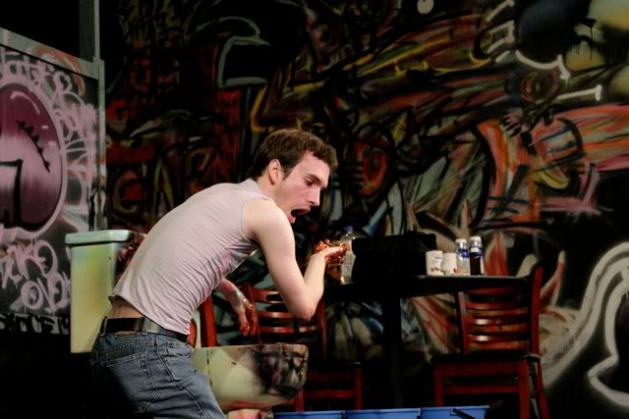
Before Hamlet closed I had worked out a plan to do Trainspotting – the script I had been hunting for ten years – at the Milestone. A rather cold (it was winter at the Milestone), but monumental success. Artistic creativity traditionally travels east to west where theatre is concerned, great Broadway comedies and dramas getting turned into movies. Traffic in the other direction usually involves adding musical scores to proven Hollywood hits. So where did you come up with the idea of adapting favorite films to the stage without layering on songs, music, and dance? I chose Trainspotting because I fucking loved the film. I had read that it was play before it was a movie back in college but could never find a copy of the script. During Hamlet, I made a mission to find this play – not to put it on, just to find it. I did find it – in New Zealand. A limited press of four plays by Harry Gibson. It was an expensive book that I wish I still owned. (I drunkenly gave it away to… Matt Cosper?). The play was fantastic and by Hamlet’s close, I already moved on putting it on stage. I had an idea to print color programs – and my gal at the time had come across a large set of expanded CD sets, which we stuffed with local band CD’s and songs that played throughout the show. In the aftermath, I “realized” people didn’t come to see the new kids on the block but to see Trainspotting. So I decided to press the point. My thought was, if I can get people who have never been to see a theatrical show – or haven’t in years – I could trick them into seeing something they know. Hook ‘em! Then pull an Uncle Vanya on them. Open up the viewer pools, right? What I missed was, some of the people seeing Trainspotting were looking for the folks like the ones running Three Bone and Appalachian Creative. They had no idea what to do with me. So I was alone in the theatre community again, but I was pulling people who didn’t attend Uncle Vanyas. Somehow, I stumbled into a niche. There IS a hungry audience who LOVE live performance, but they want stories they are familiar with. Now on the song and dance bit. I hate musicals. For every Little Shop, you have 40 The Last Star Fighters. This whole trend of just putting shit out there that had some sort of film source material with a slapdash music behind it ‘cause that’s what people say the masses want – is shite. Utter shite. And it is reflected in what is on stage. Crap music… crappier adapted story. Maybe some good dancing and definitely great lighting, effects, and costumes. You need those to hide the fact that the work sucks. Not the performances – in most cases – but the way the story is being retold. Take away all those bells and whistles – are you still telling a story or just bouncing from one song to the next? Personally, I feel you get more from the story without the song and dance. There’s more nuisance to a play and it relates more to your audience. But just in case it doesn’t, sit in their laps while throwing vomit and shit at them. All I know is that I don’t want Mr. Blonde in Reservoir Dogs to do a whole musical number about cutting off a fucking ear. Fuck that. Cut the ear off and let the blood drip. 
What I hope have been able to offer is for the viewer to move past what we can expect from a script we already know in one format and bring to light new aspects of those familiar moments. Eternal Sunshine, for example – I had quite a number of people tell me they hated the film but loved the stage show. It made them want to go back and watch the movie – making them rethink why they remembered the film in the first place. If you added music to those, I feel it would lose resonance. I mean – I play up the comedy ‘cause I’m a hack, but even then, what I was hearing from a lot of our audiences was that what was on the page leaped out into life and grabbed you by the balls. Much more so than any song and dance or even on the screen. How do you decide on which movies you want to stage, and what sort of difficulties do you encounter? Have there been instances of false starts, frustrating failures, forbidden rights, or just plain fuck-it’s-I’ve-changed-my-mind? Trainspotting was a show I wanted to do ‘cause I loved the movie back in college. And the book I read after seeing the movie. After that, I thought to myself, what else is out there? That didn’t go very far because most translations just end up being fucking musicals. It was like that until I focused on what I thought would be good to translate to stage, coupled with movies I liked or directors I was fond of and crosschecked that with books that had been turned into movies. I found that Fight Club had been done in Seattle and tracked it down. Tarantino [ReservoirDogs] was another – but there is no book for him, just the movie script. That took a while to get any answers on, but several theatres have mounted that as a play, and I did research through them. For a while, that was my method – finding out that another theatre had done a show somewhere in the world and pestering the crap out of them to find out how. Sometimes I made decisions by asking the social media world what it wanted to see. Adapting a script meant getting someone from a distribution company, the writer, and production teams to sign off on it. That always means a mixture of editing and adapting. Some were easy – such as Night of the Living Dead (which is public domain), and others were…complex. Like Eternal. That script still needs another 20 pages chopped off. There are those you can’t do – I desperately want to bring Nightmare Before Christmas and Emmett Otter’s Jug Band Christmas to stage (both Disney. Anything Disney is off the table.) – and others that are way too much of a burden to bring to life. Like Clue. You have to ask Hasbro for the rights – but they say you need to get the rights from Paramount, who will tell you to talk to Universal… who tells you to talk to Hasbro. Thing is, once you get Hasbro to sign off, Samuel French comes in and complains about the Cluedo script they have and demand that you pay royalties there as well – making the whole thing rather expensive or another protracted timeline between companies talking to one another. But it has been done before. In fact- there is such a demand for the Cluescript these days that I have been informed that they are attempting to make an official version that will be marketed out by HASBRO proper, removing Samuel French, Universal, and Paramount from the equation altogether. I suspect as soon as that hits the market Theatre Charlotte will drop a pretty penny on it- unless ATC survives it’s current homelessness. There were some change-my-mind shows, like “Lock, Stock, and Two Smoking Barrels.” Desperately wanted to do that show but backed out of doing it for cost and space on the calendar. You also encounter scams. I’ve been scammed by a company that didn’t have the proper rights and had to scuttle a show because of it right on the eve of opening. Frustrating as hell and puts a strain on the ole ticker. Then there’s just bad scripts. Like Clockwork Orange. The official adaptation is terrible. Just plain terrible. That’s one where I was like “Fuck this script.” There are other versions but getting those have proven to be painstakingly hard. There’s also the rare idea that doesn’t pan with available scripts- like M.A.S.H.and The Land of the People Who Do What They Want (better known as V for Vendetta). The MASH ideas would have involved using the local reserve for equipment, an uncle for a helicopter, and a local high school for a football field. You’d then follow the show in a living 4077 [hospital]. You could follow any character – a la Punchdrunk theatre style entertainment. With V for Vendetta there was a translation issue – the play was in Norwegian… and my idea would have been a follow-the-show event much like Disturbance. The translating ended up being a bit too much to handle so I scuttled it. There a few translations to stage out there I’ve heard of but never found except a new one – adapted by Sean Mason out of Manchester. I’ve already contacted him and he and I are talking about how I can bring it to the stage in the future for a US premiere. Let me finish on one that is a movie but not why we were doing it: The Man in the Iron Mask. I wanted to do a big sword show since Princess Bride. Big swashbuckling scenes… I actually wrote a Pirate script that was awful. The concept was sound, but man – I couldn’t handle the story I was trying to write then. I may go to work on it again soon – who knows? But when I approached Mandy Kendall with the big sword idea she jumped to her favorite writer – Dumas. I didn’t want a 3 Musketeers play and she suggested Iron Mask. We got to work, and I did most of the adapting of the script from the source material. A thoroughly fun adventure as I had never actually read any of the Musketeers stories. 
What do you look back on as your best productions? Trainspotting at Story Slam is perhaps the closest that came to the vision I had in my head to make it to the stage. The Milestone version had my widest scope of inclusion, like with local bands and such. Lion in Winter was a fantastic show and for me personally, I believe that is my best work. As far as overall idea? Big Labowski, Princess Bride, and Eternal Sunshine of the Spotless Mind. Which were the most fun to be involved in? Disturbance in Whitechapel. It was a unique idea – for me at least. And running around setting up bodies, explaining what was going on to cops, getting spaces to let us do what we were doing, and actually researching/writing the damn thing was probably one of the most fun times I’ve ever had on a project. Second time through, I put up stage curtains on all the windows, bought a bunch of wine, and hunkered down in my Ripper cave for 48 hours. Then again this list: Big Labowski, Princess Bride, and Eternal Sunshine of the Spotless Mind all make the top as well. 
Was Fight Club the ultimate nightmare, or was there worse? Don’t get me wrong – Fight Club was a logistical nightmare. I kept losing spaces and Marlas… and there was that train and the rain…. but that was a cakewalk compared to having to deal with the Chop Shop during Rosencrantz & Guildenstern Are Dead. Jay – the owner – is a wonderful guy, but he just doesn’t get what it takes to do theatre. Or be an audience member. Often he would come in with someone and talk loudly during the show. He even did that one night at SEEDS during Lion in Winter. We all busted ass to get R&G together, and I broke down in the greenroom on our final night ‘cause he had been telling me about an hour before show that he was shutting us down at a certain time – mainly ‘cause the audiences weren’t that big for R&G. He was being a dick about it, so I panicked. Tania Kelly, Megan Stegall, and I worked out a way to leapfrog through scenes to bring down the run time. Only problem is, and this is a good problem, the last night was standing room only. We packed the place. The look on his face when he walked in halfway through the first act – and during an entrance from that side – was priceless. We didn’t cut a single line and ran over about 5 minutes. There have been other headaches. Most of those led to aborted shows, or debacles like the Queen City Fringe. Probably the most troublesome all around was a night when Colby Davis showed up drunk to a night of Eternal Sunshine during its second run. He continued to drink during the show and took some liberties on stage with the actresses that were never rehearsed. I’ve never had such a breakdown in cast trust and the resulting alienation before or since. To this day, the decision not to replace him for the rest of the run has haunted me. It directly affected the show, the mindset of people working with me afterwards, and many of my personal relationships. It was a rookie directorial mistake and one I should have been more prepped for. What are the best things that you’ve found about the Charlotte scene since your arrival in 2008 – and what has really pissed you off? Well, here’s the thing. I’ve been popping in and out of Charlotte since 1995. When I moved here on this current run back in ‘05, I had a pretty rosy attitude about Charlotte and the theatre here. One of the best things about Charlotte is the ability to create and the amount that was being created. There was once a lot of places to put on shows. Not that there isn’t now – but once again, the days are gone when you could pick and choose from what was a healthy community. Add to that the loss of so many buildings, plus the fact that everyone has become money-starved since around 2012, and that picture isn’t so great anymore. One of the cool things I’ve found out as of late is the hidden African American theatre here. There’s some great work going on there that doesn’t get a lot of press. I guess that’s true all around. Charlotte has an abundance of people who wish and want to create and want to play. That’s one of its best parts. I don’t think we utilize that base well enough. The theatre community itself is very caring about the idea of theatre, but they have little want to present a united front to show the general public that we do indeed have a theatre community outside of touring shows. As for what pisses me off? City Council. Toll lanes. Pat McCrory. The statement theatre is dead. The idea that in a city of 800,000 people, we don’t have a professional theatre. Even worse – that no one outside of the community seems to care. That that very same caring community dismisses people like myself when I’m warning of bullshit like what happened to ATC. I started my own theatre column three years ago and have been bitching a lot on those pages about our inability to save our theatre groups. I’m pissed that our community is so dismissive of each other. That an organization like the LIT that claimed to be inclusive were immediately exclusive. I’m pissed that that mentality runs throughout the community. I dislike cliques even though I’m actually part of that problem myself. I dislike that newcomers have a hard time getting a foot in the door. Theatre minds here rarely take a chance… and even when they do, it’s the safest option. I’m not saying be dangerous like those assholes at Chicago’s Profiles Theatre. There’s a difference between daring and dangerous. When we had a chance to gather together to make a comprehensive plan for the theatres in town, we just let it die. I’m referring to the meeting that the A&S Council called at CAST. Had a great turnout. We separated into groups, met a few times and it became readily apparent that some people just didn’t want others to participate. To be a community, you have to be ready to accept everyone out there – mimes and all. Nothing came of that whole shebang, and look where we are today. No CAST. ATC is not functioning. Most of the fringe groups have withered. I have to say artistic morale is quite low, and it shouldn’t be. I have met so many wonderful and talented people here, and I want them all to be able to put up the work they want to make. That being said, there’s a lot more to be pissed about right now than happy, unless you’re doing theatre outside of Charlotte. Do you think you’ve made an impact – and if so, how would you describe it? Oh, yeah. I think I helped spur the last surge of storefront theatre. I remember going to work at the Children’s Theatre and talking with Matt Cosper about GONZO and Trainspotting. He said, “I want to do that. I wanna do what you do, Cartee.” Now if memory serves – he had been doing that a few years earlier. Actor’s Farm? At any rate, as Fight Club was going up – Machine Theatre started its engines. Stephen Seay was starting his own group independently. I feel that between the three of us, we jumpstarted the small theatre scene. Seay was pulling in his demographic at Petra’s. Machine was getting a high five from the theatre community, and I was pumping the general public with shows like Reservoir Dogs. 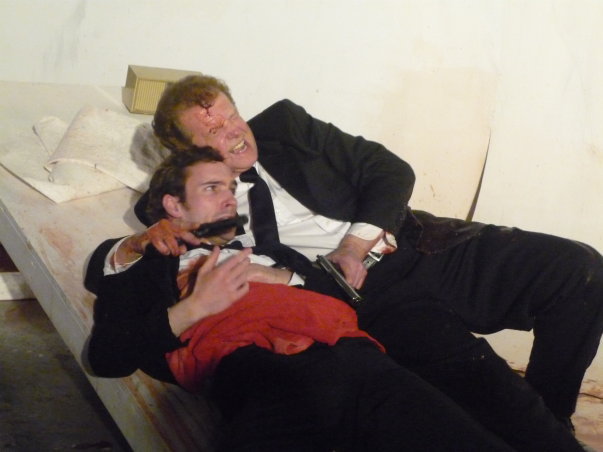
2 or 3 years running, an actor who got their first Charlotte part by running into COTU auditions ended up becoming Newcomer of the Year. There are a multitude of folks who started at COTU who are now bigger parts of the theatre community. These people may never had joined up due to the mindset of a lot of theatres in the area. Michael Ford got the bug in letting me do GONZO at the Mill… that directly led to UpStage. I could be vain here – but it seems that where I went, people seemed to follow. I started doing theatre in a space and – lo and behold – others wanted to come and play too. I felt confined in a space and moved to another – suddenly others were there as well. I think – while not the first by a long shot – I did lead the charge for others even if only in terms of space. Ideas were like that as well – like the Fringe Fest. Not the first attempt at a fringe (despite BOOM saying so), but the idea on the scope is still something I believe Charlotte needs. The aforementioned BOOM it a direct result of that effort. I like to think I’ve grown talent pools and opened Charlottean masses to theatre that is more approachable for them (‘cause not everyone wants to see a Neil Labute, and let’s face it, Uncle Vanya). I’ve also been up in everyone’s happy little spot telling them everything is not as kosher as it seems. We have major problems, and we have to deal with them – and some of those problems are very much our fault. People don’t like hearing that, but it does make them think. I was only too happy to help. What made you decide to close up shop in Charlotte? Charlotte did. One of the reasons I moved here was cost. It was cheap. In the past three years, everything has shot up beyond what I want to pay. That alone didn’t do it. I have great issues with this state politically and even more so locally. The great bulldozing that has gone on has greatly depressed me. Destroying the neighborhoods I enjoyed living in has only made me want to flee this place altogether. Artistically, I feel trapped. I find there is little support for theatre in Charlotte in general. Living and working in this art is a mite hard anywhere, so to have extra obstacles thrown in your path becomes untenable after a time. Artistically, I need a new canvas. I want to be surrounded by people with some differing thoughts and more accepting. I want to live in an accepting community that seeks to be stronger rather than one who tears itself apart every few years. I’ve also become a bit of a detriment to my own shows by simply speaking my mind. You piss off enough people and they, in turn, like to poison the well. To be fair – some of that piss and vinegar is warranted. I try not to be a bad guy, but sometimes I just am. Mainly due to lack of funds. The short and sweet of it is, Charlotte has become untenable for artists like myself to live and work. So: I want to run away to another, more accepting community where I can get better pay and have the work I want to create be better received by my fellow artists and not just the public. What are your plans after December 10? I have a position in Austin I’m pursuing that will open up at the beginning of the year. I’m planning on taking a year off from theatre to write. I have several shows I want write, and I’m working on a book. I do plan on being back here in some form next summer with O’Neill’s Shakespeare Carolina. What, I can’t say out loud yet. 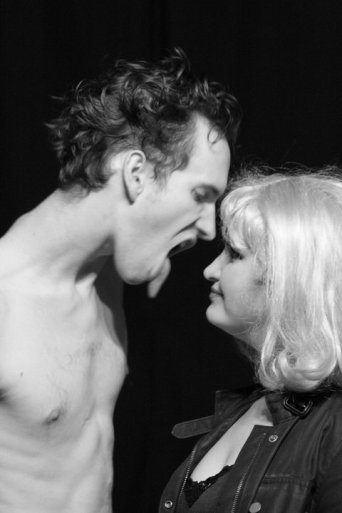
After that, I’m jumping hardcore into theatre there and helping out as much as this miserable flesh will let me. I also plan on starting a COTU branch there. I’m not moving just to say fuck you Charlotte. There are long term plans – like starting up a COTU circuit. Creating a talent circuit and do short exchanges between cities. My friends are still in Orlando, I have a man in Baltimore, and more than a few Citizens here are threatening to take up the mantle and run shows. See, here’s the thing about COTU I think people have not truly gotten. COTU – its core concept – is that anyone can do this. And everyone should. Once you do a show with us, you are a Citizen and are absolutely free to go and start your own thing or do your COTU show. You can request any and all resources that may be available or get direction on where to do a show or who may be available for tech, acting, and other such things. I can be utilized from afar, as was the case when I was in Oklahoma and wrote, did the press, and set up a space for Nick Iammatteo’s production of Sid and Nancy here in Charlotte. There’s a team of ladies who are good candidates for a new core. I encourage it. As for me – it’s getting close to about time to hit the old dusty trail. But I do have a few more shows first! .
OTHER COTU PROJECTS
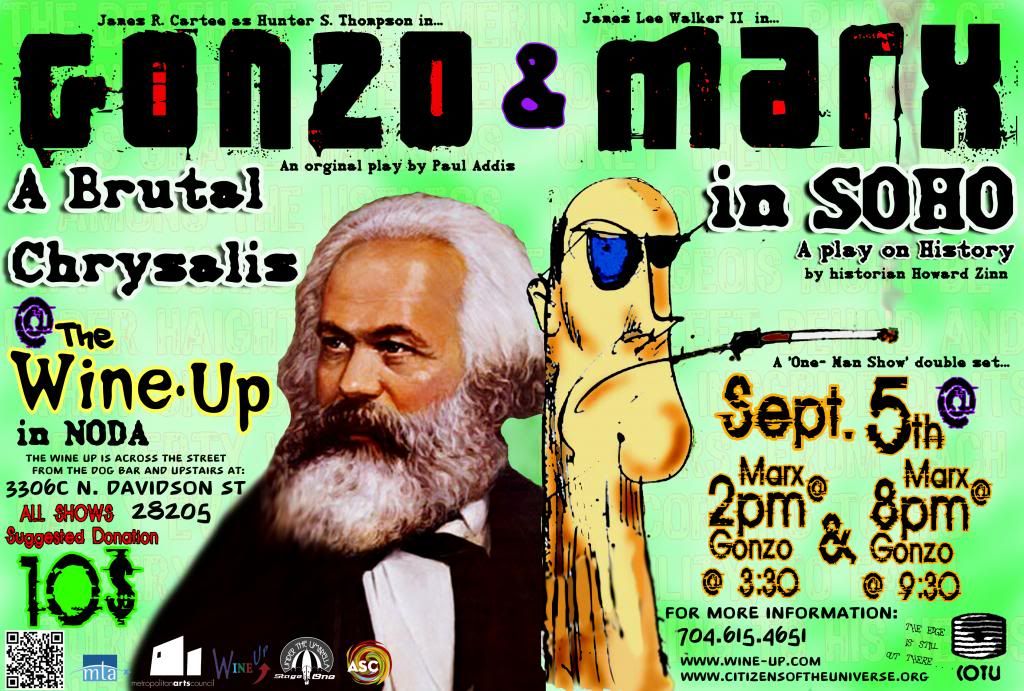
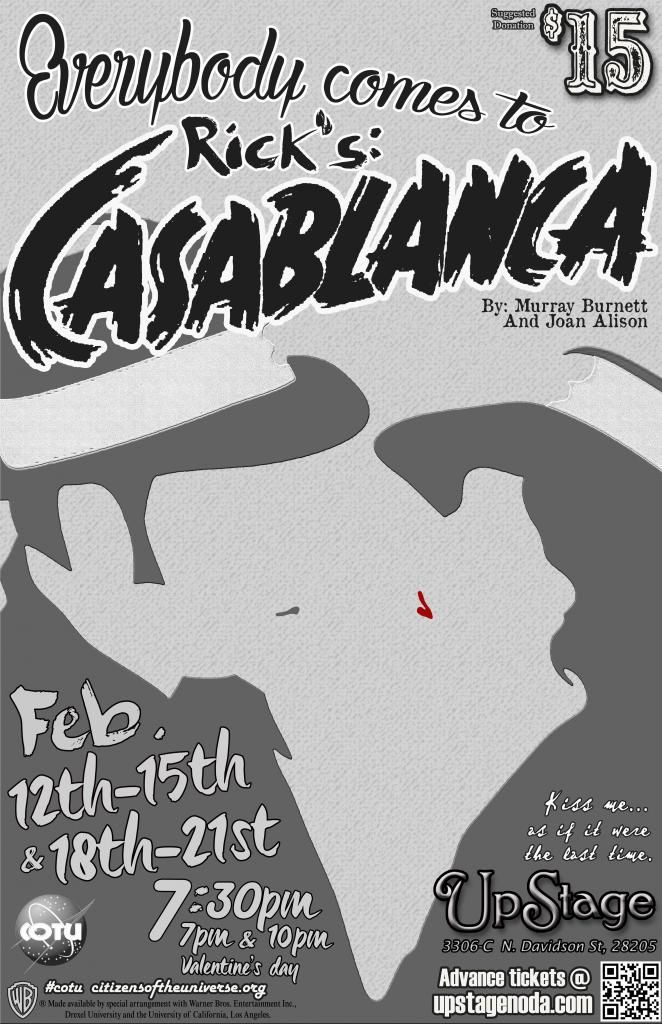
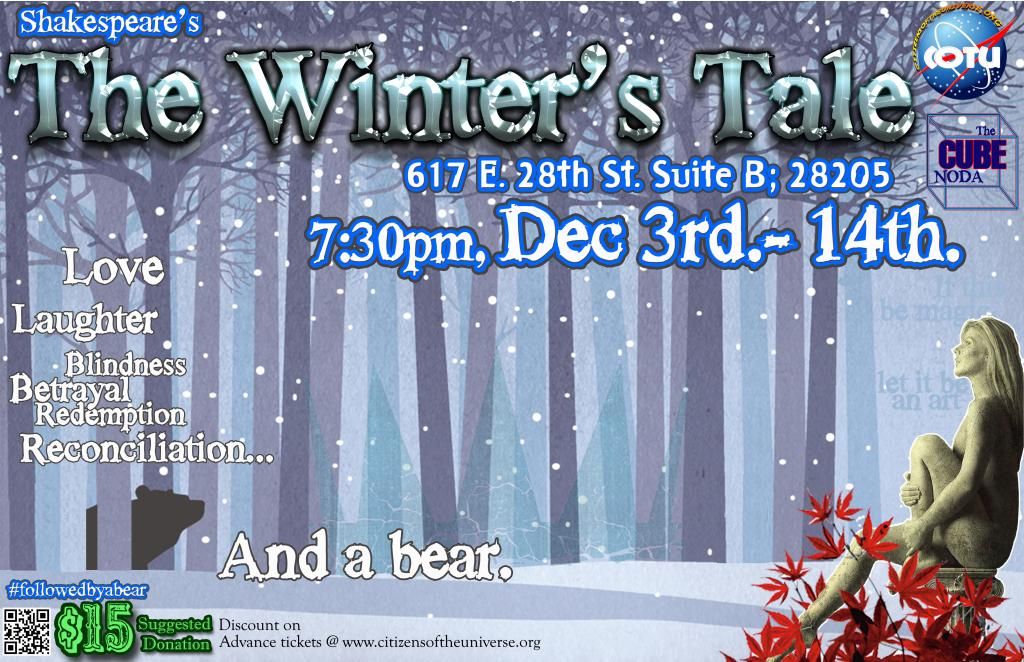

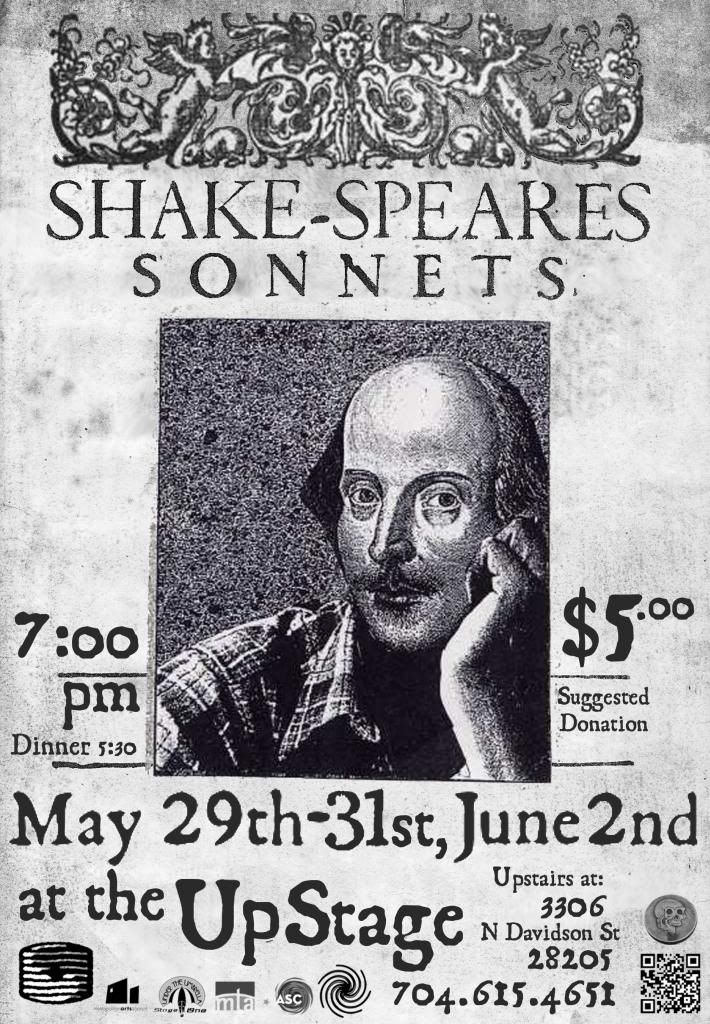

|